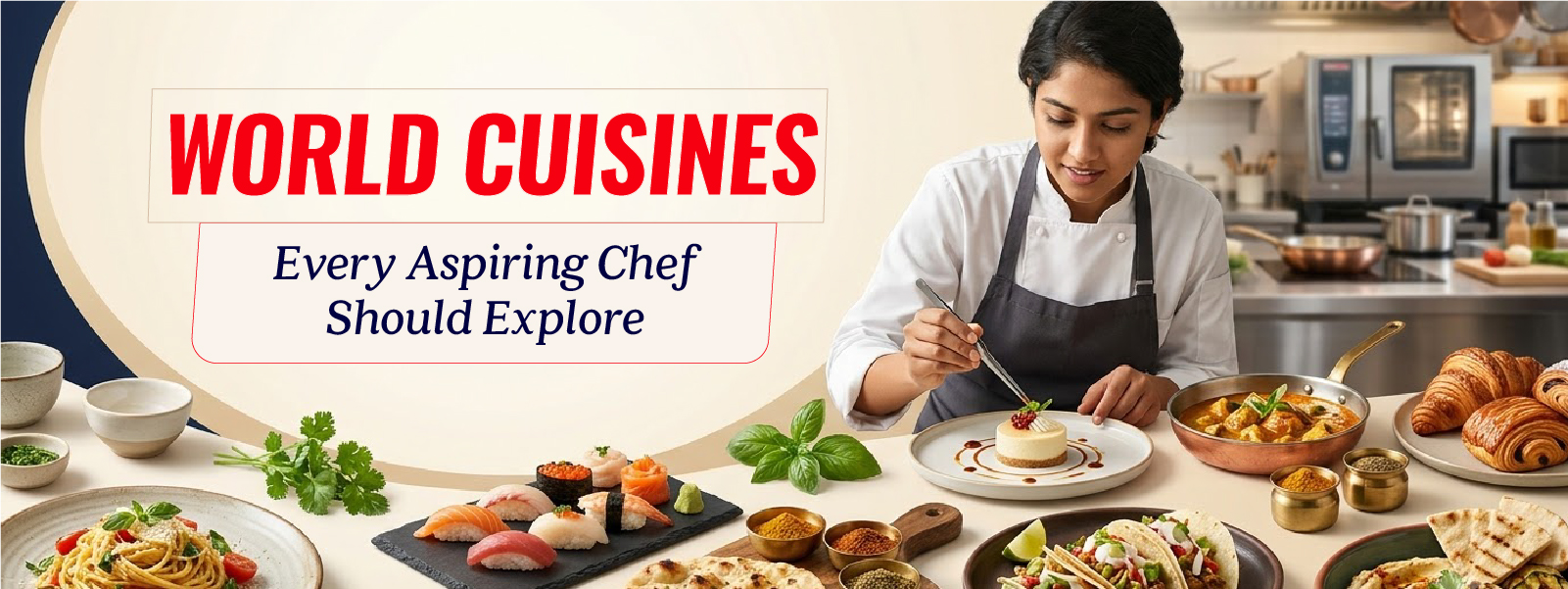
A chef who understands only one culinary tradition can become technically skilled, but a chef who explores different food cultures begins to see cooking from a much wider perspective.
Consider the difference between preparing a dish by following a recipe and understanding why that recipe works. Why does a French sauce depend on a particular technique? Why does Japanese cuisine place such emphasis on seasonality? Why does Thai food often bring contrasting flavours together in a single bite?
These questions are what make exploring world cuisine so valuable for aspiring chefs.
For students considering cooking courses in India, exposure to international culinary traditions can provide a broader understanding of ingredients, techniques, flavour combinations and professional kitchen practices. Students exploring cooking classes in Delhi or culinary arts courses in India should therefore look for programmes that go beyond teaching isolated recipes and introduce them to diverse culinary approaches.
One way to develop this broader foundation is through structured Cooking and Baking Classes at TGCA, where culinary learning can connect practical kitchen skills with different food traditions and professional techniques.
World cuisine is not simply a collection of dishes from different countries.
Food develops through geography, history, climate, culture, religion, trade and locally available ingredients. A coastal region may develop a strong seafood tradition, while an agricultural region may build its cuisine around grains, vegetables or livestock.
Cooking techniques evolve alongside these ingredients.
This means that learning a cuisine is also an opportunity to understand the environment and culture that shaped it.
For an aspiring chef, that context makes the food more meaningful and the techniques easier to understand.
Professional kitchens increasingly bring together culinary influences from different parts of the world.
Learning international cuisines can help students develop:
A student who has worked with different cuisines may also become more comfortable approaching an unfamiliar recipe.
Instead of asking, "Have I made this dish before?", they can ask, "What technique is this using, and what principles can I apply?"
That is a more useful question for a developing chef.
French cuisine has played an influential role in professional culinary education.
Students can learn from its emphasis on precision, preparation and classical technique. Stocks, sauces, reductions, knife work and controlled cooking methods provide a technical foundation that can be applied beyond French food.
Pastry is another important area.
French pastry traditions demonstrate how accuracy, temperature, ratios and technique can influence the final product.
The larger lesson is not simply how to prepare a particular French dish. It is how disciplined technique can produce consistent results.
Italian cooking is often associated with pasta and pizza, but its principles extend much further.
Fresh ingredients, regional traditions and relatively simple preparations are central to many Italian dishes.
Students can explore:
Japanese cuisine offers a different perspective on professional cooking.
Precision, seasonality, balance and presentation are particularly important. Ingredients are often treated with restraint rather than being overwhelmed by heavy seasoning.
For aspiring chefs, Japanese cooking can provide lessons in:
Chinese cuisine should never be viewed as one uniform style. China contains numerous regional culinary traditions, each with distinctive ingredients, techniques and flavour profiles.
Students can explore techniques such as:
Wok cooking, for example, teaches students about heat management, timing and preparation. Ingredients need to be organised before cooking because once the process begins, there may be little time to search for what comes next.
That reinforces an important professional kitchen principle: good preparation makes fast cooking possible.
Thai cuisine provides a fascinating lesson in flavour balance.
Sweet, sour, salty, spicy and aromatic elements can appear together, creating dishes with considerable depth.
Students can learn to think about flavour relationships rather than treating seasoning as an afterthought.
Ingredients such as herbs, chillies, citrus and aromatic roots contribute different dimensions to a dish.
The broader lesson is useful for any chef: contrasting flavours can work together when they are carefully balanced.
Mexican cuisine demonstrates the strong relationship between food, culture and regional identity.
Corn, beans, chillies, tomatoes, herbs and other ingredients feature prominently across many traditional preparations.
Students can explore different preparation techniques while learning how ingredients that appear simple can create complex flavours when treated correctly.
Mexican food also demonstrates the importance of understanding traditional ingredients rather than automatically replacing them with more familiar alternatives.
Mediterranean cooking often places fresh ingredients at the centre of the plate.
Vegetables, grains, seafood, herbs, olive oil and legumes appear across many regional traditions.
The cooking can appear straightforward, but that simplicity reinforces an important culinary principle: when ingredients are central, preparation matters.
A perfectly grilled vegetable, fresh herb combination or well-seasoned grain preparation can demonstrate how restraint can produce excellent food.
For aspiring chefs in India, understanding Indian cuisine is essential.
India has an extraordinary range of regional culinary traditions. Techniques, ingredients, spices and preparation methods vary considerably between regions.
Students can explore:
Middle Eastern cuisines offer another valuable combination of ingredients and techniques.
Students can explore the use of:
Aspiring chefs should not stop with the cuisines discussed above.
Korean cooking can introduce students to fermentation, bold seasoning, contrasting textures and distinctive preservation techniques.
Spanish cuisine offers lessons in seafood, cured ingredients, rice preparations, tapas and regional cooking.
Greek cooking demonstrates the use of vegetables, grains, seafood, herbs, dairy and olive oil in fresh and balanced preparations.
The cuisines of Southeast Asia provide opportunities to explore aromatic herbs, noodles, seafood, chilli, coconut and complex flavour combinations.
Every cuisine can teach a chef something different.
A professional culinary student should not leave a kitchen remembering only a list of dishes.
The more valuable knowledge is what sits underneath those dishes.
If you learn how to make a particular curry, for example, understanding how spices are prepared and how flavours develop is more useful than memorising a sequence of ingredients.
Similarly, learning one pasta dish becomes more valuable when you understand pasta texture, sauce consistency and cooking technique.
This approach makes culinary knowledge transferable.
Exposure to different cuisines can make students more adaptable.
Imagine a chef receives an unfamiliar ingredient. A narrow approach might lead to uncertainty. A broader culinary education encourages experimentation based on existing knowledge.
Students can draw connections between:
This can support creativity without turning creativity into guesswork.
Learning international cuisine also requires respect.
A dish should not be treated simply as a trend or stripped of its cultural context for the sake of novelty.
Aspiring chefs should take time to understand where dishes come from, how they developed and why particular ingredients or techniques matter.
Fusion cooking can be creative, but meaningful fusion usually begins with understanding the traditions being combined.
Respect for culinary heritage can make experimentation more informed and thoughtful.
Structured culinary education can provide exposure to different cuisines through practical kitchen sessions, demonstrations, assignments and guided preparation.
At TGCA, practical culinary training can help students develop foundational cooking skills while exploring different culinary preparations.
The benefit of structured training is that students can receive guidance while learning rather than relying entirely on trial and error.
They can practise techniques, make mistakes, understand corrections and repeat the process until their skills become more consistent.
Students comparing culinary programmes should look beyond the course title.
Consider:
The strongest culinary education should help students understand both what they are cooking and why they are cooking it that way.
International cuisine becomes even more useful when students combine it with strong foundational skills.
Knife handling, mise en place, hygiene, heat control, ingredient preparation and kitchen discipline remain important regardless of whether the student is preparing pasta, sushi, curry or a stir-fry.
At TGCA, students can build these foundations through practical culinary education while developing a broader understanding of food and cooking.
The objective is to help learners become adaptable cooks who can apply their knowledge across different professional environments.
Exploring world cuisine gives aspiring chefs much more than a longer list of recipes. French cuisine can teach precision. Italian cuisine can demonstrate the power of simplicity. Japanese cuisine can develop an appreciation for seasonality and presentation. Chinese cuisine can strengthen heat management and preparation skills. Thai cooking can demonstrate flavour balance, while Indian cuisine can introduce students to extraordinary regional diversity and spice techniques.
For students considering cooking courses in India, exposure to different cuisines can provide a broader understanding of ingredients, techniques and culinary traditions. Learning across cuisines can also help students adapt to different kitchen environments and develop a more versatile approach to cooking.
The most valuable lesson is to look beyond the dish. Understand the ingredient. Learn the technique. Study the culture. Notice the balance of flavours and textures. Then consider how that knowledge can be applied elsewhere.
For students pursuing culinary education, exposure to different cuisines can help build the versatility, curiosity and technical confidence needed to grow in professional kitchens.
World cuisine refers to the diverse food traditions developed across different regions and cultures, shaped by geography, history, local ingredients, cooking methods and cultural practices.
International cuisines expose students to different ingredients, techniques, flavour combinations and presentation styles, helping them become more adaptable, knowledgeable and creative professional cooks.
French, Italian, Japanese, Chinese and Indian cuisines provide valuable foundations, but students can benefit from exploring many regional traditions to develop broader culinary knowledge.
Yes. Exposure to different culinary traditions can improve technique, adaptability, flavour understanding, creativity and problem-solving, all of which are valuable skills in professional kitchens.
Many structured culinary programmes introduce students to multiple cuisines through practical sessions and guided training. Students should check the curriculum and practical exposure before enrolling.
Culinary Instructor
 Whatsapp
Click one of our representatives below to chat on WhatsApp or send us an email to
info@tedcoeducation.com

Counselor
Bakery and Pastry Courses
Counselor
Culinary Arts Courses
Click one of our representatives below to chat on WhatsApp or send us an email to
info@tedcoeducation.com
Counselor
Bakery and Pastry Courses
Counselor
Culinary Arts Courses

