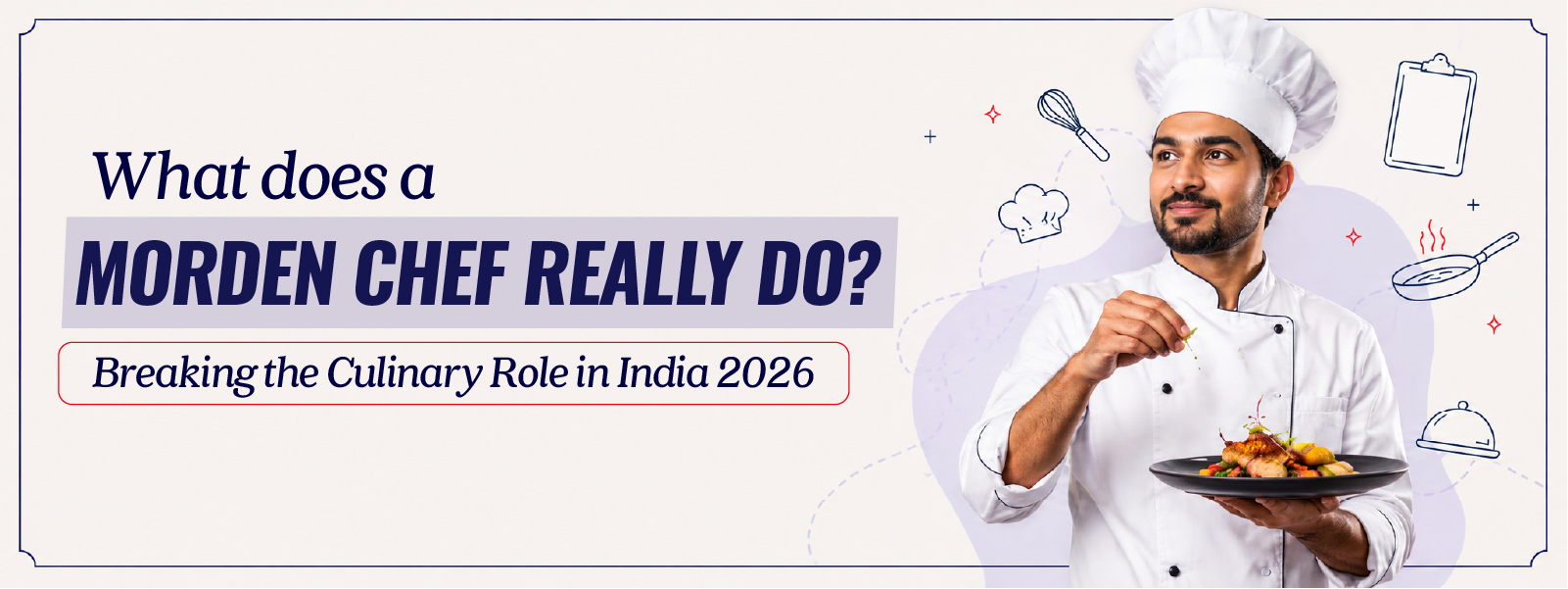
Ask someone what a chef does, and you will probably get an image of someone in a tall white hat, standing over a stove, tasting sauces. That image is not wrong. But it is also not complete. Not even close. In 2026, the role of a chef in India has evolved into something far broader, far more dynamic, and honestly, far more exciting than most people realise. A culinary arts course today does not just prepare you to cook. It prepares you for a role that blends craft, leadership, business thinking, and creativity in ways that simply did not exist a decade ago.
If you are a student trying to decide whether a culinary career is right for you, or a parent trying to understand what this career path actually looks like, this guide is for you. We are going to break down exactly what a modern chef does, day to day and across their career, and why the training behind that role matters more than ever.
This guide covers how the chef's role has evolved, what a typical day in a hotel kitchen actually looks like, the responsibilities that exist beyond the kitchen, the technical and leadership skills required in 2026, the different types of chef roles available today, and how the right culinary arts course prepares you for all of it. By the end, you will have a genuinely accurate picture of what this career involves, not the stereotype, the reality.
Twenty years ago, a chef's job was almost entirely defined by what happened inside the four walls of the kitchen. Cook well, manage your station, follow the menu. That was the job. In 2026, that description covers maybe sixty percent of what a professional chef actually does.
The other forty percent includes things like managing food costs and supplier relationships, training and mentoring junior staff, contributing to menu design and seasonal planning, understanding customer trends and dietary preferences, and in many cases, building a personal or restaurant brand through social media and content. The chef who only knows how to cook, without understanding any of this, is increasingly the exception rather than the standard.
This is the real shift. A modern chef in India is expected to be technically excellent, yes, but also commercially aware and personally driven. Whether you end up in a 5-star hotel kitchen, running your own restaurant, or building a food brand online, the chef courses that prepare you best are the ones that build all three of these dimensions, not just the cooking technique.
The modern chef is not just someone who cooks well. They are someone who runs a small business inside a larger one, every single day.
So, what does a chef do in a hotel kitchen in India on a typical day? It starts long before the first guest walks in. Morning shifts begin with checking deliveries, reviewing the day's menu and any special requests, and starting prep work that takes hours, stocks, sauces, doughs that need resting time, and proteins that need marinating.
As service approaches, every station gets set up with mise en place, everything in its place, ready to go. During service itself, the pace is relentless. Orders come in continuously, tickets are called out, and every dish needs to go out at the right time, at the right temperature, plated to the right standard. After service, the kitchen is broken down, cleaned, and prepped again for the next shift. This cycle repeats every single day, often across breakfast, lunch, and dinner services back to back.
A Commis Chef focuses on learning and executing specific tasks within a station, building speed and consistency. A Chef de Partie owns a station completely, managing their section's output during service. A Sous Chef oversees multiple stations, coordinates the overall service flow, and supports the Head Chef. A Head Chef or Executive Chef has ownership of the entire kitchen operation, menu, costs, team, and standards. Each role contributes differently, but every role operates within the same demanding, fast-paced environment.
Senior chefs in 2026 spend a significant portion of their time on work that happens nowhere near a stove. Menu development involves researching trends, testing new dishes, balancing variety with operational feasibility, and pricing items correctly. Food costing means tracking ingredient costs against menu prices to ensure profitability, something that directly affects whether a restaurant or hotel kitchen makes money.
Supplier management involves building relationships with vendors, negotiating prices, ensuring quality and consistency of ingredients, and managing the logistics of getting fresh produce, meat, and dry goods into the kitchen reliably. And kitchen operations leadership covers scheduling, staffing, training, and maintaining the standards that keep a kitchen running smoothly even when the head chef is not physically present.
Here is something that genuinely did not exist as part of a chef's job description fifteen years ago: digital presence. In 2026, many chefs, especially those in independent restaurants, cloud kitchens, and even hotel properties, are expected to contribute to social media content, whether that means demonstrating a technique on camera, talking about a new menu item, or simply building the personal brand that draws customers to a restaurant. A culinary arts course that includes even a basic understanding of this dimension gives graduates a real advantage in the current job market.
Despite everything that has changed, the foundation of a culinary arts course has not. Knife skills, the five classical mother sauces, stock making, and rigorous kitchen hygiene standards remain absolutely non-negotiable. These are not old-fashioned skills being phased out. They are the bedrock that every other skill, traditional or modern, is built on. A chef who cannot execute these basics flawlessly will struggle no matter how many trends they understand.
Layered on top of the classical foundation, modern chefs in 2026 increasingly need to understand plant-based cooking techniques, as demand for vegetarian and vegan options continues to grow across India's hospitality sector. They need awareness of food technology, including new ingredients, alternative proteins, and equipment innovations. And they need to understand sustainability practices, reducing food waste, sourcing responsibly, and managing kitchens in ways that are both efficient and environmentally conscious. These are not optional extras. They are increasingly part of what hotels and restaurants expect from their culinary teams.
A professional kitchen is a team environment under constant pressure, and managing that team well is one of the most important skills a chef develops as they progress in their career. Team management means understanding each person's strengths, assigning responsibilities effectively, and ensuring everyone knows what is expected of them during service.
Conflict resolution matters because kitchens are high-stress environments where tempers can flare, and a chef who can de-escalate tension, address issues directly, and maintain a respectful environment keeps their team functioning well over the long term. And building a kitchen culture, one where people show up, support each other, and take pride in their work even during the most chaotic services, is what separates kitchens that retain good staff from kitchens that constantly struggle with turnover.
These leadership qualities are not things that suddenly appear when someone gets promoted to Sous Chef. They are built progressively, starting from the very first year of a diploma in culinary arts programme. Working in a brigade structure, taking ownership of a station, communicating clearly during a live service simulation, these experiences build leadership instincts long before a student's first job title includes the word chef.
Within a traditional kitchen hierarchy, here is what each role actually means. The Commis Chef is the entry-level position, learning fundamentals and executing tasks under supervision. The Chef de Partie runs a specific section of the kitchen, such as the grill, sauce, or pastry station, with full responsibility for that section's output. The Sous Chef is second in command, coordinating across stations and stepping in wherever needed during service. The Head Chef leads the kitchen on a day-to-day basis, including menu execution and staff management. The Executive Chef has overall responsibility for the culinary operation, often across multiple outlets within a hotel or group, including strategy, budgets, and standards.
Beyond the traditional hierarchy, culinary arts colleges in india are now producing graduates who go on to specialise in roles that simply did not have clear pathways before. A Pastry Chef focuses entirely on the dessert and baking side of a kitchen, often with its own internal hierarchy. A Private Chef works directly for individuals or families, designing personalised menus. An R&D Chef works with food brands and companies to develop new products and recipes. And a Food Content Creator builds an audience and career around demonstrating culinary skills through digital platforms. All of these are legitimate, viable career paths that a strong culinary education opens up.
TGCA's diploma in culinary arts is designed around the reality of what a modern chef's career actually involves, not just the classical fundamentals, though those remain central, but also the leadership, business thinking, and adaptability that today's industry demands.
Hotel and restaurant employers consistently describe TGCA graduates as prepared not just technically, but professionally, ready to take on a station, communicate within a team, and understand the broader context of how a kitchen operates as a business. That readiness is the direct result of training that takes the modern chef's full role seriously, not just the part of it that involves a stove. Among culinary arts colleges in India, this comprehensive approach to training sets TGCA graduates apart in the job market.
A modern chef in India in 2026 is a technician, a leader, a manager, and often a creator, all in one. The culinary arts course that prepares someone for this career needs to cover classical technique, yes, but also leadership, business thinking, and an awareness of how the food industry is changing. The romanticised image of a chef standing over a stove is real, but it is only one part of a much bigger, much more dynamic picture.
For students who are genuinely passionate about food, this evolution is good news. It means more ways to build a career that fits your specific strengths and interests, whether that is in a high-pressure hotel kitchen, your own food business, or somewhere in between.
If this broader picture of what a chef does excites you more than the narrow stereotype, that is exactly the mindset that succeeds in this career. The next step is simple: visit TGCA's campus at Connaught Place, see the kitchen, meet the faculty, and have a real conversation about what training for this complete role entails. 2026 batches are open now, and the sooner you start, the sooner this career becomes yours.
If you are serious about becoming more than just a cook and want to build a successful career as a modern culinary professional, TGCA offers the ideal starting point. With City and Guilds (UK) accreditation, industry-experienced faculty, commercial kitchen training, active placement support, and international internship opportunities, TGCA prepares you for the realities of today's hospitality industry.
2026 batches are open now. Book your free campus visit, explore the kitchens, meet the chef mentors, and take the first step towards a rewarding culinary career.
A 5-star hotel chef manages prep, live service, and station coordination daily, alongside menu planning, food costing, supplier coordination, and team training. Senior chefs also handle budgets, quality standards, and increasingly, social media and brand-related responsibilities.
Modern chef roles, especially beyond entry level, involve significant management. This includes team leadership, cost control, menu development, and supplier relationships. Cooking remains central, but management skills become increasingly important as chefs progress in their careers.
Chefs now engage more with digital content, sustainability practices, and plant-based menus than five years ago. The role has expanded to include brand building and business awareness, alongside the classical technical and leadership skills that remain foundational to the profession.
A Chef de Partie manages one specific kitchen station independently during service. A Sous Chef oversees multiple stations, coordinates the entire service flow, and directly supports the Head Chef, representing a significant step up in responsibility and leadership scope.
Yes. TGCA's diploma integrates kitchen management, food costing, and team-based brigade training from year one, alongside classical technique. This builds both the technical foundation and the leadership instincts that modern chef roles increasingly require.
Centre Head & Head of Department
 Whatsapp
Click one of our representatives below to chat on WhatsApp or send us an email to
info@tedcoeducation.com

Counselor
Bakery and Pastry Courses
Counselor
Culinary Arts Courses
Click one of our representatives below to chat on WhatsApp or send us an email to
info@tedcoeducation.com
Counselor
Bakery and Pastry Courses
Counselor
Culinary Arts Courses

