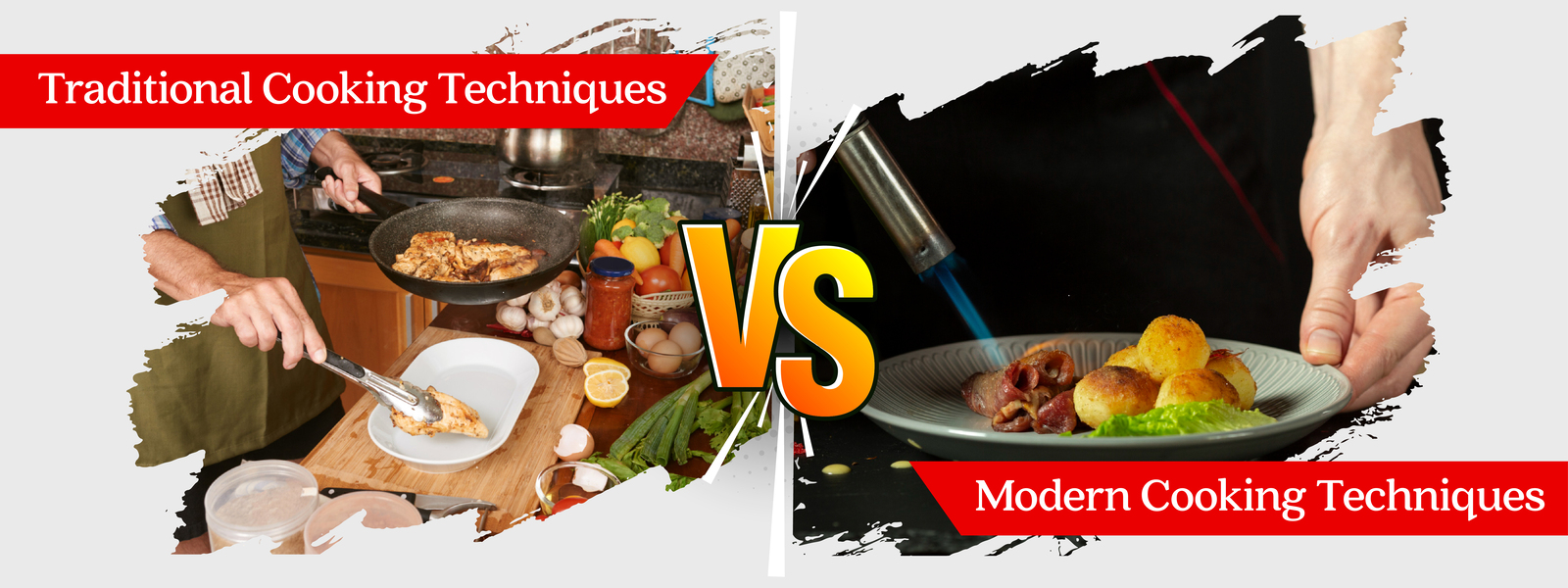
Every time you step into the kitchen, you are stepping into a story that began thousands of years ago. Cooking is a ritual passed down by ancestors, a way of keeping the past alive through the simple act of feeding someone. Yet, cooking is also an evolving science. Today, we understand the “why” behind the “how” transforming ingredients with a level of precision that previous generations could only dream of.
While the food world often splits into two camps, the traditionalists guarding the flame and the modernists chasing the new, we prefer to see it as a single journey. Whether you are using a clay pot or a precision cooker, the goal remains the same: to create something beautiful. The answer isn't simple. In fact, if you want to survive in the professional kitchen of 2026, the answer is "Yes."
Think about the Dum Pukht style of Lucknow. You seal a heavy pot with dough and let it breathe over a slow fire for hours. There is no timer. There is no digital readout telling you the internal temperature of the mutton. You know it’s done by the smell. You know it’s ready by the sound of the steam escaping the dough seal. Traditional cooking is tactile.
It relies on the "Chef’s Intuition." It is knowing that the onions are ready, not because 10 minutes have passed, but because they have turned a specific shade of mahogany. It is understood that a clay pot imparts a distinct earthiness that stainless steel can never replicate. This approach teaches you respect. It forces you to touch the ingredients, to understand their texture, and to adjust your cooking based on the humidity in the air or the quality of the produce that day. It is cooking with the soul.
Modern cooking techniques taught in culinary schools today, like Sous Vide, Spherification, and Flash Freezing, are not gimmicks. They are solutions to problems. In traditional cooking, grilling a steak is a gamble. You hope the centre is medium-rare while you char the outside. In modern cooking, you bag the steak and cook it in a water bath at exactly 54°C.
You don’t "hope" it’s medium-rare; you know it is. It is mathematically impossible for it to be anything else. Modern techniques allow for textures that nature never intended. We can turn olive oil into a powder. We can create "caviar" out of mango juice using sodium alginate. This isn't just showing off; it is about surprising the palate and elevating the dining experience. It is cooking with the brain.
This is where most students get lost. They join culinary schools in India that are stuck in the past, teaching only heavy curries and basic chopping. Or, they join institutes that are too obsessed with trends, teaching them how to make foams before they can roast a chicken. At Tedco education, we believe in the hybrid chef.
Our professional cooking course is designed to transport you back in time. In the morning, you might be learning the ancient art of Tandoor, handling live charcoal and mastering the heat of the clay walls. In the afternoon, you might be using a whipped cream siphon to create a delicate aeration for a dessert. We teach you the traditional and modern cooking techniques side-by-side because that is what the industry demands. A 5-star hotel today wants a chef who can make a perfect Biryani and a perfect Sous Vide Salmon.
They want someone who respects the ingredient enough to cook it simply, but understands science enough to fix a broken sauce.
You might think you can learn the traditional stuff from your grandmother and the modern stuff from YouTube. You would be wrong. Grandmothers don't measure. They say "a pinch of this" or "a fistful of that." That is beautiful, but you can't scale it for a restaurant serving 500 people.
You need a culinary arts course to translate that intuition into a standardised recipe. Similarly, YouTube can show you how to use a Sous Vide machine, but it won't teach you the food safety risks of cooking at low temperatures. It won't teach you about anaerobic bacteria. This is why a professional cooking course is non-negotiable for serious career builders. It gives you the "Why" behind the "How."
The battle of traditional vs modern cooking techniques isn't about one being better than the other. It is about having a full arsenal. If you only know tradition, you are a historian. If you only know modernism, you are a lab technician. But if you know both? Then, you are a Chef. Bridge the gap between ancient skills and modern kitchens. Enrol today.
The kitchen is evolving. The tools are changing. But the goal remains the same: to make something delicious.
Absolutely. Think of it like learning music. You need to learn the scales and the classics before you can start playing jazz improvisation. If you jump straight into molecular gastronomy without understanding the basics of roasting, sautéing, and braising, your food will lack depth. You cannot "deconstruct" a dish if you don't know how to construct it first. A solid foundation in traditional methods gives you the context you need to use modern tools effectively.
Not anymore. While techniques like spherification started in high-end Michelin-star kitchens, methods like Sous Vide and flash freezing have trickled down to casual dining and even high-volume catering. These tools are used for consistency and efficiency, not just for "fancy" presentation. Even burger joints now use modern equipment to ensure every patty is cooked perfectly every single time, proving that these skills are valuable across the entire industry.
Yes, it is actually safer than many traditional methods if done correctly. Because you are cooking at precise, controlled temperatures for specific durations, you can pasteurise the meat without overcooking it. However, because it involves cooking in a vacuum-sealed bag at lower temperatures, you need to understand the science of bacterial growth. This is exactly why attending a culinary arts course is vital; we teach you the safety protocols that a YouTube video might skip.
Many older institutes still focus heavily on traditional hotel management curriculums. When looking for culinary schools in India, you need to check their facility. Do they have a Tandoor? Do they also have a Combi-Oven and Vacuum Sealers? Institutes like Tedco education pride themselves on a curriculum that blends the syllabus of international bodies (like City & Guilds) with the rich heritage of Indian cuisine, ensuring you get the best of both worlds.
No. A machine can execute a task, but it cannot taste. A combi-oven can cook a chicken perfectly, but it cannot tell if the chicken needs more salt or if the sauce is too acidic. Modern techniques are tools to help the chef, not replace them. The "Chef’s Palate" that ability to taste and adjust is something that remains deeply human and is the core focus of any professional cooking course, regardless of how much technology is in the kitchen.
Bakery & Pastry Specialist
 Whatsapp
Click one of our representatives below to chat on WhatsApp or send us an email to
info@tedcoeducation.com

Counselor
Bakery and Pastry Courses
Counselor
Culinary Arts Courses
Click one of our representatives below to chat on WhatsApp or send us an email to
info@tedcoeducation.com
Counselor
Bakery and Pastry Courses
Counselor
Culinary Arts Courses

