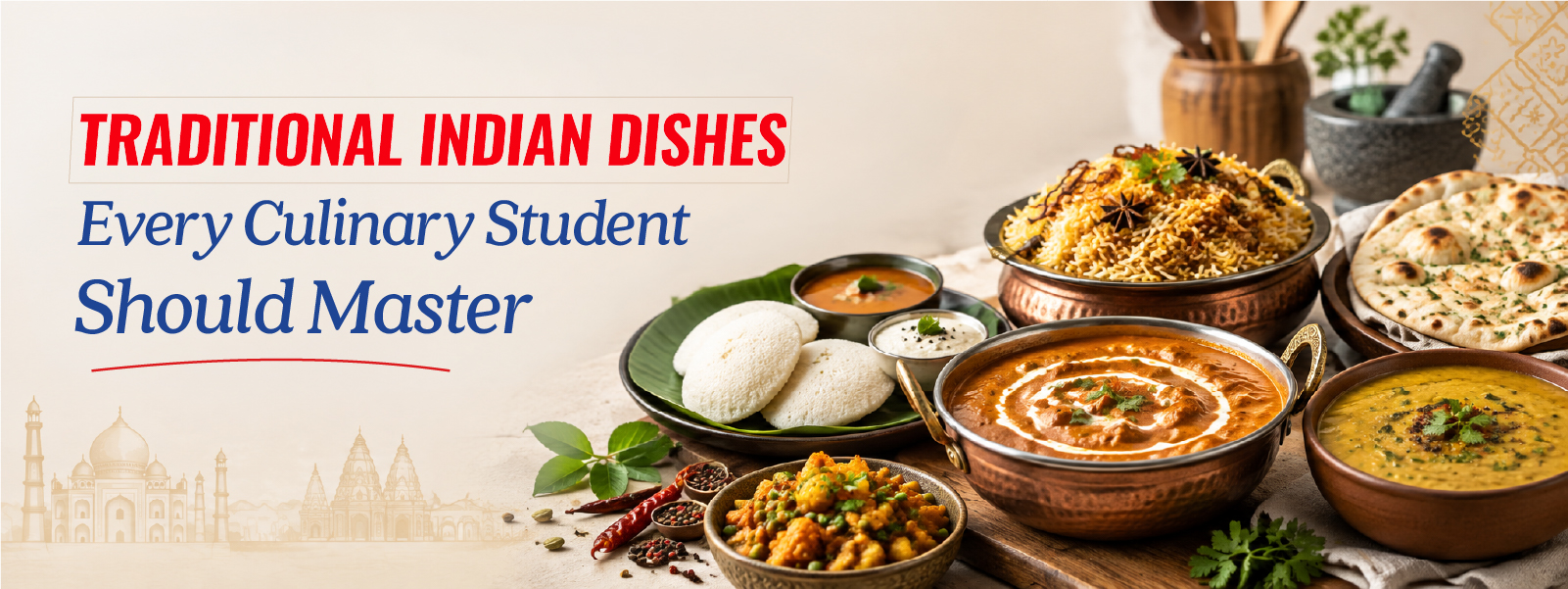
Indian cuisine is built on regional ingredients, cooking methods and generations of culinary knowledge. For students studying culinary arts in India, learning traditional dishes is not simply about memorising recipes. It is about understanding how heat, spices, fermentation, texture and time work together to create distinctive food.
A good culinary student should be able to look beyond a dish and understand the technique behind it. Dal makhani teaches slow cooking. Dosa introduces fermentation and temperature control. Biryani develops an understanding of layering and steam. Indian sweets teach precision with sugar, dairy and consistency.
This is why traditional Indian cuisine remains an important part of a professional culinary education.
Before preparing regional specialities, students need to understand the techniques that appear repeatedly across Indian kitchens.
Bhunao involves slowly cooking ingredients, particularly onions, tomatoes and spices, until their moisture reduces and the mixture develops deeper flavour. It is central to many North Indian gravies.
Dum is a slow-cooking technique in which food cooks in a covered vessel, allowing steam and flavour to remain within the dish. Biryani, nihari and several Awadhi preparations demonstrate this principle.
Tadka, also known as tempering, involves heating oil or ghee and adding ingredients such as cumin, mustard seeds, curry leaves, dried chillies or other spices. The infused fat is then added to the dish.
Dhungar uses aromatic smoke to add another layer of flavour. A small amount of controlled smoke can give certain preparations a characteristic roasted aroma.
Talna refers to frying, a technique used across snacks, breads, sweets and savoury preparations.
Understanding these methods gives students a foundation they can apply to dishes from different regions.
Indian cooking is not simply about adding more spices. Students need to understand the role of each ingredient.
Whole spices can provide a different aroma and texture from ground spices. Timing also matters. Some spices are added to hot fat at the beginning, while others are incorporated later to retain their freshness.
Learning when to bloom spices, when to cook them down and when to add delicate ingredients helps students develop better control over flavour.
North Indian cuisine provides an excellent introduction to slow-cooked gravies, dairy-based preparations, tandoori cooking and spice management.
Dal makhani is a lesson in patience. Black lentils and kidney beans are cooked until creamy, then developed with a rich base of spices, tomato and dairy.
For students, the important skill is not simply reproducing the final flavour. It is learning how cooking time changes texture and allows ingredients to become integrated.
Butter chicken demonstrates how a cooked protein and a rich tomato-based gravy can be brought together.
Students can learn about marination, controlled cooking, sauce consistency and the balance between acidity, richness and spice.
Rogan josh introduces students to the relationship between aromatics, spices and slow cooking. Regional variations also demonstrate why Indian dishes should not always be treated as fixed recipes.
The dish can therefore become a useful exercise in understanding culinary traditions and regional interpretation.
Tandoori cooking is another important skill.
Students should understand how marination affects flavour and texture, how food behaves under intense heat and how controlled charring contributes to the finished dish.
The goal is not simply to produce dark marks on food. Proper tandoori cooking requires attention to moisture, cooking time, heat and the balance between smoky, roasted and spiced flavours.
Mughlai and Awadhi cuisines introduce students to slow cooking, rich gravies, aromatic spices and carefully developed textures.
Nihari demonstrates the value of extended cooking and carefully developed flavour.
Korma introduces students to rich gravies where spices, dairy, nuts or other ingredients can create a layered texture and aroma.
Galouti kebab is particularly useful from a technique perspective because tenderness and texture are central to the dish.
These preparations encourage students to think about texture as carefully as flavour.
Yakhni-based preparations demonstrate how a well-developed stock can become the foundation for a finished dish.
Students learn that good cooking often begins before the main dish reaches the plate. Stock preparation, ingredient selection, temperature control and slow cooking can all influence the final result.
This approach is particularly valuable for students preparing for professional kitchens, where consistency matters as much as creativity.
South Indian cuisine offers a different set of techniques, particularly around fermentation, tempering, rice and lentil preparation.
Dosa and idli provide an excellent introduction to fermentation.
Students need to understand how batter behaves, how fermentation changes flavour and texture, and how temperature affects cooking.
Dosa also teaches control over batter consistency and cooking surfaces, while idli demonstrates the importance of steaming and gentle handling.
These are valuable lessons because fermentation is increasingly relevant across professional kitchens and modern culinary practice.
Sambar demonstrates how lentils, vegetables, tamarind and spices can work together without one element overwhelming the others.
Rasam introduces students to lighter textures and the balance of sour, spicy and aromatic notes.
Coconut-based curries provide another lesson in regional flavour construction, particularly the use of coconut, spices and tempering.
Together, these dishes show students that Indian cuisine extends far beyond the rich gravies often associated with restaurant menus.
Eastern and North-Eastern cuisines introduce students to ingredients and techniques that are sometimes less represented in mainstream culinary education.
Bengali cuisine offers valuable lessons in fish preparation, mustard and spice balance.
Shorshe-based dishes demonstrate how mustard can become a defining flavour rather than simply another seasoning.
Panch phoron, a traditional five-spice blend, also teaches students how whole spices can contribute aroma and texture when used with the right cooking method.
North-Eastern Indian cuisines provide exposure to fermentation, smoking and distinctive regional ingredients.
These preparations are important for culinary students because they demonstrate how geography, climate, preservation needs and local produce influence food traditions.
They also encourage students to approach Indian cuisine as a collection of diverse regional food cultures rather than a single cooking style.
Western India offers another broad culinary landscape, from Gujarati vegetarian cuisine to Maharashtrian street food and Goan coastal cooking.
A Gujarati thali can teach students about balance and variety within a single meal.
Sweet, sour, salty, spicy and textural elements can appear across different dishes. Students can therefore study not only individual preparations but also how a complete menu is constructed.
Misal demonstrates how a dish can combine different textures, temperatures and levels of spice.
For students, it is an opportunity to study layering and garnish while understanding how regional street food can have a strong identity of its own.
Goan cuisine introduces students to coastal ingredients and the influence of different culinary traditions.
Vindaloo provides lessons in acidity, spice and marination, while xacuti demonstrates complex spice preparation and roasted aromatics.
Coastal seafood preparations further teach students how delicate ingredients should be handled without overwhelming their natural characteristics.
Indian breads and rice dishes are fundamental skills for students attending culinary arts courses.
Each bread presents a different technical challenge.
Roti requires controlled dough preparation and cooking. Naan and kulcha introduce leavening, shaping and high-heat cooking. Paratha focuses on layering and texture, while bhatura demonstrates how fermentation and frying affect a dough.
Appam adds another regional dimension through fermented batter and its distinctive texture.
Students should learn these preparations as techniques rather than isolated recipes. Understanding dough hydration, fermentation, resting and cooking conditions allows them to adapt their skills to different breads.
Biryani is an excellent example of how technique affects the final result.
The dum method relies on controlled layering and steam, allowing rice and other ingredients to cook together while retaining their individual characteristics.
Pulao generally follows a different approach in which rice and accompanying ingredients are cooked together with a measured quantity of liquid.
Comparing the two helps students understand absorption, moisture management, layering and cooking time.
Indian desserts require precision, particularly when working with sugar, dairy and consistency.
Gulab jamun teaches students about dough consistency, controlled cooking and sugar syrup.
Rasgulla introduces students to chhana-based preparation and the relationship between texture and cooking conditions.
Halwa demonstrates how fat, grain or flour, liquid and sugar can be gradually brought together.
Barfi provides an introduction to reducing dairy-based mixtures to the correct consistency before setting and portioning.
Sugar syrup stages are particularly important in Indian confectionery.
Students need to understand that syrup consistency can influence the texture of the finished sweet. Small differences in cooking can produce noticeably different results.
Khoya-based preparations provide another useful lesson in moisture reduction and dairy concentration.
These techniques can later support more advanced pastry and confectionery work.
Traditional dishes do not have to remain limited to traditional presentation.
Professional chefs increasingly reinterpret regional dishes for hotels, restaurants, tasting menus and contemporary dining concepts.
Modern presentation should begin with respect for the dish.
Instead of changing an established preparation simply to make it look different, chefs can consider portion size, texture, colour, temperature and composition.
For example, the flavours of a traditional dish may be presented through several smaller components while retaining the core flavour profile.
The key is to modernise presentation without removing the identity that makes the dish recognisably Indian.
Indian dishes can appear across different levels of hospitality.
A hotel buffet may present regional dishes in familiar formats. A contemporary restaurant may reinterpret the same flavours through smaller portions and refined plating.
Understanding this difference helps culinary students think beyond recipes and consider the commercial context in which food is served.
Students taking culinary classes should therefore practise both traditional preparation and thoughtful presentation.
A strong culinary education should give students opportunities to work across cuisines rather than focusing only on a handful of popular restaurant dishes.
At TGCA, students can build their foundation through practical culinary education covering cooking methods, ingredients, food preparation, regional dishes, presentation and professional kitchen practices.
The Diploma in Culinary Arts can be particularly relevant for students who want structured culinary training and broader exposure to professional cooking.
For students comparing cooking courses in India, it is worth looking beyond the number of recipes taught. The more important questions are whether the programme provides practical kitchen experience, teaches the reasoning behind techniques and helps students build consistency.
Traditional Indian cuisine gives culinary students a remarkably broad technical foundation.
Dal makhani teaches patience and slow cooking. Tandoori dishes introduce high-heat cooking. Dosa and idli develop fermentation skills. Biryani teaches moisture and layering. Indian sweets build precision with sugar and dairy. Regional cuisines from Bengal, Gujarat, Maharashtra, Goa and the North-East add further depth.
The real objective is not to memorise dozens of recipes. It is to understand the techniques behind them and develop the ability to reproduce, adapt and present Indian food with consistency.
For students pursuing culinary arts in India, that regional knowledge can become an important part of their professional repertoire.
Students can begin with foundational preparations such as dal, a basic curry, rice, roti, dosa, sambar and an Indian sweet before progressing to more technique-intensive regional dishes.
Regional dishes expose students to different ingredients, cooking methods, flavour profiles and food traditions, helping them develop a broader understanding of Indian cuisine.
Important techniques include bhunao, dum cooking, tempering, fermentation, slow cooking, roasting, frying, stock preparation and controlled sugar cooking.
Yes. Chefs can reinterpret traditional flavours through contemporary portions, plating and menu formats while retaining the core identity of the original preparation.
Look for practical kitchen training, experienced instructors, a broad curriculum, food safety education, exposure to different cuisines and opportunities to practise techniques repeatedly.
Culinary Instructor
 Whatsapp
Click one of our representatives below to chat on WhatsApp or send us an email to
info@tedcoeducation.com

Counselor
Bakery and Pastry Courses
Counselor
Culinary Arts Courses
Click one of our representatives below to chat on WhatsApp or send us an email to
info@tedcoeducation.com
Counselor
Bakery and Pastry Courses
Counselor
Culinary Arts Courses

