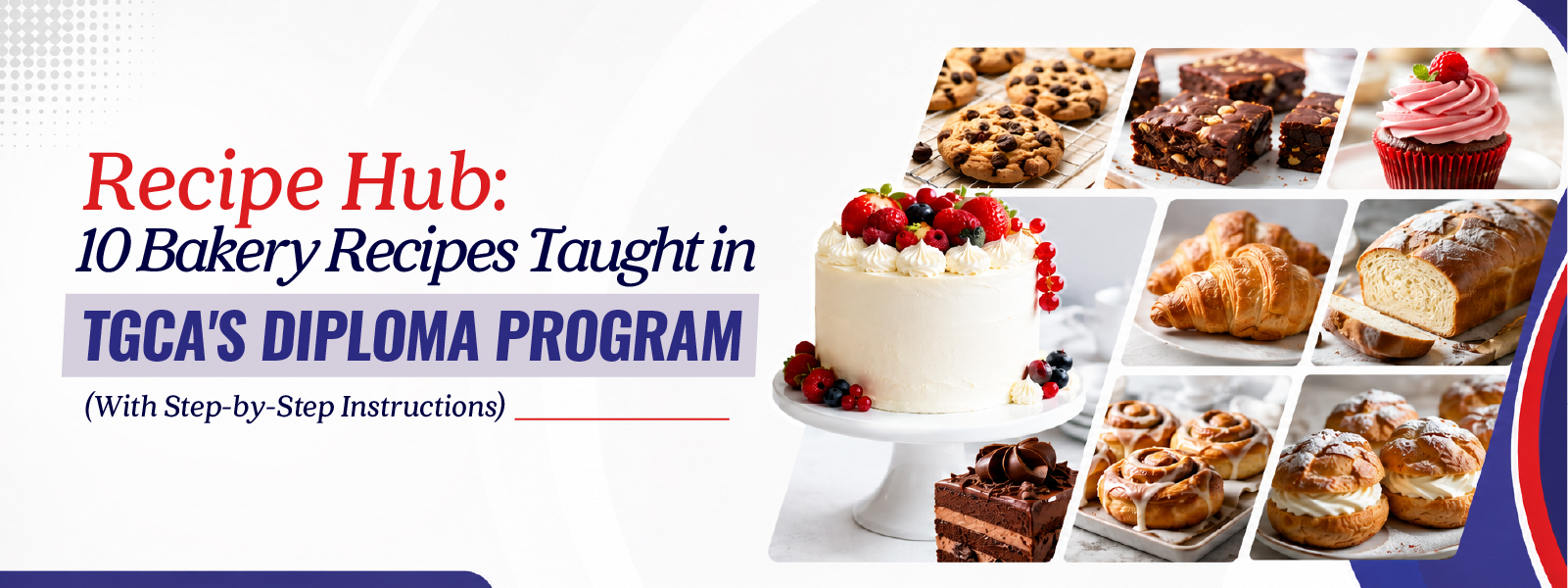
One of the most common questions prospective students ask before enrolling is: what will I actually make? The Diploma in Culinary Arts and Diploma in Bakery and Pastry Arts at TGCA cover a comprehensive curriculum, from foundational easy cake recipes in the early weeks to advanced laminated pastry, chocolate work, and plated desserts in the later modules. This Recipe Hub gives you a genuine window into that curriculum, ten real recipes taught at TGCA, with full step-by-step instructions for three and a concise overview of what each remaining seven teaches you as a professional baker.
Understanding what recipes are taught in bakery diploma course before you enrol helps you see the progression from beginner-friendly foundations to the advanced techniques that make a diploma graduate genuinely employable. Every recipe on this list is chosen not just because it produces a delicious result, but because it builds a specific professional skill that hotel kitchens, patisseries, and bakery businesses look for in trained graduates.
This blog is structured in two parts. The first three recipes come with complete step-by-step instructions so you can try them at home and see what professional-standard baking involves. The remaining seven recipes are presented with a skill-focused overview, explaining what each one teaches and why it matters in a professional context. If any of these recipes excite you and you want to learn them properly, in a commercial kitchen, with expert faculty, the details of TGCA's programmes are at the end of this guide.
All recipes below are simplified home versions of the professional techniques taught at TGCA. Full professional training uses commercial equipment, larger quantities, and significantly more precision than home kitchens allow.
These ten recipes represent the foundational to intermediate range of the bakery diploma recipes curriculum at TGCA. They are chosen because they cover the essential skill categories every professional baker must master: sponge cake technique, laminated pastry, bread making, egg-based pastry cream, chocolate ganache, cookie consistency, mousse work, and sugar-based caramel. Together they form a complete professional foundation that connects directly to the techniques used every day in hotel pastry kitchens, bakery brands, and patisseries across India and internationally.
The Victoria sponge is the foundational easy cake recipe step by step that every professional baker learns first, because it teaches the creaming method, the science of even rising, and the importance of precision in flour and fat ratios. Master this and every other sponge-based cake becomes significantly more intuitive.
Skill you build: Creaming method, aeration control, oven calibration, and the science of consistent sponge structure.
Croissants are the most technically demanding laminated pastry that Professional Baking Classes at TGCA introduce students to in the intermediate stage of the diploma. The lamination process, creating hundreds of alternating layers of dough and butter through a series of folds, is a technique that develops patience, precision, and an understanding of how fat and dough interact under different temperature conditions. This simplified home version introduces the principle. The professional version at TGCA uses a sheeting machine and specific butter types for consistent results at scale.
Skill you build: Lamination technique, temperature management, dough resting discipline, and understanding gluten development.
The chocolate ganache tart is one of the easy cake recipes that combines two fundamental pastry skills: shortcrust pastry (pâte sucrée) and ganache making. It teaches students how cream and chocolate interact at different ratios to produce different textures, from pourable glaze to firm sliceable filling, a principle that applies across dozens of professional patisserie products.
Skills you build: Shortcrust pastry technique, blind baking, ganache ratios, and understanding chocolate emulsification.
The following seven recipes are part of the professional bakery recipes for beginners to intermediate curriculum at TGCA. Each one builds a specific professional skill category essential for a complete bakery training:
Sourdough bread making teaches fermentation science, hydration management, shaping under tension, and the scoring and baking techniques that produce a professional crust. Students maintain their own starter culture, learning to read fermentation activity and adjust proofing times accordingly. This recipe builds patience, observation, and an understanding of living cultures that applies across all fermented doughs.
Skills you build: Wild yeast fermentation, gluten structure, dough hydration, scoring technique, and deck oven baking.
French macarons are one of the most technically demanding cookies in professional patisserie. They require precise egg white aging, exact folding technique (macaronage), consistent piping, and precise oven temperature management. The Italian meringue method taught at TGCA produces a more stable result than the French method and is the professional standard in hotel and patisserie kitchens.
Skill you build: Italian meringue, macaronage folding, piping consistency, and humidity and temperature management.
Pastry cream is the backbone of dozens of professional pastry products, from eclairs and mille-feuille to fruit tarts and cream puffs. The recipe teaches students about starch gelatinisation, egg tempering, and the precise technique required to produce a smooth, stable cream without scrambling the eggs or developing a skin. This is a foundational recipe that every professional pastry chef must be able to produce consistently.
Skills you build: Egg tempering, starch gelatinisation, cream consistency control, and flavour infusion techniques.
Choux pastry is unique among pastry types because it uses heat to gelatinise the starch before baking, creating a hollow interior through steam expansion. Students learn the panade technique, the exact consistency of batter required for professional piping, and the two-stage baking method that produces a hollow, crisp shell. Filled with crème pâtissière and dipped in chocolate glaze, the completed eclair requires mastery of multiple techniques simultaneously.
Skills you build: Panade technique, batter consistency, piping, steam control, and multi-technique assembly.
The tarte tatin teaches students about caramel making, the Maillard reaction in fruit cookery, and the confidence required to invert a hot tart without losing its shape. It uses the same shortcrust pastry technique as the ganache tart but adds the fundamentally different skill of cooking fruit in sugar to a precise caramelisation stage. One of the easy cake recipes that is deceptively technical in professional execution.
Skill you build: Dry caramel technique, fruit cookery, flavour development through caramelisation, and inversion confidence.
Mille-feuille (a thousand layers) uses the same laminated puff pastry principle as croissants but in a classic stacked French pastry format. Students learn to bake puff pastry to a flat, even, caramelised crisp, layer it with crème pâtissière, and finish with a precise feathered fondant top that requires speed, a hot skewer, and a steady hand. This recipe combines multiple previously learned skills in a single, demanding assembly.
Skills you build: Puff pastry baking, assembly precision, fondant feathering technique, and multi-component pastry construction.
Crème brûlée teaches students the custard principle, the ratio of cream to egg yolk that produces a set but silky texture, the importance of gentle oven temperature and a water bath (bain-marie), and the technique of caramelising the sugar surface with a blowtorch to the exact cracking point without burning. A deceptively simple recipe that requires complete precision at every stage.
Skills you build: Custard ratio, bain-marie technique, temperature control, and blowtorch caramelisation.
Tedco Education's TGCA diploma programme covers these ten recipes and hundreds more across the full year of training. But what makes a diploma programme significantly more valuable than a collection of recipes is what it builds beneath the recipe level: the understanding of why each technique works, the ability to adapt when something goes wrong, the speed and consistency to reproduce results under service pressure, and the professional kitchen discipline that every employer looks for before a graduate walks into their first kitchen.
A student who has learned a recipe from YouTube knows how to follow a specific sequence of steps. A student who has completed a professional diploma at TGCA understands the science, the technique, and the professional standards behind every step, and can apply that understanding across hundreds of different recipes they have never seen before. That difference is exactly what City and Guilds accreditation recognises and what professional kitchens pay for.
Every recipe above, from the Victoria sponge to the crème brûlée, builds from the same foundational skills: precision in measurement, understanding of temperature and its effect on ingredients, the patience to allow resting and proofing times without shortcutting, and the professional habit of mise en place, having everything prepared and in place before you begin. These are the skills that professional training builds through repetition, and they are what separates a professionally trained baker from a talented home baker who has learned a lot of recipes.
In a professional kitchen, a recipe is a starting point. The skill is what happens when something goes wrong, and you know how to fix it without asking anyone.
The ten recipes in this guide, from the classic Victoria sponge to the crème brûlée, give you a genuine picture of what bakery diploma recipes look like in practice. They are not intimidating, but they are precise. They are not impossible for a beginner, but they reward proper technique in ways that make the difference between a good result and a professional one unmistakably clear. If any of them excites you, that excitement is a reliable signal that professional baking training is the right path.
Tedco Education's TGCA teaches every recipe on this list, and hundreds more, as part of the Diploma in Bakery and Pastry Arts at the Connaught Place campus in New Delhi. The best way to understand what professional bakery training actually feels like is to attend a free demo class and experience it in person. 2026 batches are open now. Book your free demo class today by calling 011-69240093 or visiting tedcoeducation.com.
TGCA's City and Guilds-accredited Diploma and Certificate in Bakery and Pastry Arts give you hands-on training in all of these recipes and hundreds more.
2026 batches are open now. Book a free demo class today.
TGCA's Diploma in Bakery and Pastry Arts covers artisan breads, laminated pastry, sponge cakes, mousse and entremet, choux pastry, tarts, custards, chocolate work, cookies, and plated desserts. The curriculum progresses from foundational techniques to advanced professional skills across the full year.
Yes. The three full recipes, Victoria sponge, croissants, and chocolate ganache tart, are home-friendly versions of professional techniques. Beginners should start with the Victoria sponge and progress to croissants once comfortable. Professional training at TGCA builds all these skills systematically in a commercial kitchen environment.
Professional bakery recipes use precise weights rather than volume measures, commercial equipment for consistent results, larger batch sizes, and professional finishing techniques. They are optimised for consistency and speed under service conditions, qualities that home recipes are not designed to develop.
Yes. The foundational recipes including Victoria sponge, ganache tart, and pastry cream are part of both the Certificate and Diploma programmes. Advanced recipes like mille-feuille and croissants are covered in greater depth in the full 1-year Diploma in Bakery and Pastry Arts.
Yes. TGCA offers free demo classes at the Connaught Place campus where prospective students can experience the professional kitchen, try a foundational technique under faculty guidance, and get a real sense of what the diploma programme involves before committing to enrolment.
Culinary Instructor
 Whatsapp
Click one of our representatives below to chat on WhatsApp or send us an email to
info@tedcoeducation.com

Counselor
Bakery and Pastry Courses
Counselor
Culinary Arts Courses
Click one of our representatives below to chat on WhatsApp or send us an email to
info@tedcoeducation.com
Counselor
Bakery and Pastry Courses
Counselor
Culinary Arts Courses

