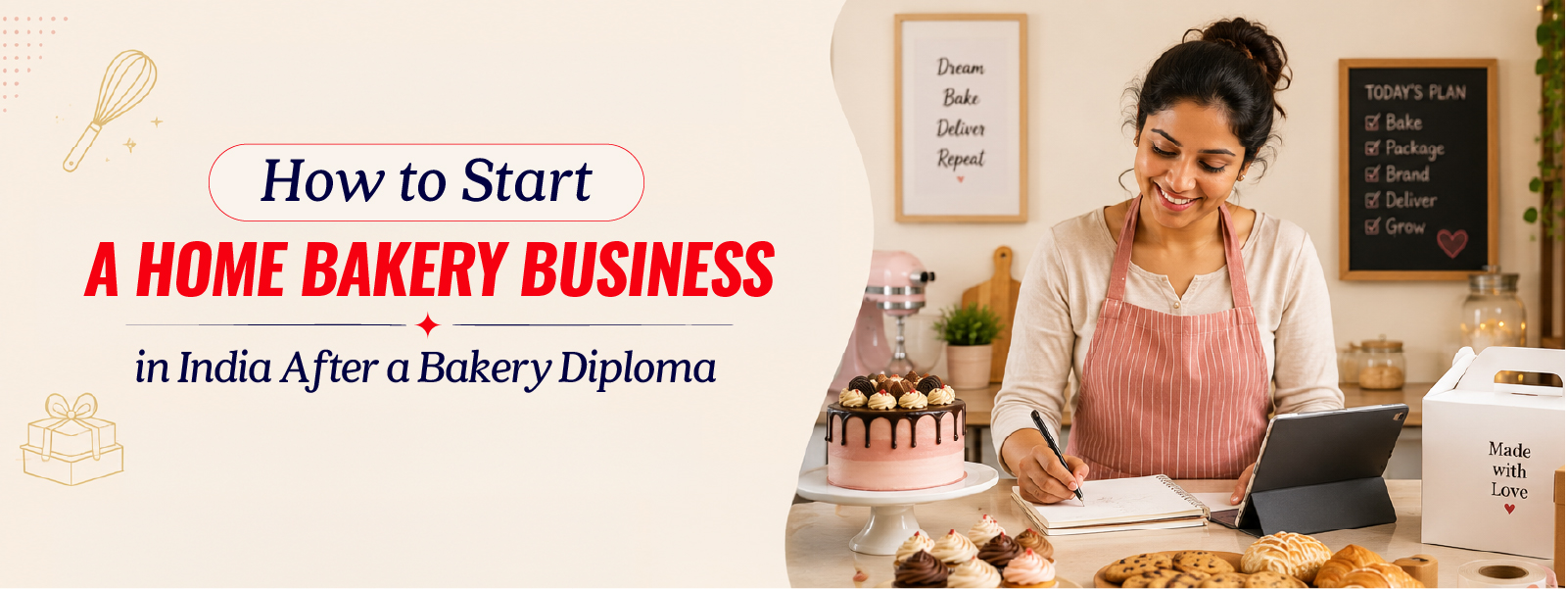

Starting a home bakery business in India in 2026 is one of the most accessible food entrepreneurship paths available, but the gap between a successful home bakery and one that quietly closes within a year almost always comes down to one thing: the quality of training behind the baker. A Professional Baking Course from an accredited institute gives you more than baking skill. It gives you the food costing knowledge, the professional credibility, and the kitchen discipline that separate a home bakery that grows from one that just gets by.
This guide is written specifically for students who have completed or are about to complete a professional bakery diploma and are now seriously thinking about what launching a home bakery business actually involves. It covers every practical step, from FSSAI registration and startup costs to pricing your products and building your first client base, most clearly and honestly possible.
Whether you completed your diploma last week or you are still in your final semester and planning ahead, this guide gives you a realistic, step-by-step picture of what launching a home bakery business in India actually involves. Not the Instagram-filtered version. The real one, with the licensing, the pricing, the startup costs, and the client acquisition strategies that actually work for newly qualified baking graduates in 2026.
This guide covers the home bakery route specifically. If you are interested in cloud kitchens, custom cake studios, or corporate gifting bakeries, those business models are covered in our companion blog on Top Bakery Business Ideas After a Baking Course in India 2026.
India's relationship with baked goods has changed significantly in the last five years, and the change is accelerating. Urban Indian consumers are increasingly seeking out artisan, premium, and personalised baked products that the mass retail bakery market simply does not supply at the quality level they want. Sourdough breads, custom celebration cakes, French pastry, specialty cookies, and health-conscious baked alternatives are all growing demand categories where home bakery businesses with professional training can genuinely compete and win.
The delivery infrastructure makes 2026 an especially good moment to start. Swiggy and Zomato have made it possible for a home baker to reach thousands of customers without a retail shopfront. Instagram and WhatsApp have made it possible to build a brand and take orders with a near-zero marketing budget. And the consumer willingness to pay significantly more for a product with a genuine story, a skilled maker, and a professional credential behind it has created real pricing power for home bakery graduates who present themselves correctly.
The honest difference between a self-taught home baker and a diploma-qualified one is not always visible in the product, at least not immediately. But it shows up in consistency, in the ability to scale production without losing quality, in the professional understanding of food safety that protects both the baker and their clients, and in the credibility that makes charging a premium price feel justified to the client rather than presumptuous. These are the advantages that a professional diploma builds, and they are what make the difference between a home bakery that grows and one that stays small indefinitely.
The Food Safety and Standards Authority of India (FSSAI) requires every food business in India, including home bakeries, to be registered before selling products. This is not optional, and it is not something you can defer until your business grows. FSSAI registration for home bakeries in India is the first legal step, and it is also a meaningful business signal: delivery platforms like Swiggy and Zomato require it as a condition of listing, corporate clients increasingly ask for it before placing orders, and it demonstrates a level of professionalism and seriousness that distinguishes legitimate home bakeries from casual sellers.
Home bakeries in India typically qualify for a Basic FSSAI Registration, the simplest and lowest-cost category, which is appropriate for food businesses with an annual turnover of up to Rs 12 lakh. The process involves creating an account on the FSSAI FoSCoS portal, filling in the registration form with your business details, submitting the required documents, and paying a nominal annual fee of Rs 100. Documents typically required include your Aadhaar card, a passport-size photograph, a list of the food products you will be making, and the address of your kitchen.
Approval typically takes a few days to a few weeks. Once approved, you receive an FSSAI registration certificate and a 14-digit registration number that must be displayed on your packaging. Keep your registration current; it needs to be renewed annually.
One of the most common mistakes new home bakery businesses make is underestimating startup costs or overspending on equipment before they have a single confirmed client. Here is a realistic home bakery startup cost in India picture for a diploma-qualified baker launching in 2026:
The most important startup investments are the ones that directly affect product quality and client trust: a reliable oven, accurate weighing scales, FSSAI registration, and professional-looking packaging. Defer the nice-to-haves, custom logo design, premium website, and specialist equipment until you have consistent revenue to fund them. Many successful home bakery businesses operate for 6 to 12 months on a very lean setup before investing in the next level of infrastructure.
A home bakery business plan does not need to be a 50-page document. But it does need to answer four questions clearly before you start spending and selling. What will you make and why, meaning what is your specific product focus and what makes it worth paying for? Who is your customer, meaning who specifically will buy from you, and how will you reach them? How will you price your products, meaning what does each product cost to make and what margin do you need to be profitable? And how will you grow, meaning what does success look like at 3 months, 6 months, and 12 months, and what do you need to get there? A Bakery Chef Course from a programme like TGCA's builds the food costing and kitchen management awareness that makes answering these questions significantly easier than it would be for a self-taught baker.
One of the most counterintuitive but consistently correct pieces of advice for new home bakery business owners is to specialise rather than offer everything. A home bakery that makes exceptional sourdough bread builds a recognisable, repeatable, word-of-mouth business faster than one that makes sourdough, custom cakes, croissants, cookies, and macarons with mixed results across all of them. Specialisation allows you to develop one product category to a genuinely exceptional standard, build a reputation for it, price it at a premium, and scale it more efficiently.
Look at your diploma training and ask honestly which area of your baking is genuinely strongest and which products you find most exciting to make. The intersection of what you do best and what you genuinely enjoy is almost always the right product focus for a home bakery that you want to sustain over the long term.
Pricing is where most new home bakery businesses make their most consequential and most damaging mistake: they underprice. Understanding how to price homemade cakes and other baked goods correctly from the start is one of the most valuable skills a bakery diploma graduate can develop, and it is directly related to the food costing training that a professional programme provides.
The correct approach to pricing starts with understanding your cost of goods sold (COGS). For every product you sell, calculate the exact cost of every ingredient, including small quantities of spices, vanilla, and other flavourings that are easy to overlook. Add your packaging cost per unit. Add a proportion of your overhead costs, electricity, gas, and equipment depreciation, allocated to that product. The total is your base cost.
From your base cost, apply a markup that reflects the value of your time, your professional training, and the premium quality of your product. For a home bakery targeting the premium market, a markup of 2.5 to 4 times the base ingredient cost is a reasonable starting benchmark, though this varies significantly by product category and target market. The key principle is this: never set your price by looking at what other home bakers are charging. Set it by understanding your own costs and the value your professional training and product quality genuinely represent.
Pricing confidence comes from understanding your value, and a home bakery business plan that includes a clear pricing rationale gives you exactly that. When a client asks why your custom cake costs more than one from an untrained home baker, you have a clear answer: professional diploma training, City and Guilds accreditation, food-safe certified production, premium ingredients, and consistent quality. These are not abstract claims. They are real differentiators that justify real price differences, and clients who value quality will understand and respect them.
The fastest route to a first client base for a home bakery is your existing personal and professional network. Friends, family, former classmates, neighbours, and colleagues are your first audience, and they are the most forgiving, most willing to pay, and most likely to recommend you to others if your product is good. Treat every order from this initial network with the same professional standards you would apply to any client: proper packaging, on-time delivery, and follow-up to ask for feedback and, if appropriate, a testimonial.
Referrals from happy clients are the single most powerful marketing tool for a home bakery at this stage. A satisfied customer who tells two friends, who each tell two more, builds a client base faster than almost any other strategy, and costs nothing. Invest in making every early client so pleased with the product and the experience that sharing it with someone else feels natural.
Once your product and packaging are consistent, Instagram is your primary external marketing channel. Post product photos with good natural lighting, show your process, share the story of your training and your approach to quality, and engage consistently with your audience. The goal in the early months is not viral growth. It is building a small, genuinely interested following who trust your quality and think of you when they need baked goods.
For delivery platform listings on Swiggy and Zomato, your FSSAI registration is a prerequisite. List a tightly focused menu of your best products, price them correctly, including platform commissions of 20 to 30 percent, and focus on your ratings from the first order. High ratings on delivery platforms are the primary discovery mechanism, and the investment in getting every early delivery right pays back through organic platform visibility.
Tedco Education's TGCA is one of the few culinary institutes in Delhi where food costing and kitchen management are genuine curriculum components rather than afterthoughts. For students who plan to launch a home bakery business after graduation, these modules are directly and immediately applicable. Understanding how to cost a recipe accurately, how to manage ingredient procurement efficiently, and how to run a kitchen as a profitable operation are the business skills that separate home bakeries that make money from those that generate revenue without profit.
Tedco Education's City and Guilds (UK) accreditation gives TGCA graduates something that self-taught bakers simply cannot access: an internationally recognised professional qualification that clients, delivery platforms, and corporate buyers can verify and trust. When a home bakery owner tells a corporate client that they hold a City and Guilds Level 2 Diploma in Bakery and Pastry Arts from an accredited institute, that credential shifts the conversation from 'can you make good cakes' to 'tell me about your minimum order quantities.' That shift is worth more than most people realise in the early stages of building a home bakery brand.
Starting a home bakery business in India after a bakery diploma is a clear, achievable, and genuinely exciting pathway in 2026. The five steps, FSSAI registration, understanding your startup costs, building a simple business plan, pricing correctly from day one, and building your first client base strategically, are all within reach of any diploma-qualified baker who approaches the process with the same discipline and professionalism they applied to their training.
The market is ready. The infrastructure for selling and delivering is better than it has ever been. And the professional credential from a serious bakery diploma gives you a foundation of credibility and skill that the tens of thousands of self-taught home bakers competing in this market cannot match. Use that advantage, price it into your products, communicate it to your clients, and build a home bakery that reflects the standard of your training.
If the home bakery business is the goal, the foundation is the training. The stronger, more comprehensive, and more credibly accredited your diploma, the stronger the foundation your business is built on. TGCA's 2026 batches are open now. If you are still in the planning stage of your bakery journey, this is the moment to take the step that everything else will be built on. Come and see the kitchen, meet the faculty, book a free demo class, and start building toward the bakery business you want to run.
TGCA's City and Guilds-accredited Diploma and Certificate in Bakery and Pastry Arts give you the technical foundation, food costing skills, and professional credibility to launch a successful home bakery business. 2026 batches are open now.
Yes. Every food business in India, including home bakeries, requires FSSAI registration before selling products. Home bakeries typically qualify for basic registration at Rs 100 per year. It is also a mandatory requirement for listing on Swiggy, Zomato, and most corporate client onboarding processes.
A realistic home bakery startup in India requires Rs 35,000 to Rs 1,00,000 covering a reliable oven, stand mixer, basic tools, FSSAI registration, initial ingredients, packaging, and basic photography. Defer non-essential investments like websites and specialist equipment until consistent revenue is established.
Calculate your exact ingredient cost per product, add packaging and overhead proportions, then apply a markup of 2.5 to 4 times your base cost depending on product and target market. Never price by comparing to untrained home bakers. Your professional diploma justifies and demands a meaningful price premium.
Yes, with FSSAI basic registration, a home kitchen is a legal production location for a home bakery business in India. Ensure your kitchen meets basic food safety standards, that your storage is appropriate, and that you have adequate equipment to maintain consistent product quality at the volume you plan to sell.
A bakery diploma from an accredited institute provides professional baking skills, food costing knowledge, kitchen management fundamentals, and a credible qualification that allows premium pricing. It also provides FSSAI compliance awareness and professional discipline that separates sustainable home bakeries from short-lived ones.

Pastry Instructor
 Whatsapp
Click one of our representatives below to chat on WhatsApp or send us an email to
info@tedcoeducation.com

Counselor
Bakery and Pastry Courses
Counselor
Culinary Arts Courses
Click one of our representatives below to chat on WhatsApp or send us an email to
info@tedcoeducation.com
Counselor
Bakery and Pastry Courses
Counselor
Culinary Arts Courses

