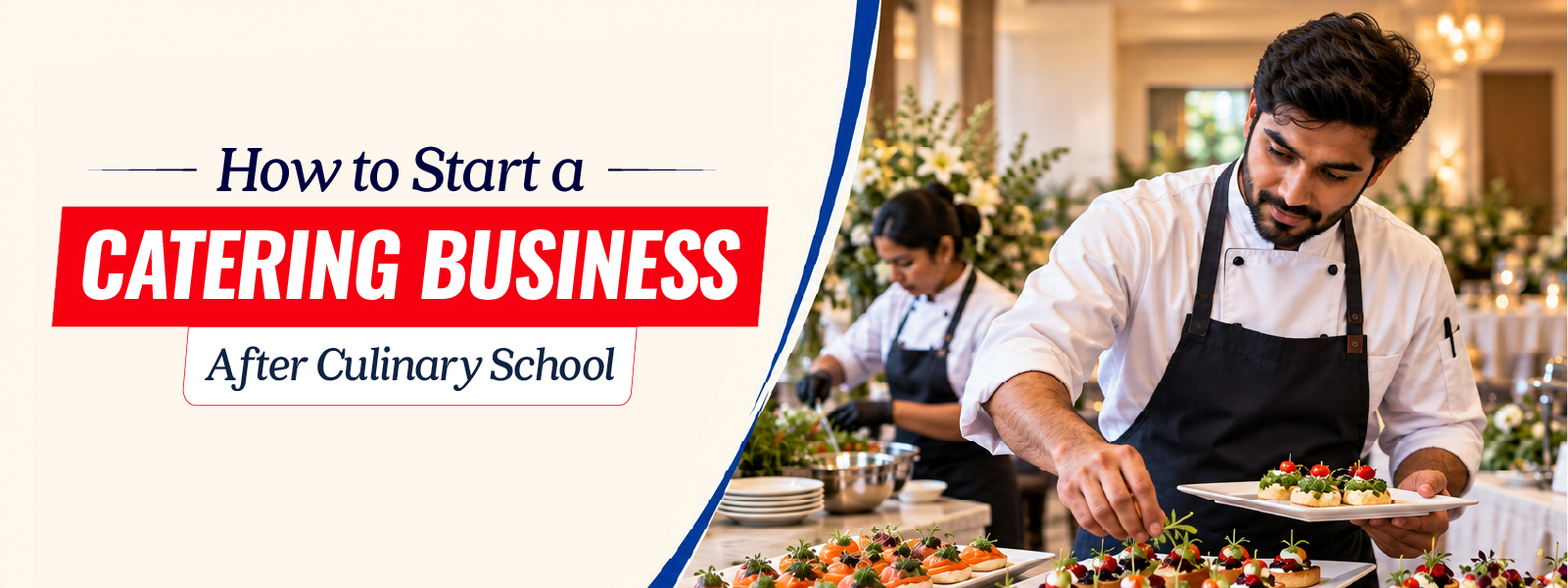
Completing a diploma in culinary arts can give you more than professional cooking skills. It can also provide a foundation for building your own food business. For graduates interested in entrepreneurship, catering can be a practical way to turn culinary skills into a service-based business without immediately opening a full-scale restaurant.
However, good food alone does not make a successful caterer. You also need to understand menu costing, sourcing, staffing, food safety, logistics, customer service and cash flow. Your culinary training gives you the kitchen foundation, while running a catering business requires you to build the business skills around it.
Here is a practical roadmap for moving from culinary graduate to catering entrepreneur.
The first decision is not what equipment to buy. It is deciding what type of catering business you want to build.
Your niche will influence your menu, equipment, pricing, staffing, marketing and even the type of kitchen you need.
Wedding and social catering can involve large guest numbers and varied menus. Depending on the event, you may provide complete food service, selected food stations, desserts or a combination of services.
This model requires strong planning because the number of guests, venue facilities, service timings and menu requirements can change from one event to another.
Corporate catering may involve office lunches, meetings, conferences, training sessions and employee events.
Consistency and punctual delivery are particularly important because food often needs to arrive within a defined service window.
Smaller events can be a more manageable starting point for a new business.
You might cater for birthdays, family gatherings, private dinners or small celebrations. This allows you to test menus, understand customer preferences and build references before accepting larger assignments.
A focused concept can also help you stand out.
Examples include:
Choose a niche that matches your culinary strengths as well as the demand in your target market.
Before creating a menu, understand who is going to buy it.
Search for existing catering businesses in your target area and study their menus, service formats, event types and publicly available pricing. You are not trying to copy them. You are trying to understand where your potential customers already spend money and where there may be an opportunity for a different offering.
Every dish should be costed before you put a selling price on it.
For each recipe, calculate the cost of the ingredients required for one portion. Then consider other expenses associated with delivering the order.
Your costing may include:
For example, if a menu looks inexpensive based only on ingredient costs but requires several additional staff members and long-distance transportation, the actual cost of serving that event will be considerably higher.
Do not price your catering service simply by looking at what another caterer charges.
First understand your own cost structure. Then determine the margin you need to cover business expenses, unexpected costs and future growth.
It is also useful to create different packages rather than offering an enormous menu from the beginning.
A simple structure might include:
This makes it easier for customers to compare options while giving you greater control over production.
Food businesses need to take regulatory requirements seriously from the beginning.
The Food Safety and Standards Authority of India states that every Food Business Operator must be licensed or registered under the applicable FSSAI framework. FSSAI's current information states that petty food businesses with annual turnover up to ₹12 lakh fall under registration, while businesses above that threshold generally require a licence, subject to the applicable category and criteria.
Because catering businesses can fall under different categories, check the current eligibility criteria applicable to your specific operation before applying.
FSSAI compliance is not simply about obtaining a number.
A catering business also needs to maintain appropriate food safety and hygiene practices covering areas such as:
FSSAI operates the FoSCoS system for food licensing and registration.
Depending on your business structure, turnover and activities, GST registration and other local permissions may apply. GST registration applications are handled through the official GST portal.
You may also need to check requirements relating to your local authority, premises, fire safety and other applicable permissions.
Do not assume that a home-based operation is automatically exempt from every local requirement. Requirements can vary according to location and the nature of the business.
Maintain records for purchases, suppliers, stock, recipes, costing, invoices, staff and food safety procedures.
Good documentation becomes increasingly important as the number of events increases.
You do not necessarily need a large commercial kitchen on day one.
Your starting model could depend on the type and scale of catering you plan to offer.
A small home-based operation may work for limited production where local rules and food safety requirements permit it.
This model can reduce initial premises costs, but available storage, preparation space, refrigeration and production capacity can become limitations as orders grow.
A shared or rented commercial kitchen can provide access to better facilities without requiring you to immediately invest in a complete kitchen setup.
It can be useful when your production requirements are larger than what your existing space can comfortably handle.
Prioritise equipment based on your actual menu.
Your initial requirements may include:
Do not buy every piece of equipment simply because it appears in a professional kitchen. If a machine will only be used occasionally, renting or outsourcing that requirement may make more sense initially.
Your suppliers become an important part of your catering operation.
Build relationships with reliable vendors for vegetables, dairy, grains, spices, meat or other ingredients relevant to your menu.
Do not choose suppliers based only on the lowest price. Consistent quality and reliable delivery can be more valuable than a small difference in purchase price.
Create a simple inventory system that records:
Use appropriate stock rotation practices and keep storage areas organised.
If you regularly throw away unused ingredients, your menu costing may look profitable on paper while your actual business loses money through wastage.
You may be able to manage small orders yourself, but larger events require planning for additional staff.
Instead of immediately maintaining a large permanent team, a new caterer may use a combination of core staff and event-based workers, depending on the operation and applicable employment requirements.
A catering event usually involves several stages:
The cooking itself is only one part of the job.
For example, a dish that tastes excellent but arrives late because transportation was poorly planned can still result in an unhappy client.
Your first customers may come through people who have already experienced your food.
Start building a portfolio while you are still training or working in the industry, where appropriate.
Use clear photographs of dishes, menus and event setups. Show consistency rather than filling your portfolio with dozens of unrelated dishes.
A small, well-presented menu can communicate more confidence than a huge menu that you cannot execute consistently.
Create a professional online presence with accurate business information.
Depending on your business model, useful channels can include:
Keep your menu, contact information and service areas updated.
Event planners, wedding venues, corporate administrative teams and other event professionals can become valuable referral sources.
However, relationships work both ways. Delivering reliable food and professional service is what turns a first referral into a long-term source of business.
A tasting can help a potential client evaluate your food before confirming a large event.
Instead of preparing everything you offer, create a focused tasting menu that represents your style and the proposed event menu.
Starting a catering business can look simple from the outside. In practice, several operational mistakes can quickly affect profitability.
One of the most common problems is pricing based only on ingredient costs.
If you forget labour, transportation, packaging, wastage, equipment and overheads, your selling price may not cover the true cost of the event.
A profitable order can still create cash-flow pressure if you have to pay suppliers and staff before receiving the customer's payment.
Set clear payment terms and understand exactly when money will enter and leave the business.
Growth is useful only when you can maintain quality.
If your kitchen can comfortably produce 100 portions but you accept an event requiring 500 without sufficient facilities, staff and planning, service quality can suffer.
Start with an operating capacity you can manage and increase it gradually.
Customers remember consistency.
The same dish should taste and look reasonably consistent whether you prepare it for ten people or a larger event. Standardised recipes, accurate measurements, preparation checklists and proper staff training can help achieve this.
A catering entrepreneur needs business skills, but the foundation still starts with understanding food.
A culinary diploma can provide structured exposure to cooking techniques, food preparation, kitchen hygiene, menu planning and professional kitchen practices. These skills can become useful when you begin developing menus and managing production for paying customers.
For students considering chef courses, it is worth looking beyond recipes alone. Understanding food costing, production planning, portion control and hygiene can make the transition from culinary training to food entrepreneurship more practical.
TGCA's culinary training can help students build practical knowledge of professional food preparation and kitchen operations. For someone considering entrepreneurship after culinary education, these fundamentals can provide a starting point for developing the additional business, costing and operational skills required to run a catering service.
Starting a catering business after culinary school involves much more than preparing good food.
You need to identify a suitable niche, research your market, cost every menu carefully, understand applicable registrations, build reliable supplier relationships and create an operation that can deliver consistently.
Start with a manageable scale. Test your menu, understand your real costs and listen to customer feedback before expanding.
Your culinary training gives you the foundation. The next step is learning how to turn that foundation into a reliable business.
Yes. A culinary diploma can provide practical food preparation and kitchen knowledge that may be useful when starting a catering business. You will also need to develop business, costing and operational skills.
Small events, private gatherings, limited corporate orders or a focused specialist menu can provide manageable starting points. The right model depends on your skills, resources, location and target customers.
Food businesses in India are required to obtain the applicable FSSAI registration or licence. The requirement depends on the nature and scale of the business, so check the current FoSCoS eligibility criteria before starting operations.
There is no single reliable starting figure. Costs vary according to the menu, city, kitchen model, equipment, staffing, transport and event size. A small operation can require a very different investment from a large-scale caterer.
Besides cooking, you need menu costing, purchasing, inventory control, food safety, staff coordination, time management, customer communication and basic financial management. These skills become increasingly important as the number of events grows.
Centre Head & Head of Department
 Whatsapp
Click one of our representatives below to chat on WhatsApp or send us an email to
info@tedcoeducation.com

Counselor
Bakery and Pastry Courses
Counselor
Culinary Arts Courses
Click one of our representatives below to chat on WhatsApp or send us an email to
info@tedcoeducation.com
Counselor
Bakery and Pastry Courses
Counselor
Culinary Arts Courses

