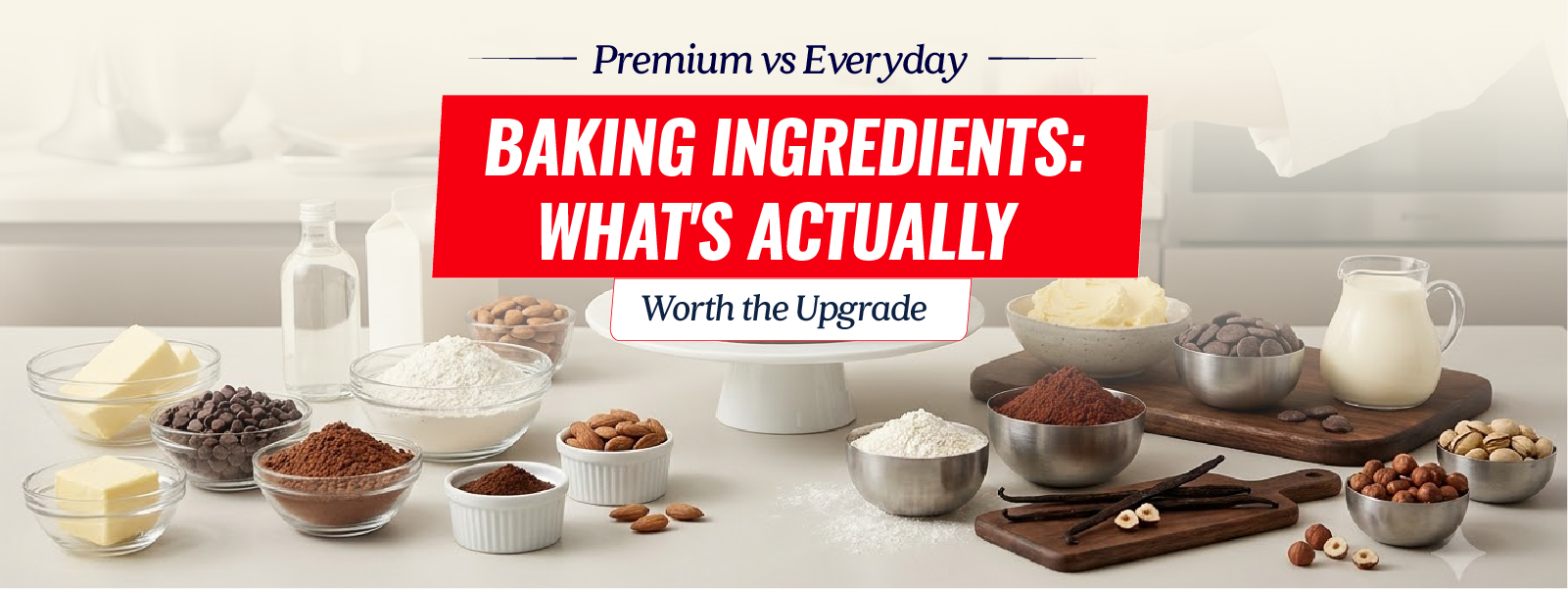
Walk into a professional bakery and you may notice something before the first tray of cakes comes out of the oven. The ingredients are carefully organised. Butter is measured precisely. Flour is weighed rather than scooped. Chocolate is selected for a particular recipe, while vanilla is treated as more than just another bottle on the shelf.
This raises an interesting question for anyone who bakes at home: Do premium baking ingredients really make a difference, or are you simply paying more for a fancy label?
The answer is somewhere in between.
Not every expensive ingredient will make your cake better. At the same time, certain upgrades can dramatically change the flavour, texture, aroma and appearance of a finished bake. The real skill lies in knowing where quality matters and where an everyday ingredient will do the job perfectly well. Learning these practical details is also an important part of a Professional Baking Course, where you understand how ingredient quality affects different recipes and baking techniques.
Understanding this difference is part of becoming a more confident baker. Once you understand how ingredients behave and how different baking methods affect them, you can spend your money where it actually counts.
The word "premium" can be misleading. A higher price does not automatically mean an ingredient is better for every recipe.
Premium baking ingredients may offer better flavour, higher fat content, greater consistency, more refined processing or characteristics that make them particularly suitable for professional baking. However, their value depends heavily on what you are making.
Think about a simple vanilla sponge. If it contains several strong flavours, such as chocolate, coffee or fruit, spending significantly more on vanilla may not produce a noticeable difference.
Now imagine a delicate vanilla buttercream. There is nowhere for poor-quality vanilla to hide. Its flavour sits right at the centre of the dessert.
That is the key principle:
The more important an ingredient is to the final flavour, texture or structure, the more worthwhile a quality upgrade becomes.
Butter is one of the first baking ingredients where quality can have a noticeable impact.
Butter contributes fat, flavour, moisture and texture. It also behaves differently depending on its composition.
A good-quality butter can give pastries a richer flavour and can affect the texture of cakes, biscuits and laminated doughs. In recipes where butter is one of the main ingredients, the difference can be easier to notice.
Premium butter can be particularly useful for:
Imagine biting into a freshly baked shortbread biscuit. There are relatively few ingredients competing for attention. Flour, sugar and butter are doing most of the work.
In that situation, butter quality matters.
For a heavily flavoured chocolate cake, however, the difference may be less obvious.
Everyday butter is perfectly suitable for many home baking needs. If you are making a basic sponge or a batch of cookies for the family, you do not necessarily need the most expensive option available.
More important than buying the costliest butter is using the correct type and handling it properly.
Temperature matters. Measuring matters. Mixing matters.
A premium ingredient cannot rescue poor baking methods.
Flour is another ingredient where bakers can easily spend more than necessary.
The important factor is not simply price. It is whether the flour is suitable for the recipe.
Different flours have different protein levels and characteristics. This affects gluten development, elasticity and the final structure of baked products.
A flour that works beautifully for bread may not produce the same result in a delicate cake.
For example:
Bread: You generally want flour capable of developing enough gluten to support fermentation and create structure.
Cakes: A softer flour can help produce a more tender crumb.
Pastries: The desired result depends on the type of pastry and the baking method.
This is why professional bakers do not simply ask, "Which flour is the most expensive?"
They ask, "Which flour is appropriate for this product?"
That is a much more useful question.
For everyday cakes, biscuits and muffins, a reliable everyday flour can perform extremely well. Spending more may be worthwhile when you are making specialised breads, laminated pastries or products where flour characteristics have a significant effect on the finished result.
Chocolate is one category where upgrading can make a substantial difference.
If chocolate is being used as a supporting ingredient in a large cake batter, you may not need the most expensive couverture chocolate available.
But if chocolate is the star of the dessert, quality becomes far more important.
Think about a chocolate tart with a smooth ganache filling. There may be only a handful of ingredients in the filling. The chocolate's cocoa flavour, sweetness, bitterness and texture are immediately noticeable.
This is where premium baking ingredients can justify their price.
Consider spending more when chocolate is used for:
For everyday chocolate cakes or recipes where cocoa powder and other ingredients dominate the flavour, a dependable mid-range product may be enough.
The goal is not to buy the most expensive chocolate.
The goal is to buy chocolate that suits the recipe.
Vanilla is often used in tiny quantities, which makes people wonder whether premium vanilla is worth buying.
It can be.
Real vanilla products can offer a more complex aroma than basic vanilla flavouring. But again, context matters.
If you are preparing a delicate custard, vanilla ice cream, pastry cream or simple buttercream, vanilla can become a major part of the final flavour.
If you are making a strongly flavoured cake filled with chocolate and fruit, its contribution may be much less obvious.
This is a useful rule for your baking needs:
Upgrade ingredients that the customer or guest can actually taste.
There is little value in spending heavily on an ingredient that disappears behind five stronger flavours.
Eggs are among the most important basic ingredients in baking.
They provide structure, moisture, richness, emulsification and, in some recipes, aeration.
But you do not necessarily need "premium" eggs for every bake.
Fresh, good-quality eggs stored correctly are generally what you need for most recipes.
Where egg quality and handling become especially important is in products where eggs play a major structural role, such as sponge cakes, meringues, custards and certain enriched doughs.
Even then, technique is crucial.
A beautifully fresh egg will not fix an overmixed sponge or poorly controlled oven temperature.
Usually, not dramatically.
Sugar affects sweetness, colour, moisture retention, texture and browning. Different sugars can also produce different results.
Brown sugar, caster sugar, icing sugar and granulated sugar each have their own applications.
The important thing is understanding what the recipe requires.
Using a particular sugar simply because it is more expensive does not guarantee a better bake.
For everyday baking, a reliable sugar that matches the recipe is generally enough.
However, specialty sugars can be useful when their specific characteristics contribute to the product.
For example, a particular sugar may be selected for texture, caramel notes or appearance rather than simply because it carries a higher price tag.
Salt is one of the cheapest ingredients in the kitchen, but its role is surprisingly important.
It balances sweetness and helps bring out other flavours. In bread-making, it also influences dough development and fermentation.
You do not need an expensive salt for every cake.
What matters more is using the correct quantity and understanding how it interacts with the recipe.
This is a good reminder that better baking does not always mean more expensive baking.
Sometimes better baking simply means better technique.
Dairy can be another area where quality matters, especially in pastry creams, ganaches, cheesecakes, whipped creams and butter-rich desserts.
For example, if you are making a simple whipped cream dessert, the fat content of the cream can influence how well it whips and how stable the final product becomes.
Likewise, the characteristics of cream can affect the texture of a ganache.
But the same principle applies: choose according to the recipe rather than the label.
A professional baker learns to look beyond packaging.
They consider fat percentage, consistency, functionality, flavour and application.
There is sometimes a misconception that professional baking means filling your kitchen with expensive ingredients.
It does not.
Professional baking is largely about consistency and understanding.
A baker who understands ingredients can produce excellent results using relatively ordinary products because they know how those products behave.
They know when butter should be softened.
They know when dough needs more development.
They understand why a cake needs gentle folding rather than aggressive mixing.
They recognise when chocolate needs careful temperature control.
They know that the same ingredient can behave differently depending on the baking method.
That knowledge is considerably more valuable than simply buying premium products.
If your baking budget is limited, prioritise the ingredients that have the greatest influence on the final product.
If chocolate is the main flavour, a better chocolate can make a meaningful difference.
For croissants, shortbread and laminated pastries, butter quality can influence both flavour and performance.
Premium vanilla can be worthwhile when vanilla is clearly noticeable.
For fruit tarts, cheesecakes and desserts where fruit is prominent, freshness can matter more than buying an expensive processed ingredient.
Certain breads, pastries and confectionery products may benefit from ingredients selected specifically for their technical properties.
You do not need to upgrade everything.
Everyday ingredients are generally sufficient for:
Instead of spending twice as much on every ingredient, identify the two or three ingredients that define the recipe.
This approach gives you better control over both quality and cost.
Picture two bakers standing in front of the same kitchen counter.
One has the most expensive butter, premium flour, luxury chocolate and imported vanilla.
The other has dependable everyday ingredients.
The first baker follows a recipe without understanding what each ingredient is doing.
The second understands temperature, ratios, mixing, fermentation and baking methods.
Which one is more likely to produce a consistent result?
The second.
That is because professional baking is not a competition to see who can buy the most expensive ingredients. It is a discipline built around knowledge, precision and practice.
A strong baking education teaches you to look at ingredients differently. Instead of seeing flour simply as flour, you begin to understand its role in structure. Instead of seeing butter simply as fat, you understand how its temperature affects dough and pastry. Instead of seeing sugar simply as something that makes desserts sweet, you learn how it affects colour, moisture and texture.
This shift in thinking is one of the biggest steps between casual baking and professional baking. When choosing a baking institute near me, students should look beyond recipes and consider whether the programme teaches the science, techniques and practical skills needed in a professional bakery.
At Tedco Education, practical bakery education is designed around this broader understanding. Its professional bakery programmes combine practical training with theoretical knowledge, covering areas such as ingredient functionality, baking techniques, pastry production, food safety, kitchen practices and professional standards.
For someone considering baking as more than a hobby, a Professional Baking Course can provide structured exposure to ingredients, equipment, techniques and professional kitchen practices rather than relying solely on recipes.
Before paying extra for an ingredient, ask yourself three questions:
Is this ingredient one of the main flavours?
If yes, quality may be worth the extra cost.
Does this ingredient affect the structure or texture?
If yes, technical characteristics may matter more than price.
Will the difference actually be noticeable in the finished product?
If the answer is no, your money may be better spent elsewhere.
This simple test can prevent unnecessary spending while helping you make smarter choices.
Premium baking ingredients have their place, but buying expensive products is not what makes someone a great baker.
The real advantage comes from understanding ingredients and knowing when their quality matters.
Spend more on the ingredients that define your product. Save on those that play a supporting role. Most importantly, learn how each ingredient behaves before deciding whether an upgrade is necessary.
A beautifully baked croissant is not created by expensive butter alone. A rich chocolate dessert does not become exceptional simply because the chocolate has a premium label. The result comes from the relationship between ingredients, technique, temperature, timing and the person controlling them.
Once you understand that relationship, your baking changes.
You stop asking, "What is the most expensive ingredient I can buy?"
You start asking the much better question:
"What does this recipe actually need?"
That is the thinking that takes baking from following instructions to understanding the craft.
Not always. Premium ingredients can offer better flavour or performance, but everyday products work perfectly well for many recipes. The right choice depends on the recipe.
Chocolate, butter and vanilla are often worth upgrading when they are prominent flavours. For everyday cakes and biscuits, reliable basic ingredients can deliver excellent results without unnecessary expense.
Not necessarily. Flour should be selected according to its protein content, texture and intended use. Matching flour to the recipe and baking method is more important than choosing expensive products.
Yes. Professional bakers regularly use everyday ingredients when they are suitable for the product. Their expertise comes from understanding ingredient behaviour, accurate measurements, preparation techniques, temperature control and consistency.
Beginners should first focus on learning fundamental techniques and understanding basic ingredients. Once their skills develop, they can selectively upgrade ingredients where quality makes a noticeable difference.

Centre Head & Head of Department
 Whatsapp
Click one of our representatives below to chat on WhatsApp or send us an email to
info@tedcoeducation.com

Counselor
Bakery and Pastry Courses
Counselor
Culinary Arts Courses
Click one of our representatives below to chat on WhatsApp or send us an email to
info@tedcoeducation.com
Counselor
Bakery and Pastry Courses
Counselor
Culinary Arts Courses

