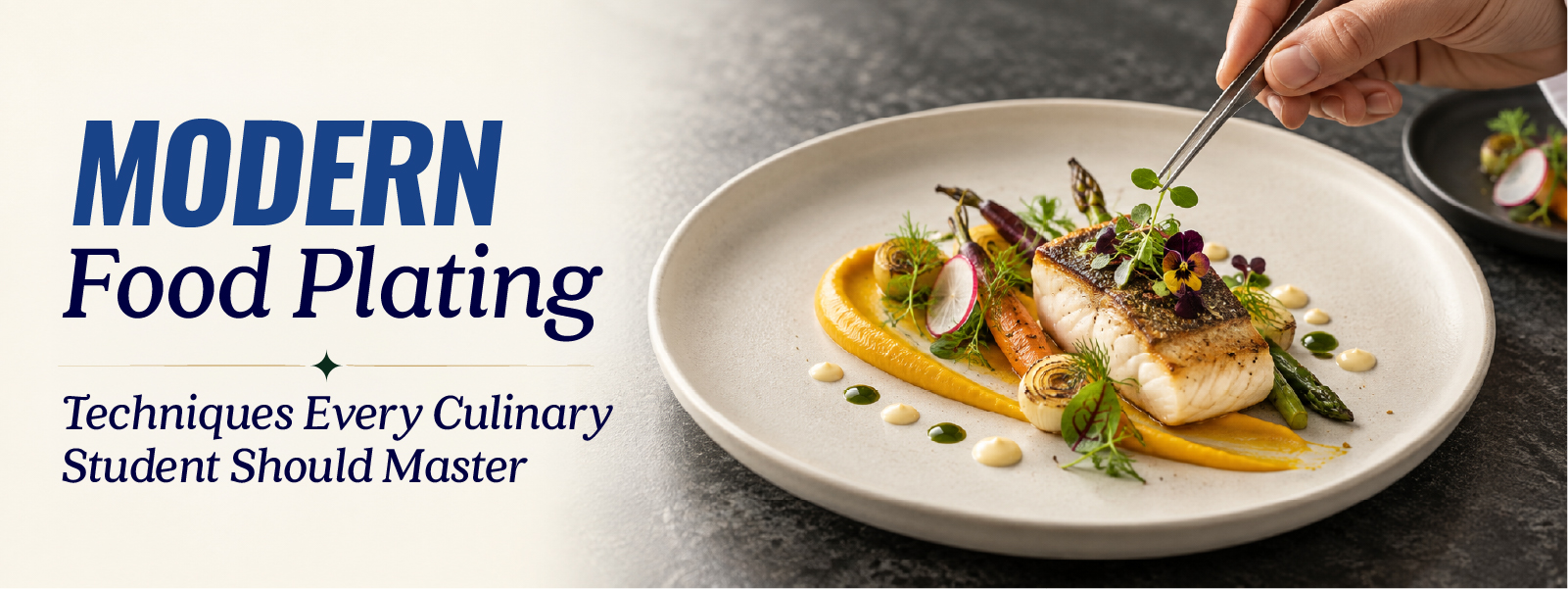
A well-cooked dish can still lose impact if it reaches the table without thoughtful presentation. For students pursuing a culinary arts course, food plating is an important practical skill because chefs are often expected to consider flavour, texture, portioning and appearance together.
Modern plating is not about covering a plate with decorations. It is about deciding where each component belongs, creating visual balance and making the dish easy to understand before the first bite. These skills can matter during practical assessments, chef trials, competitions and professional service.
When a plate leaves the kitchen, guests experience its appearance before they taste it.
The first visual impression can communicate the style of the restaurant, the type of cuisine and the chef's approach to the dish.
Plating can also influence practical aspects of service. A poorly arranged plate may make a sauce difficult to eat, cause delicate ingredients to collapse or allow hot and cold components to interfere with one another.
There is an important difference between adding decoration and actually plating a dish.
A decorative approach might add herbs, flowers or sauces simply because the plate looks empty.
Intentional plating asks different questions:
The goal is to make the presentation feel purposeful.
Before learning specific plating styles, students should understand basic composition.
Every plate needs a visual point of focus.
This does not necessarily mean placing the main ingredient exactly in the centre. Off-centre positioning can create a more dynamic composition while allowing supporting elements to guide attention towards the main component.
Balance is also important. If every element is placed on one side, the plate can feel visually heavy.
Negative space is the empty area around the food.
Leaving part of the plate clear can make the individual components easier to see. It can also prevent the presentation from feeling crowded.
Empty space should be intentional rather than simply indicating that the chef did not know what else to add.
The rule of thirds can provide a useful starting point for composition.
Instead of dividing the plate into equal sections, imagine it as a grid and position the main elements around the points where the lines intersect.
It is not a rigid rule. Professional plating often involves breaking traditional composition rules once the chef understands why the arrangement works.
Height can add dimension to a dish.
For example, carefully layered vegetables can provide structure around a main protein, while a crisp element may create height without making the plate unnecessarily tall.
Directional flow can also guide the eye across the plate. Curved sauces, arranged vegetables or repeated small elements can create movement.
The important point is stability. A plate should survive the journey from the pass to the table.
A plate becomes more interesting when its components provide contrast.
Colour should primarily come from the food itself.
Think about combinations such as:
Natural colour contrast can make a dish more appealing without relying on artificial decoration.
However, colour should also make culinary sense. Adding an unrelated ingredient simply because it is bright can make the dish feel disconnected.
Texture is just as important as colour.
A plate can combine:
For example, a smooth purée paired with a crisp vegetable element can provide contrast in both texture and appearance.
Plating therefore starts during menu development. If every component has the same texture, no amount of arrangement can completely solve the problem.
The plate is part of the presentation.
Round plates are versatile and work with many styles of presentation. Rectangular and irregular plates can create different visual structures but may be more suitable for specific dishes or service formats.
Size matters as well.
A plate that is too small can make the food appear crowded. One that is too large can make a properly portioned dish appear sparse.
White plates provide a neutral background and allow food colours to stand out.
Dark plates can create strong contrast with lighter foods, while coloured or patterned plates can contribute to the overall visual identity.
The choice should complement the dish rather than compete with it.
Different materials can create different impressions.
Ceramic is widely adaptable and suitable for many types of service. Slate can work for selected presentations, while wood may suit rustic or casual concepts.
Glass can be visually effective for particular desserts or presentations but needs careful handling and cleaning.
Always consider practicality. A plate may look impressive in a photograph but be unsuitable for hot food, high-volume service or comfortable eating.
There is no single correct way to plate every dish.
Classic plating usually gives the main protein a clear position, with sides and sauce arranged in a structured way.
This style can be particularly useful when clarity and portion identification are important.
Free-form plating gives the chef more freedom to arrange components organically.
It can work well for contemporary dishes where ingredients are intended to create a less formal appearance.
Landscape-style presentation treats the plate almost like a scene, arranging components across the surface rather than building everything around one central point.
This can work particularly well when the dish contains several complementary elements.
Here, one component partially covers another.
A crisp element may sit over a purée, or vegetables may partially conceal the main ingredient.
The technique can create visual curiosity while still allowing the guest to understand the dish.
Minimalist plating uses fewer elements and more negative space.
This style requires discipline. With fewer components, every element becomes more noticeable, so precision matters.
Sauce is one of the easiest elements to overuse.
A swoosh can create movement across a plate.
Small dots can add controlled repetition, while a smear can provide a clean base for another component.
These techniques should be applied with restraint. A sauce should contribute flavour as well as visual structure.
Controlled droplets can create precision when used with suitable sauces or gels.
Modern kitchens may also use gels, powders, foams, crumbs and other textures to add contrast.
A tuile can provide height and crispness.
A powder can introduce a concentrated flavour or contrasting texture.
Foams can add lightness, while micro herbs may provide freshness and colour.
The test should always be the same: does the element belong to the dish?
If removing it would make no difference to the flavour, texture or overall concept, it may simply be decoration.
Precision becomes easier with the right tools.
Common plating tools include:
Squeeze bottles allow chefs to control the amount and shape of sauces, purées and suitable gels.
Tweezers are useful when positioning delicate ingredients accurately without disturbing the rest of the plate.
Students should practise with these tools until movements become controlled rather than overly cautious.
Ring moulds can help create consistent shapes for suitable ingredients such as grains, salads or vegetable preparations.
A quenelle spoon can shape soft preparations into an elegant oval form. It takes practice because temperature, consistency and spoon movement all affect the result.
Indian food presents an interesting plating challenge because many traditional dishes are built around gravies, rice, breads and multiple accompaniments.
Modern presentation should not remove the identity of the cuisine.
A deconstructed presentation may separate components that are traditionally served together.
For example, elements associated with a familiar Indian preparation can be presented individually while retaining their key flavours.
The technique can be visually interesting, but the dish should remain recognisable and enjoyable to eat.
Gravies can be presented through controlled portions rather than spreading them across the entire plate.
A small pool of sauce, carefully placed garnish and neatly arranged main components can create structure while preserving the character of the dish.
The objective is not to make Indian food look European. It is to present familiar ingredients thoughtfully while respecting their culinary identity.
A plate that looks good in person may behave differently on camera.
Natural or diffused light can reveal colour and texture more effectively than harsh direct lighting.
The camera angle should suit the dish.
A top-down photograph can work well for dishes with strong overall composition, while a lower angle may better show height and layering.
Some colours appear differently under artificial lighting.
Fresh greens, glossy sauces and crisp textures can photograph strongly, but excessive shine can create distracting highlights.
Take test photographs when developing dishes for promotional content.
Restaurant plating and delivery presentation are not the same.
A delicate tower of ingredients may look attractive at the pass but collapse inside a takeaway container.
For delivery, consider:
The best takeaway presentation is one that still looks appetising when the customer opens the container.
Good plating is often about knowing what to leave out.
Adding more elements does not automatically make a dish look more sophisticated.
Too many components can make flavours difficult to distinguish and leave the presentation visually confused.
Temperature matters.
If a hot dish is served on a cold plate, the food can lose heat quickly. Plates should be handled according to the requirements of the dish and kitchen service.
A sauce mark or fingerprint on the rim can make an otherwise carefully prepared plate look unfinished.
Before the plate leaves the kitchen, check the rim and clean any unwanted marks.
A garnish should have a reason to be there.
Avoid adding ingredients simply because they are traditionally used as decoration. A garnish should ideally contribute flavour, aroma, texture or visual purpose.
Never use an ingredient that the guest is not expected to eat simply to fill empty space.
Plating improves through repetition.
Students taking culinary classes can practise by plating the same dish several different ways and comparing the results.
Try changing one variable at a time:
This exercise helps develop visual judgement rather than encouraging students to memorise fixed plating patterns.
For students pursuing a diploma in culinary arts, plating should be treated as part of the wider cooking process. The final presentation depends on preparation, portioning, cooking accuracy, sauce consistency and timing as much as it depends on arranging food on the plate.
Modern plating is best learnt through hands-on practice.
A student can read about negative space, quenelles and sauce techniques, but practical work reveals how quickly a sauce spreads, how a delicate garnish reacts to heat or how a plate changes once several components are added.
A structured culinary programme can provide opportunities to practise these skills alongside cooking techniques, kitchen discipline and service preparation.
At TGCA, practical culinary training gives students opportunities to work with professional kitchen techniques and develop their understanding of food presentation. For students considering chef courses, this type of hands-on practice can help them become more comfortable with the precision expected during practical assessments and professional kitchen service.
Modern food plating is not about making every dish look complicated.
The strongest presentations usually begin with a clear understanding of the food itself. Balance, negative space, colour, texture, portioning, plate selection and sauce control all work together to create a presentation that supports the dish.
Start with the fundamentals. Learn how to position the main component, create visual balance and use colour and texture naturally. Then practise more advanced techniques such as quenelles, gels, tuiles, controlled sauce work and contemporary Indian presentation.
Most importantly, remember that the plate should still make sense as food. Good plating attracts attention, but thoughtful plating makes the guest want to take the first bite.
The key principles include balance, focal point, negative space, colour contrast, texture, portion control and purposeful arrangement. Every element should contribute to the dish rather than simply decorate the plate.
Common tools include squeeze bottles, tweezers, ring moulds, offset spatulas, brushes, sieves, quenelle spoons and precision cutters. Each helps chefs control placement, shape and portioning.
Regular practice is the most effective approach. Students can plate the same dish in different ways, photograph each version and evaluate balance, spacing, colour, texture and practicality.
Modern techniques can be used with Indian cuisine as long as they respect the dish's ingredients, flavours and identity. Contemporary presentation should improve clarity and appeal without unnecessarily changing the character of the food.
Plating is commonly connected with practical culinary training because presentation forms part of professional food preparation. Students can practise composition, portioning, garnishing, sauce work and service presentation alongside cooking techniques.
Culinary Instructor
 Whatsapp
Click one of our representatives below to chat on WhatsApp or send us an email to
info@tedcoeducation.com

Counselor
Bakery and Pastry Courses
Counselor
Culinary Arts Courses
Click one of our representatives below to chat on WhatsApp or send us an email to
info@tedcoeducation.com
Counselor
Bakery and Pastry Courses
Counselor
Culinary Arts Courses

