When a student joins a culinary arts course, they expect to learn how to cook. What they do not expect, at least not at first, is that they are also signing up for one of the most effective life skills programmes available to any young person in India in 2026.
Parents often ask whether a culinary career is a serious, stable, and character-building path. The honest answer is that a professional kitchen is one of the most demanding, disciplined, and growth-oriented environments a young person can enter. It does not just teach you how to cook. It teaches you how to work, how to lead, how to manage pressure, and how to become the kind of professional that every industry, not just hospitality, genuinely values.
This blog is not just for students. It is for every parent who has wondered whether culinary training will actually prepare their child for real life. The answer is yes, and here is exactly why.
The professional kitchen is a genuinely unique environment. It is fast-paced, high-pressure, team-driven, and built on discipline and precision. Unlike most academic settings where the stakes of a mistake are low, in a professional kitchen, every decision has an immediate, visible consequence. That immediacy is what makes culinary education such a powerful character-builder. And it is why the culinary arts in India space is producing graduates that employers across industries describe as some of the most work-ready young professionals they hire.
A professional kitchen operates as a brigade. There is a clear hierarchy from the executive chef at the top to the commis chef at the entry level, with every role having specific responsibilities, accountabilities, and expectations. This is not unlike any other professional organisation, whether it is a law firm, a hospital, or a tech company.
What makes the kitchen unique is that this structure is experienced physically and in real time. There are no theory assignments about workplace hierarchy. You live it, every shift, every service. You learn what it means to respect authority, to take ownership of your role, and to contribute to a team goal under real pressure. These are lessons that most classroom environments take years to teach, if they teach them at all.
Students who complete a diploma in culinary arts consistently report that the discipline and professionalism they developed in their first year of training changed the way they approach everything in their lives. Not just cooking. Everything. The reason is simple: the consequences of professional habits in a kitchen are immediate and visible. You are either ready for service or you are not. You either meet the standard or you do not. That clarity accelerates growth in a way that few other environments can match.
Every culinary student learns the French phrase mise en place from their very first week. It means everything in its place, and it is the foundational philosophy of every professional kitchen in the world. Before service begins, every ingredient is prepped, measured, and ready. Every tool is in its designated spot. Every station is clean and organised.
Living this philosophy every single day does something to a person. It trains the brain to think ahead, to prepare thoroughly, and to operate from a state of readiness rather than reaction. Students who spend a year practising mise en place in a professional kitchen carry that habit into every other area of their lives. They are the people who show up prepared. They are the people who deliver on time. They are the people that employers notice immediately.
Every recipe in a professional kitchen has a standard. Not a suggestion, a standard. The sauce must be reduced to exactly this consistency. The tart shell must be blind-baked for exactly this long. The plating must follow exactly this arrangement. Deviating from the standard means a dish goes back to the kitchen or, worse, reaches a guest below standard.
This culture of precision is one of the most valuable professional habits a culinary arts course instils. Students learn that standards are not bureaucracy. They are the foundation of quality and trust. And once you have internalised that lesson in a kitchen, you carry it into every professional environment you enter for the rest of your career.
Leadership in a professional kitchen is not assigned in a classroom exercise. It is earned in real time through demonstrated competence, reliability, and the ability to support the people around you. A commis chef who consistently delivers quality work, communicates clearly, and helps their colleagues earns the trust and respect of senior chefs. That trust is how promotion happens in a kitchen.
By their second year, most culinary diploma graduates have already taken on some degree of supervisory responsibility, managing a section, training a newer colleague, or running a station independently during service. These are real leadership experiences, not simulated ones. And they build genuine confidence and capability that every employer immediately recognises.
A kitchen service is one of the highest-pressure team exercises in any professional environment. Fifteen to twenty people are working in a confined space, under heat and time pressure, producing dozens of different dishes simultaneously, all of which need to arrive at the pass at exactly the right moment in exactly the right condition.
That kind of coordination demands clear, direct communication. It demands that every person know their role and execute it reliably. It demands accountability, where if something goes wrong, you fix it, learn from it, and do not let it happen again. These are not soft skills. They are professional competencies that make culinary graduates extraordinarily effective team members and leaders in any industry.
There is no environment quite like a professional kitchen during a busy dinner service. Orders are coming in faster than they can be plated. The executive chef is calling out tickets. Timers are going off. Something has gone wrong at one station, and it needs to be fixed without disrupting the rest of the service.
Students who train in this environment through rigorous cooking courses in Delhi programme at a professional institute do not just learn to survive pressure. They learn to thrive under it. They develop the ability to stay calm, assess priorities rapidly, communicate clearly, and execute with precision even when everything around them is moving fast. This is one of the most sought-after professional qualities in any industry, and culinary training builds it more effectively than almost any other training environment.
Employers across hospitality, food brands, and even corporate settings consistently report that culinary graduates are among the most resilient and composed employees they hire. The reason is not that culinary training removes sensitivity to pressure. It is that it systematically exposes students to high-pressure situations until their response becomes confident and controlled rather than anxious and reactive. That is a transformation that takes most professionals years to achieve in other fields. Culinary training accelerates it significantly.
In a professional kitchen, time is not flexible. A three-course dinner service has a precise timeline. The starter must be ready when the table is seated. The main must be plated at the exact moment the starter plates are cleared. The dessert must be ready to follow immediately. Every component of every dish has a preparation window and a service window, and managing all of those simultaneously across multiple tables is a genuine cognitive challenge.
Students who spend a year managing these competing timelines develop an extraordinary ability to prioritise, plan, and execute multiple tasks in parallel without losing quality or losing their composure. This is time management in its most practical and immediate form, not a theory taught in a seminar but a skill built through hundreds of hours of real kitchen experience.
The time management skills developed in a professional kitchen are not kitchen-specific. They are universal. The ability to work under a deadline, manage multiple concurrent responsibilities, anticipate bottlenecks, and deliver consistently under time pressure is valuable in every professional environment. It is one of the reasons culinary graduates who transition into other industries, such as food brand management, event coordination, content creation, and entrepreneurship, are consistently described as high-performing, self-directed professionals.
A culinary arts course teaches creativity in the most direct way possible: by requiring students to solve real problems with real consequences. An ingredient runs out mid-service. A dish is not coming together as planned. A guest has a dietary restriction that was not communicated in advance. Each of these situations requires immediate creative problem-solving, and in a professional kitchen, there is no time to deliberate. You improvise, you adapt, and you deliver.
This kind of creative problem-solving under pressure is exactly what employers mean when they say they want innovative thinkers. Culinary graduates have it built in. It is not a personality trait they were born with. It is a skill they developed by solving real problems in real time, thousands of times over the course of their training.
The life skills from culinary training India produces extend well beyond the kitchen walls. Employers who hire from culinary programmes consistently rate graduates higher on initiative, adaptability, and problem-solving than equivalent candidates from more conventional academic backgrounds. The reason is simple: culinary training does not just give you knowledge. It gives you experience, and experience builds capability in a way that knowledge alone never can.
Among culinary arts colleges in India, TGCA is specifically designed to produce graduates who are complete professionals, not just technically skilled cooks. The commercial kitchen at Connaught Place replicates a real hotel brigade environment from day one. Small batch sizes mean every student is observed, corrected, and mentored individually. Faculty with real hotel and international kitchen experience bring professional standards and real-world expectations into every session.
The curriculum is built to develop discipline through daily mise en place practice, leadership through station ownership and peer mentoring, stress management through live service simulation, time management through multi-task kitchen sessions, and creativity through open recipe challenges and seasonal menu projects. These are not add-ons to the culinary curriculum. They are woven into it, because TGCA knows that the students who succeed in their careers are the ones who bring both technical skill and professional character to their first kitchen.
The feedback TGCA consistently receives from hotel partners, restaurant groups, and placement employers is that its graduates are noticeably different from graduates of other culinary programmes. They show up prepared. They communicate clearly. They handle pressure without losing quality. They take initiative. These are not accidental outcomes. They are the result of a training environment, a faculty, and a curriculum specifically built to produce the kind of culinary professional that India's food and hospitality industry genuinely needs in 2026. That is what a culinary education benefits beyond cooking looks like in practice.
A culinary arts course is not just about learning to cook. It is about becoming a professional. The discipline, leadership, stress management, time management, and creative problem-solving skills that a professional kitchen builds are exactly the skills that every employer in every industry is looking for. And the students who develop them through a year of rigorous, hands-on culinary training carry those skills with them for the rest of their careers, wherever those careers take them.
For students who love food and want a career that challenges, rewards, and develops them in every dimension, culinary training is one of the most complete professional development programmes available.
If you are a student who loves cooking and has been wondering whether a culinary arts course will prepare you for real professional life, the answer is a resounding yes. And if you are a parent who has been wondering the same thing about your child, the answer is the same.
TGCA's 2026 batches are open now. Join a culinary programme that builds more than just cooking skills. Book a free campus visit or demo class today.
Yes. Professional kitchen training systematically exposes students to high-pressure service environments until their response becomes calm and controlled. This stress resilience is built through hundreds of real kitchen sessions, not classroom theory.
A culinary diploma builds discipline through daily mise en place, leadership through kitchen hierarchy, teamwork through brigade service, and time management through multi-task cooking. These habits transfer directly to any professional environment.
Absolutely. Discipline, composure under pressure, time management, and creative problem-solving are universal professional qualities. Culinary graduates who move into food brands, events, media, or entrepreneurship consistently perform above average in their roles.
TGCA's small batch sizes, professional kitchen environment, City and Guilds accreditation, and faculty with real industry experience create a training environment that builds both technical skill and professional character simultaneously.
Yes, TGCA actively encourages parent and student campus visits before enrolment. Call 011-69240093 or visit tedcoeducation.com to book a free campus visit or demo class at any time.
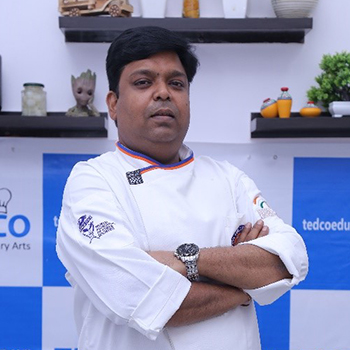
Centre Head & Head of Department
 Whatsapp
Click one of our representatives below to chat on WhatsApp or send us an email to
info@tedcoeducation.com

Counselor
Bakery and Pastry Courses
Counselor
Culinary Arts Courses
Click one of our representatives below to chat on WhatsApp or send us an email to
info@tedcoeducation.com
Counselor
Bakery and Pastry Courses
Counselor
Culinary Arts Courses

