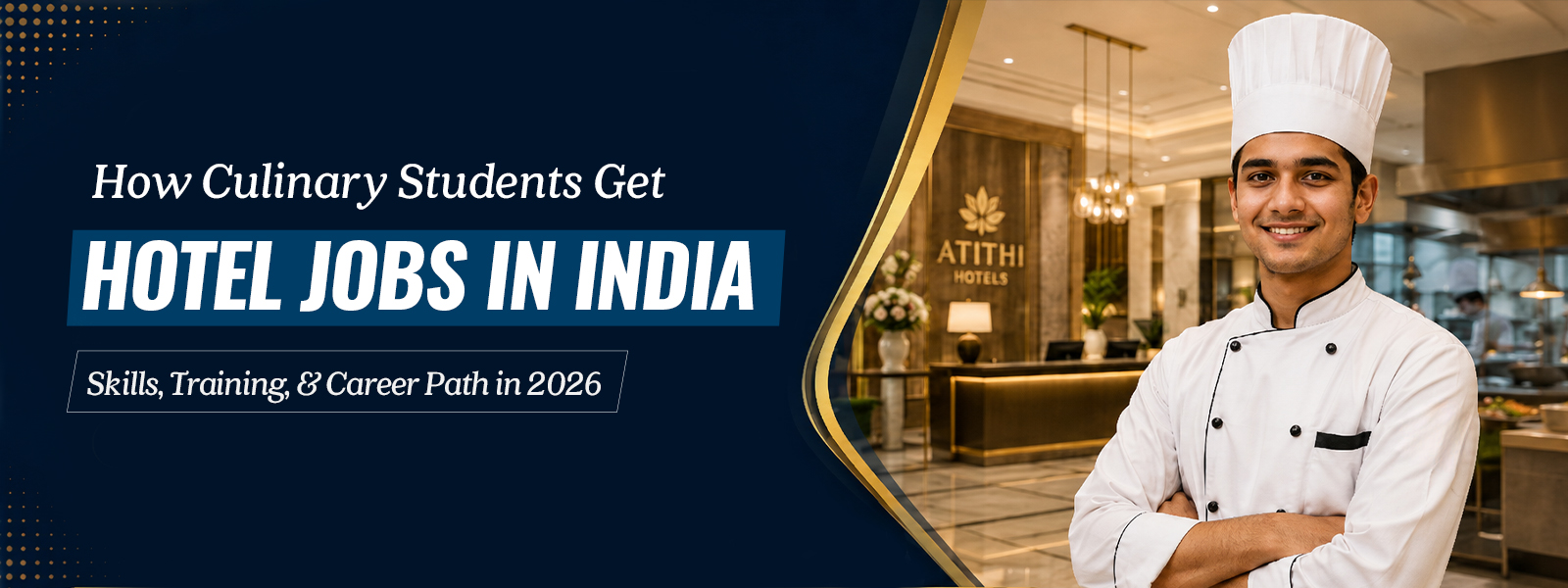
Before a parent agrees to invest in a culinary arts course, there is almost always one question that comes up: Will my child actually get a hotel job after this? It is a completely fair question and one that deserves a direct, honest answer.
The answer is yes, and the data backs it up. India's hospitality sector employs over 7.5 million people directly. Every major hotel chain in the country, from the Taj and Oberoi to Marriott, Hyatt, and ITC, has a continuous, year-round requirement for trained kitchen staff. The gap between demand and supply of formally trained culinary graduates is real and significant. That gap is good news for students who complete the right training at the right institute.
But the word right matters. Not every culinary course leads equally well to a hotel job. The institute you choose, the certification you earn, the skills you develop, and the placement support you receive all play a direct role in determining whether your culinary education translates into real employment at the hotels you want to work in.
This guide explains exactly what hotel HR teams and executive chefs look for in a culinary hire, what specific skills get students shortlisted, and how the complete journey from a culinary arts course to a hotel job works step by step. By the end of it, you will have a clear picture of what it takes and what you need to do to make it happen.
Hotel HR teams and executive chefs have a shortlist of non-negotiables that every culinary candidate must satisfy before they even get to the interview stage. Understanding these non-negotiables is the first step to making yourself a genuinely competitive candidate in the hotel jobs for culinary graduates in India 2026 market.
The most important non-negotiable is the certification level and the credibility of the institute that issued it. A City and Guilds (UK) Level 2 diploma from an accredited institute like TGCA tells a hotel HR manager immediately that the candidate has been trained to an internationally benchmarked professional standard. It reduces the risk of a bad hire and increases the confidence of the hiring team before the interview even begins.
The second non-negotiable is kitchen discipline. Executive chefs who interview culinary graduates are not just assessing technique. They are assessing whether the candidate has the professional habits, the punctuality, the cleanliness standards, and the composure under pressure that a hotel kitchen demands every single shift. These habits are built through training in a professional kitchen environment, not through theory.
The third non-negotiable is a foundational technique. Knife skills, stocks, sauces, and consistent plating are the foundation of every professional kitchen role. A candidate who cannot execute a perfect brunoise or a stable hollandaise is not ready for a hotel kitchen, regardless of how impressive the rest of their CV looks.
The typical hotel culinary hiring process in India involves a CV shortlisting stage, a practical kitchen assessment, and a personal interview. The practical assessment is where most candidates either secure the job or lose it. Candidates are typically asked to demonstrate knife skills, prepare a basic dish under timed conditions, and maintain a clean and organised station throughout. Hotels use this assessment to evaluate whether the candidate's training was genuinely hands-on and professionally standard, or superficial.
A hotel kitchen practical assessment does not care about your grades. It cares about whether you can perform under pressure with professional-grade tools in a real kitchen environment.
The technical skills that hotel kitchens consistently test and value in fresh culinary graduates can be summarised in five categories. Each one is developed through genuine hands-on training in a professional kitchen, which is why the quality of your training environment matters so much.
Knife Skills: Precision, speed, and safety across all standard cutting techniques, julienne, brunoise, chiffonade, and dicing. A chef who is fluent with a knife is a chef who is prepared for every station in a hotel kitchen.
Sauce Mastery: The five classical French mother sauces, Bechamel, Velouté, Espagnole, Hollandaise, and Tomato, are the foundation of hotel kitchen cooking. A graduate who understands these sauces from first principles is valued immediately by executive chefs.
Kitchen Hygiene: HACCP principles, allergen awareness, correct storage and temperature management, and personal hygiene standards are tested rigorously by hotels because they carry genuine food safety and legal implications.
Plating and Presentation: Hotel restaurants serve food to guests who are paying premium prices. Consistent, attractive, and standard-compliant plating is a non-negotiable expectation in any hotel kitchen role.
Station Management: The ability to set up, maintain, and break down a station efficiently within a team kitchen environment is assessed in the practical test and is a direct indicator of professional readiness.
This is why choosing the right diploma in culinary arts programme matters so much. Technical skills are not developed by watching videos or reading recipe books. They are developed by doing them hundreds of times in a real kitchen with professional-grade equipment, under the guidance of faculty who know the standard that hotels expect. Institutes that spend the majority of their curriculum time in the kitchen produce graduates who can perform in a hotel practical assessment. Institutes that prioritise theory produce graduates who cannot.
Every experienced executive chef will tell you the same thing: technical skill gets you the interview, but soft skills get you the job and keep you in it. The most technically gifted culinary graduate in the world will not last a week in a hotel kitchen if they cannot handle pressure, communicate clearly with their team, or show up consistently and reliably.
Punctuality is not just about arriving on time. It is about arriving prepared. In a hotel kitchen, arriving 10 minutes early for your shift to set up your station is the professional standard, not the exceptional one.
Composure under pressure is built through exposure to high-pressure kitchen environments during training. Students who have trained in a real brigade setting are significantly better at managing the pace and pressure of a hotel service.
Teamwork in a kitchen is non-negotiable. A hotel kitchen brigade operates as a cohesive unit. A chef who cannot communicate clearly, support their colleagues, and take direction without ego is a liability, not an asset.
Communication in a kitchen is direct, clear, and immediate. The ability to call out a ticket, communicate a problem to the chef, and relay information accurately during a busy service is a skill developed through real kitchen training.
The best culinary schools in India do not teach soft skills as a separate module. They build them through the structure of the training itself. The brigade environment, the live service simulations, the station management expectations, and the faculty mentorship of a professional culinary programme develop these qualities naturally and consistently over the course of a year. By the time a well-trained culinary graduate walks into a hotel kitchen interview, these behaviours are instinct, not performance.
Among the best culinary schools in Delhi, the ones that consistently produce graduates who land hotel jobs at the top tier share one characteristic: internationally recognised accreditation. City and Guilds (UK) accreditation is the credential that 5-star hotel HR teams in India specifically recognise and value. When a CV arrives with a City and Guilds Level 2 diploma from an accredited institute, it is processed differently from a CV with an unaccredited local certificate. The shortlisting rate is higher, the interview offer rate is higher, and the starting salary offer is higher.
This is not anecdotal. It is a pattern that repeats across every major hotel chain's hiring process in India. Taj, Oberoi, ITC, Marriott, Hyatt, and Accor all have kitchen recruitment teams that are familiar with culinary certifications and know exactly what City and Guilds represents.
Beyond accreditation, the practical quality of the training environment matters. A graduate who has trained in a commercial kitchen with professional-grade equipment is noticeably more confident and more capable in a hotel practical assessment than one who trained in a domestic kitchen setup. The culinary arts colleges in India that invest in real commercial kitchen environments produce graduates who perform better in these assessments because the tools, the pace, and the environment are familiar.
Placement networks matter too. An institute whose placement cell has active relationships with hotel HR teams can introduce graduates as credible candidates rather than cold applicants. That introduction makes a genuine difference to both the speed and the quality of the placement outcome.
The single most effective route to a first hotel job for a culinary graduate is a strong internship at a property that subsequently hires. Hotel kitchens assess interns throughout their placement. An intern who performs well, maintains professional standards, contributes positively to the kitchen team, and demonstrates genuine commitment is very frequently offered a position before their internship ends.
This is why how to get a hotel job after a culinary diploma in Delhi often comes down to one thing: the quality of your internship. Getting into the right property for your internship, working hard, being professional, and making yourself indispensable is the most reliable pathway to your first hotel offer. It is not a guarantee, but it is the closest thing to one in the culinary job market.
Graduates who have completed international internships occupy a separate and significantly more competitive tier in the hotel hiring market. When an executive chef sees that a fresh graduate has worked in a kitchen outside India, they immediately know this candidate has been exposed to international standards, has demonstrated the adaptability and professionalism needed to perform in a foreign kitchen environment, and has a global perspective that most domestic candidates cannot match. These graduates are consistently fast-tracked in the shortlisting and offer process at top hotel chains.
The pathway from a culinary course to a hotel job is straightforward when you understand each step and what it requires of you.
Step 1: Complete your diploma: Graduate with your City and Guilds Level 2 diploma and ensure your practical skills are at the professional standard your institute has prepared you for.
Step 2: Complete your internship: Use your institute's placement cell to secure an internship at a credible hotel or restaurant. Treat it as your extended audition for your first job offer.
Step 3: Build your culinary CV: A culinary CV is different from a general professional CV. It highlights your certification level, kitchen skills, internship property, and any specific techniques or cuisines you have trained in. TGCA's placement cell supports graduates in building effective culinary CVs.
Step 4: Clear the practical assessment: Most hotel kitchen interviews include a practical component. Know your knife skills, your sauces, your hygiene standards, and your plating technique cold. Practise them until they are automatic.
Step 5: Negotiate your joining terms and start: Once an offer is made, understand the package clearly, including basic salary, benefits, and any probation conditions. Then start strong. Your first 3 months in a hotel kitchen are the most important of your career.
Most hotel kitchen hiring processes in India involve three stages: a CV review and shortlisting by the HR team, a practical kitchen assessment overseen by the executive chef or a senior sous chef, and a brief personal interview covering your background, your training, and your career goals. The practical assessment carries the most weight. Students who have been trained in a real professional kitchen environment consistently perform better than those who have not.
India's major hotel chains all have active and ongoing requirements for trained culinary graduates at the entry level. Here is an overview of the top employers and the roles they typically offer fresh culinary graduates:
Taj Hotels and Resorts: One of India's most prestigious hotel groups, with properties across the country. Entry-level roles include Commis Chef positions in their various kitchen sections and bakery departments. Strong preference for City and Guilds-accredited candidates.
Oberoi Hotels and Resorts: Known for extremely high service and culinary standards. Entry-level kitchen roles are competitive but very well-regarded as career launching points. Practical assessment standards are among the most rigorous in the industry.
ITC Hotels: One of the largest hotel groups in India with a wide range of properties. Consistent requirement for culinary graduates across their luxury, premium, and midscale brands.
Marriott International brands in India, including JW Marriott, Westin, Sheraton, and Courtyard, all actively recruit from culinary institutes with recognised accreditation.
Hyatt and its brands, including Grand Hyatt, Hyatt Regency, and Park Hyatt, have significant operations across India and recruit trained culinary graduates year-round.
Job portals like LinkedIn, Naukri, and hospitality-specific platforms like Hospitality regularly carry listings for Commis Chef and Kitchen Trainee roles at top hotels across India. The most effective route, however, is through your institute's placement cell. An introduction from a trusted culinary institute carries significantly more weight than a cold application through a job portal.
Among the best culinary schools in Delhi, TGCA's placement support is one of the most active and structured. The placement cell maintains direct relationships with HR teams at leading 5-star hotel chains, restaurant groups, catering companies, and food brands across India. These are not passive job board postings. They are active, relationship-driven introductions that give TGCA graduates a genuine advantage in the hiring process.
The placement support at TGCA includes professional resume building workshops designed specifically for culinary roles, mock interview sessions that prepare students for both the personal interview and the practical kitchen assessment, and grooming and professional presentation guidance that helps graduates make the right first impression in a hotel interview.
The measure of any culinary institute's placement support is not what it promises but where its graduates actually end up. TGCA graduates are working today in the kitchens of India's leading hotel chains and restaurant groups, as well as in international kitchens across the Middle East, Europe, and on cruise lines. The combination of City and Guilds accreditation, genuine hands-on training, and active placement support is what makes the culinary arts course at TGCA consistently deliver employment outcomes that students and parents can rely on.
Getting a hotel job after a culinary course is not a matter of luck. It is the predictable outcome of making the right choices at every step of the journey. Choosing an accredited culinary arts course at a credible institute, developing strong technical and professional skills, completing a productive internship, and leveraging your institute's placement network are the four things that consistently separate culinary graduates who get hotel jobs from those who do not.
Every one of these factors is within your control. And every one of them is supported by what TGCA offers.
If a hotel kitchen career is your goal, the single most important decision you can make right now is choosing where to train. The diploma in culinary arts at TGCA gives you City and Guilds (UK) Level 2 certification, genuine commercial kitchen training, experienced faculty, an active placement cell, and an international internship programme for eligible students. Everything you need to walk into a hotel kitchen interview with the skills, the credentials, and the confidence to get the job.
2026 batches are open now. Book a free campus visit and see for yourself why TGCA graduates consistently land the hotel roles they are targeting. The job market is ready. Are you?
TGCA's City and Guilds-accredited programmes, active placement cell, and industry connections are designed to take you from 12th pass student to hotel kitchen professional. The 2026 batches are open now.
TGCA's Diploma in Culinary Arts, with City and Guilds (UK) accreditation, consistently delivers strong hotel placement outcomes. The combination of internationally recognised certification, hands-on training, and an active placement cell makes it the strongest option for hotel-focused career goals.
Yes, 5-star hotels actively recruit fresh culinary graduates for Commis Chef and Kitchen Trainee roles. Hotels prefer candidates from City and Guilds-accredited institutes and typically conduct a practical kitchen assessment before making an offer.
Fresh culinary graduates at 5-star hotel chains in India typically start at Rs 18,000 to Rs 28,000 per month. Graduates from City and Guilds-accredited institutes like TGCA tend to receive stronger starting offers than candidates from non-accredited programmes.
Most TGCA diploma graduates receive their first hotel placement within 1 to 3 months of graduation, thanks to the placement cell's active industry connections. Students who complete strong internships at hotel properties often receive job offers before their diplomas even conclude.
Yes. TGCA's placement cell maintains active partnerships with leading hotel chains, restaurant groups, and food brands. It provides resume building, mock interviews, grooming support, and direct introductions to HR teams at partner establishments across India.
Bakery & Pastry Specialist
 Whatsapp
Click one of our representatives below to chat on WhatsApp or send us an email to
info@tedcoeducation.com

Counselor
Bakery and Pastry Courses
Counselor
Culinary Arts Courses
Click one of our representatives below to chat on WhatsApp or send us an email to
info@tedcoeducation.com
Counselor
Bakery and Pastry Courses
Counselor
Culinary Arts Courses

