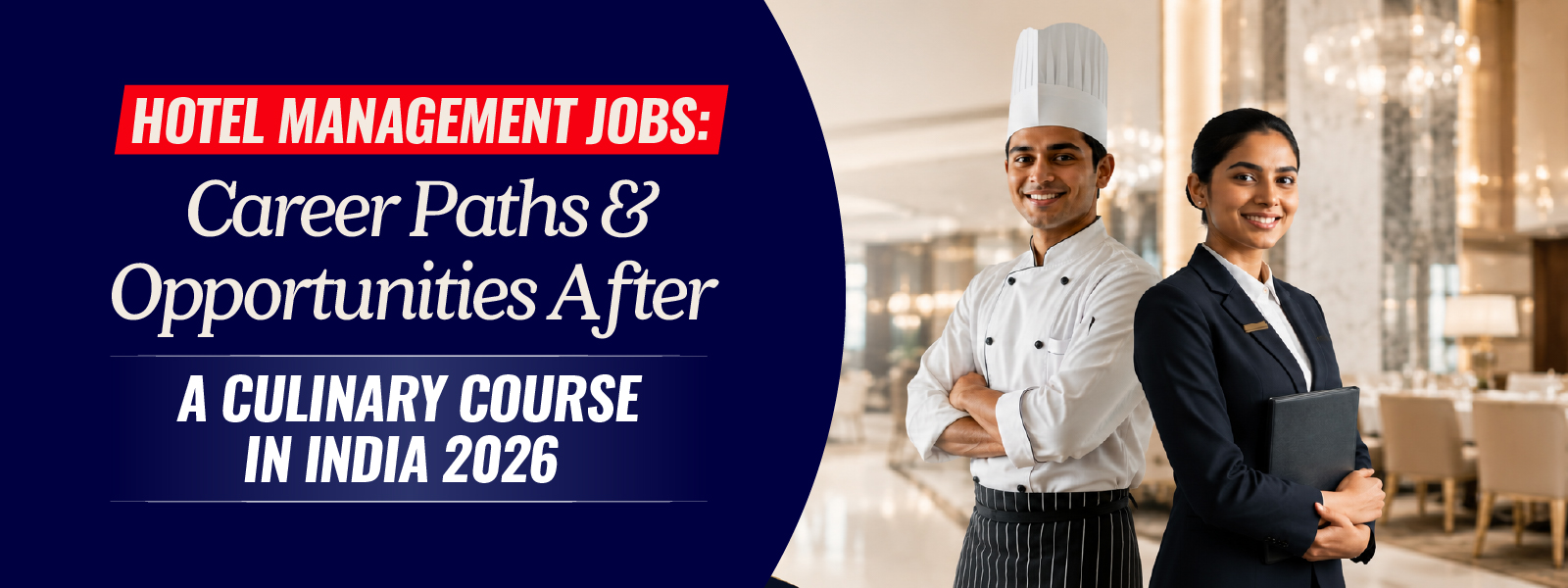

For students completing a Diploma in Culinary Arts or a Diploma in Bakery and Pastry Arts, hotel management jobs represent the most structured, most prestigious, and in many cases the highest-paying career path available. India's hotel and hospitality industry is home to some of the most professionally demanding and personally rewarding kitchens in the world. In 2026, the demand for trained, certified culinary graduates to fill those kitchens has never been stronger.
But hotel management careers in the culinary space are more varied than most students realise. They are not just about cooking at a station. They encompass a progression from entry-level kitchen roles to executive chef positions with P&L responsibility, menu ownership, and team leadership at scale. This guide maps that entire progression: the roles, the salaries, the skills required, and how the right training at the start of your career shapes how fast you move through it.
This guide gives you a complete, honest picture of hotel management jobs and career paths available to culinary graduates in India in 2026. It covers the key entry-level roles in hotel kitchens, the career progression from Commis Chef to Executive Chef, the salary expectations at each stage, the top hotel chains actively hiring culinary graduates, the skills that accelerate promotion, and how TGCA's training specifically prepares graduates for the hotel management career trajectory.
This guide focuses specifically on kitchen-side hotel management careers. For front-of-house, F&B management, and hotel operations roles, a broader hospitality management programme is typically more directly aligned.
The hotel management career landscape in India in 2026 is defined by one overriding reality: demand for trained culinary professionals significantly outpaces supply. India's hotel and hospitality sector is valued at over Rs 2 lakh crore and growing at 8 to 10 percent annually. New hotel properties from global chains like Marriott, Hyatt, Accor, and IHG are opening across Tier 1 and Tier 2 cities at a pace that requires substantial and continuous culinary hiring. The branded hotel sector in India is expected to add over 50,000 rooms by 2028, each new property requiring a fully staffed kitchen brigade from day one.
This growth translates directly into opportunity for culinary graduates. The structured career ladder within a hotel kitchen, from Commis Chef to Chef de Partie to Sous Chef to Head Chef and Executive Chef, is one of the clearest, most merit-based progression systems in any professional field. Performance determines promotion, and trained graduates from accredited institutes consistently outperform and outpace those from non-accredited or informal backgrounds.
Not all culinary qualifications are treated equally by hotel HR teams. The City and Guilds (UK) certification from an accredited institute like TGCA is specifically recognised by the HR and kitchen management teams at India's leading 5-star hotel groups. When a TGCA graduate applies for a hotel management job after a culinary course role, their application is processed differently from one with a local or non-accredited certificate. The shortlisting rate is higher, the interview invitation rate is higher, and the starting offer is typically stronger. This difference compounds significantly over a career because a stronger first role leads to faster promotion and a higher salary ceiling.
For culinary graduates in India, entry-level hotel management jobs in the kitchen typically fall into four categories:
Commis Chef: the starting point for most culinary diploma graduates in hotel kitchens. A Commis Chef works within a specific section of the kitchen, learning from and supporting the Chef de Partie above them. Responsibilities include mise en place preparation, executing specific dishes to recipe standard, maintaining station cleanliness, and developing speed and consistency under service conditions. Starting salary range: Rs 15,000 to Rs 28,000 per month at 5-star properties.
Kitchen Trainee: a structured training role offered by some hotel chains as a formal graduate entry programme. Kitchen Trainees rotate through different sections of the kitchen over a fixed period, building a broad understanding of the full kitchen operation before settling into a specific role. Starting salary range: Rs 12,000 to Rs 20,000 per month with structured training and progression milestones.
Bakery Trainee or Commis Pastry Chef: for graduates specialising in bakery and pastry arts, hotel pastry sections actively recruit at Commis Pastry Chef level. This role is focused entirely on the pastry, bakery, and dessert sections of the hotel kitchen, covering breakfast pastries, dessert menus, banquet cakes, and afternoon tea service. Starting salary range: Rs 15,000 to Rs 25,000 per month at 5-star properties.
Garde Manger Commis: responsible for cold kitchen preparation, salads, charcuterie, and cold buffet presentations. A useful early role for culinary graduates who want broad kitchen exposure before specialising in a hot section.
Hotel HR teams and executive chefs evaluating candidates for hotel management job roles at entry level consistently prioritise four things: first, the accreditation level and credibility of the culinary institute. Second, the quality of the practical assessment, which typically involves a knife skills demonstration, basic dish preparation, and an assessment of kitchen hygiene and station management. Third, the candidate's internship experience, particularly whether they have worked in a credible property during their training. Fourth, professional presentation, punctuality, and communication are the soft skills that signal whether a candidate will fit into and contribute positively to a kitchen brigade.
One of the most compelling aspects of a hotel management career through the kitchen route is how clearly defined and merit-based the progression is. A graduate from a Professional Chef Course at an accredited institute who performs well at Commis level will typically progress through the following stages:
Commis Chef (0 to 2 years): entry level, focused on learning fundamentals and executing tasks under supervision. The most important phase for building speed, consistency, and kitchen discipline.
Chef de Partie (2 to 5 years): section ownership, running a specific kitchen section independently during service. Significant step up in responsibility and the first leadership role in the brigade. Salary range: Rs 28,000 to Rs 55,000 per month at 5-star properties.
Sous Chef (5 to 8 years): second in command of the kitchen, coordinating across multiple sections, managing the brigade during service, and supporting the Head Chef. The most significant career milestone in the first decade. Salary range: Rs 60,000 to Rs 1,20,000 per month.
Head Chef or Executive Sous Chef (8 to 12 years): leading the kitchen day-to-day, menu ownership, staffing, and quality standards. Often responsible for a single outlet within a larger hotel. Salary range: Rs 1,00,000 to Rs 2,50,000 per month.
Executive Chef (12 plus years): overall responsibility for the culinary operation across all outlets of a hotel or hotel group. Menu strategy, budget management, team leadership, and brand standards are all within the Executive Chef's remit. Salary range: Rs 2,00,000 to Rs 5,00,000 per month and above at leading 5-star properties.
The career paths in hotel management in India are more meritocratic than most professional fields. Performance, not tenure, drives promotion. The factors that accelerate progression consistently are: the quality and accreditation level of your initial training, the strength of your internship property, the technical depth of your skills, particularly your fundamentals, your composure under service pressure, and your ability to take initiative and contribute beyond your immediate role. Graduates from City and Guilds-accredited institutes like TGCA consistently reach Chef de Partie and Sous Chef milestones faster than graduates from non-accredited backgrounds, because they arrive better prepared and are trusted with more responsibility sooner.
Understanding hotel management salary expectations at each career stage helps you plan your trajectory realistically and negotiate your positions confidently:
Commis Chef, 5-star hotel: Rs 15,000 to Rs 28,000 per month. Additional benefits typically include meals during shifts, uniform provision, and access to hotel staff facilities.
Chef de Partie, 5-star hotel: Rs 28,000 to Rs 55,000 per month. At this level, performance bonuses, departmental incentives, and accelerated progression to Sous Chef are common.
Sous Chef, 5-star hotel: Rs 60,000 to Rs 1,20,000 per month. A substantial jump that reflects the leadership responsibility of this role and its direct impact on the kitchen's output quality.
Head Chef or Executive Sous Chef: Rs 1,00,000 to Rs 2,50,000 per month. At this level, compensation packages increasingly include health insurance, accommodation allowances, and performance bonuses.
Executive Chef: Rs 2,00,000 to Rs 5,00,000 per month and above at leading properties. Executive Chefs at iconic Indian luxury hotel brands earn at the higher end of this range and beyond.
The hotel management job opportunities in India picture becomes even more attractive when international dimensions are included. A culinary graduate from a City and Guilds-accredited institute who secures an international internship and then joins an international hotel chain's global mobility programme can access salary levels that are completely different from domestic-only career trajectories. Chefs working in Middle Eastern luxury hotels, on cruise ships, or in European hospitality properties earn in ranges that can be 3 to 5 times equivalent domestic roles, with free accommodation, flights, and comprehensive benefits that make the total package genuinely exceptional.
India's leading hotel groups and international chains operating in India all maintain active and ongoing requirements for trained culinary graduates. The most consistent employers of culinary diploma graduates in India include:
Tedco Education's placement cell at TGCA maintains active relationships with HR teams at leading hotel groups across India. These relationships go beyond passive job board postings. They involve direct introductions, pre-screening support for hotel interviews, and ongoing alumni connections that give TGCA graduates a meaningful advantage in the hotel recruitment process. Graduates who complete TGCA's hotel management jobs preparation through the placement cell, including resume-building workshops, mock interview sessions, and practical assessment preparation, consistently receive stronger first offers and faster initial placements than those who approach hotel recruitment independently.
The careers in hospitality that progress fastest are built on an exceptionally strong technical foundation in the first two years. The specific technical skills that hotel executive chefs consistently cite as differentiators in early-career culinary graduates are:
Technical skill gets you shortlisted. Soft skills get you promoted. The most frequently cited promotion drivers by hotel HR and executive chef teams across India are: consistent punctuality and preparedness, composure and quality maintenance under service pressure, communication clarity within the brigade, willingness to take initiative beyond your immediate role, and the ability to train and support junior colleagues. These are not personality traits. They are professional habits that professional kitchen training builds systematically, which is why the quality of your culinary training programme has a direct and measurable impact on your hotel career trajectory.
The chef who gets promoted is not always the most technically gifted one in the kitchen. It is the one who shows up prepared, performs consistently, and makes the people around them better.
Tedco Education's TGCA is specifically designed to produce graduates who are ready for hotel management careers from day one of their first role. Every element of the programme maps directly to what hotel kitchens expect:
The consistent pattern for TGCA graduates entering hotel kitchens is a faster-than-average progression through the early career stages. City and Guilds accreditation, strong fundamentals built in a professional kitchen environment, and real internship experience combine to create graduates who are trusted with more responsibility earlier than peers from less structured training backgrounds. Graduates who completed hotel management jobs after culinary course preparation at TGCA report reaching Chef de Partie level between 2 and 4 years, compared to the industry average of 3 to 5 years, a difference that compounds significantly in salary and career opportunity terms over the first decade.
The hotel management jobs and career paths available to culinary graduates in India in 2026 are among the most structured, merit-based, and internationally scalable in any professional field. From Commis Chef entry at Rs 15,000 to Rs 28,000 per month to Executive Chef positions earning Rs 5,00,000 per month and above, the salary progression is real, and the international opportunities are genuinely accessible for graduates from City and Guilds accredited institutes.
The career is demanding. The standards are high. The progression requires genuine technical skill, professional discipline, and the composure to perform consistently under pressure. But for students who love food and are willing to invest seriously in their training, the hotel kitchen career path offers one of the most complete combinations of craft, leadership, income, and international opportunity available from a professional starting point after 12th.
Every Executive Chef in a 5-star hotel in India started as a Commis Chef. Every Head Pastry Chef started as a Commis Pastry Chef. The starting point matters enormously, because the training you receive, the institute you attend, the internship you complete, and the first role you land all set the trajectory for everything that follows. Tedco Education's TGCA gives you the strongest possible starting point: City and Guilds accreditation, commercial kitchen training, real internship placements, and active placement support. 2026 batches are open now. Book a free campus visit and start building your hotel management career today.
TGCA's City and Guilds-accredited Diploma in Culinary Arts and Diploma in Bakery and Pastry Arts are the strongest foundations for a hotel management career in India. 2026 batches are open now.
Culinary diploma graduates in India can enter hotel kitchens as Commis Chef, Kitchen Trainee, Commis Pastry Chef, or Garde Manger Commis. These entry-level roles lead to Chef de Partie, Sous Chef, Head Chef, and Executive Chef through a structured, merit-based progression over 8 to 15 years.
Entry-level Commis Chef roles at 5-star hotels in India pay Rs 15,000 to Rs 28,000 per month. Chef de Partie roles pay Rs 28,000 to Rs 55,000. Sous Chef roles pay Rs 60,000 to Rs 1,20,000. Executive Chefs at leading properties earn Rs 2,00,000 to Rs 5,00,000 per month.
Taj, Oberoi, ITC, Marriott International brands, Hyatt, AccorHotels, Hilton, and IHG all actively recruit culinary diploma graduates in India. These groups specifically value City and Guilds accreditation from institutes like TGCA in their kitchen graduate shortlisting processes.
Typically, 10 to 15 years, moving from Commis Chef through Chef de Partie and Sous Chef to Head Chef level. Graduates from City and Guilds accredited programmes with strong internship experience consistently achieve each milestone faster than the industry average.
Yes. TGCA's active placement cell maintains direct relationships with hotel HR teams across India. Support includes resume workshops, mock interview preparation, practical assessment coaching, and direct introductions to hotel recruitment teams for diploma and certificate graduates.
Culinary Instructor
 Whatsapp
Click one of our representatives below to chat on WhatsApp or send us an email to
info@tedcoeducation.com

Counselor
Bakery and Pastry Courses
Counselor
Culinary Arts Courses
Click one of our representatives below to chat on WhatsApp or send us an email to
info@tedcoeducation.com
Counselor
Bakery and Pastry Courses
Counselor
Culinary Arts Courses

