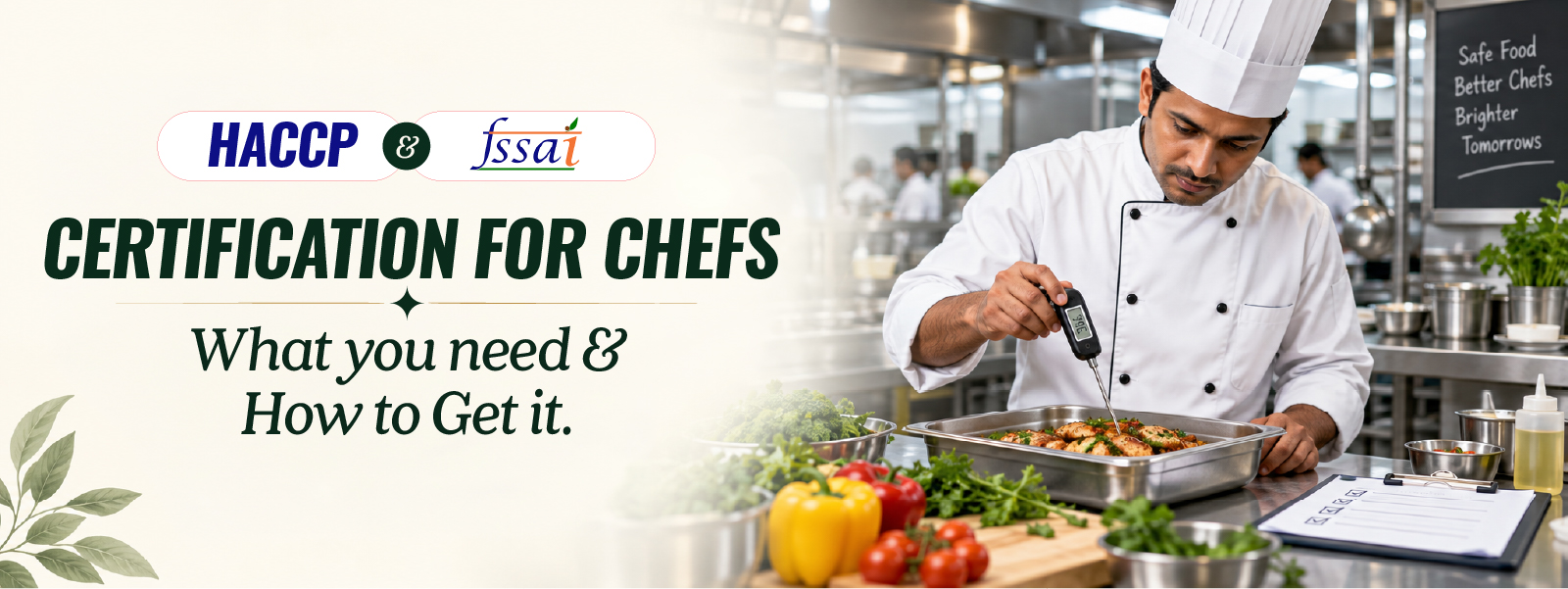
Food safety is part of everyday professional cooking, not a separate responsibility handled only by the management team. If you are considering chef courses, a professional chef course or culinary classes, understanding HACCP, FSSAI requirements and food safety training can help you prepare for the expectations of a commercial kitchen.
But there is an important distinction. FSSAI registration or licensing applies to food businesses, while FoSTaC provides food safety training and certification for food safety supervisors. HACCP is a systematic approach to identifying and controlling food safety hazards. They are connected, but they are not interchangeable certificates.
For chefs, bakers, caterers and future food entrepreneurs, knowing how these systems work can make food safety much more practical.
HACCP stands for Hazard Analysis and Critical Control Point. It is a preventive food safety system designed to identify hazards and control them at points where food safety could be compromised.
Rather than relying only on testing the finished food, HACCP focuses on controlling hazards throughout the food process. FSSAI guidance describes HACCP as part of a broader food safety management system and emphasises prerequisite programmes such as good hygiene and manufacturing practices.
The seven principles provide a structured way of managing food safety:
FSSAI's food safety guidance identifies these seven principles as the foundation of HACCP implementation.
Consider a kitchen preparing cooked food for service.
Potential controls may relate to cooking, cooling, storage or another stage where a food safety hazard needs to be controlled. The exact critical control points depend on the food, process and operation. HACCP should therefore be developed around the actual process rather than copied as a generic checklist.
For a chef, this means understanding why a particular control exists instead of simply recording a number on a form.
The Food Safety and Standards Authority of India (FSSAI) is India's statutory food safety regulator.
Its framework covers food safety standards and requirements applicable to food businesses. FSSAI also provides sector-specific guidance and inspection resources covering areas such as hygiene, food handling and food safety management.
A common misunderstanding is that every chef needs an individual FSSAI licence.
That is not how the system works.
FSSAI registration and licensing apply to Food Business Operators (FBOs). The category applicable to a business depends on factors such as the nature and scale of the food operation.
A chef working for a hotel or restaurant does not normally obtain an FSSAI business licence personally simply because they are a chef. The food business itself is responsible for complying with the applicable licensing and food safety requirements.
This distinction is important for students entering the industry.
If you are researching food safety certification for chefs in India, you are likely to come across FoSTaC, which stands for Food Safety Training and Certification.
FoSTaC is an FSSAI training programme for food business operators and food safety personnel. FSSAI states that food businesses holding Central or State Licences should have at least one trained and certified food safety supervisor for every 25 food handlers or part thereof at their premises.
A food safety supervisor helps the food business maintain appropriate food safety practices.
Depending on the operation, responsibilities can involve:
The role is therefore broader than simply knowing how to cook safely.
FSSAI states that FoSTaC includes courses at Basic, Advanced and Special levels. The appropriate course depends on the person's role and the food sector involved.
The published FoSTaC fee structure also shows different categories, including basic, advanced and sector-specific courses, with different durations and fee limits. For example, the published 2024 fee schedule lists basic courses at four hours and advanced and sector-specific courses generally at eight hours, subject to the specific course.
Because FoSTaC course offerings, fees and programme details can change, candidates should check the current FSSAI FoSTaC portal before enrolling.
The phrase "HACCP certified chef" can sometimes create confusion.
HACCP is primarily a system used by a food business, rather than a universal personal licence that every chef must hold.
An individual can undertake HACCP-related training to understand hazard analysis, critical control points, monitoring, corrective actions and documentation. A business can then implement an appropriate HACCP-based food safety system.
These are different things.
Individual training gives a person knowledge of HACCP principles and their application.
Facility or business certification relates to an organisation's food safety management system and whether it meets the requirements of the relevant certification standard or scheme.
Therefore, if a job advertisement asks for HACCP knowledge or training, check exactly what the employer means before paying for a course.
A useful HACCP training programme should provide an understanding of:
FSSAI's guidance makes clear that HACCP does not operate effectively in isolation. Good hygiene practices and other prerequisite controls need to be established as part of the broader food safety system.
HACCP and FoSTaC are not the only food safety training or management systems you may encounter.
ISO 22000 is an international standard for food safety management systems. It incorporates HACCP principles within a broader management framework.
For an individual chef, the relevance of ISO 22000 will depend on the employer and role. For food businesses, food manufacturers and larger operations, knowledge of food safety management systems can be particularly useful.
Many employers also provide or require food hygiene training covering practical areas such as:
FSSAI's food handler guidance covers these areas as part of safe food handling practices.
Food safety knowledge can become increasingly relevant as your responsibilities grow.
An entry-level chef may mainly need to demonstrate that they understand safe food handling and follow the kitchen's procedures. Someone moving into supervision may take greater responsibility for monitoring compliance and maintaining records.
Roles where food safety responsibilities may become particularly relevant include:
However, certification should not be treated as a guarantee of employment or a particular salary. Employers consider many factors, including culinary skills, experience, communication, operational knowledge and the requirements of the specific role.
For international or cruise-related opportunities, employers may also specify their own food safety qualifications or training requirements. Always check the requirements of the particular employer rather than assuming that one certificate is accepted everywhere.
Food safety becomes meaningful when it is applied consistently during daily operations.
When food arrives, staff may need to check factors such as condition, packaging, storage requirements and temperature where applicable.
Problems should be identified and handled according to the business's food safety procedures.
A professional kitchen needs an organised storage system.
Labels and records can help staff identify products and manage stock appropriately. Raw and ready-to-eat foods also need appropriate separation to reduce contamination risks.
Records may cover areas such as:
The exact records required depend on the operation and its food safety system.
Documentation is not paperwork for its own sake. It provides evidence that controls are being followed and helps management identify recurring problems.
Even a well-designed food safety system can fail if staff do not follow it consistently.
A kitchen may have excellent procedures but weak documentation.
Missing temperature records, incomplete cleaning schedules or unrecorded corrective actions can make it difficult to demonstrate that controls are being maintained.
Food safety cannot depend entirely on one supervisor.
Everyone handling food should understand the procedures relevant to their work. FSSAI guidance emphasises the importance of appropriate HACCP knowledge and skills among management and employees.
Improper storage or uncontrolled temperature changes can compromise food safety.
Staff need to understand the storage requirements for the foods they handle and follow the kitchen's monitoring procedures.
Unclear or missing labels can create confusion about what a product is, when it was prepared or how it should be stored.
Simple, consistent labelling procedures can help prevent avoidable mistakes.
Food safety should not be treated as a topic students memorise for an examination and forget afterwards.
Students taking culinary arts courses in India need to understand how hygiene, safe food handling, storage, cleaning and kitchen discipline fit into everyday cooking.
A professional chef course can introduce these principles alongside practical food preparation. The aim is to develop habits that become part of normal kitchen work, from keeping a workstation clean to handling ingredients correctly and following established food safety procedures.
At TGCA, food safety and hygiene form part of the practical learning environment for culinary and bakery students. This helps students understand that professional cooking involves more than technique and presentation. Safe preparation, organised workstations and disciplined kitchen practices are fundamental to producing food for customers.
HACCP, FSSAI and FoSTaC serve related but different purposes.
FSSAI registration and licensing apply to food businesses. FoSTaC provides structured food safety training and certification for food safety personnel. HACCP provides a systematic approach to identifying and controlling food safety hazards.
For a chef, the most useful approach is to understand how these systems translate into daily kitchen practices.
If you are still studying, start with the fundamentals: personal hygiene, cross-contamination prevention, safe storage, cleaning, temperature control and proper food handling. As your career develops, you can consider additional food safety training based on your role and employer's requirements.
Good chefs do more than produce food that tastes good. They understand how to prepare it safely, consistently and responsibly.
Generally, FSSAI registration or licensing applies to the food business rather than an individual chef. The business must hold the appropriate registration or licence according to its applicable category and requirements.
No. HACCP is a systematic food safety approach based on hazard analysis and critical control points. FoSTaC is an FSSAI food safety training and certification programme for food safety personnel.
Not every chef individually needs a FoSTaC certificate. FSSAI states that food businesses with Central or State Licences should have at least one trained and certified food safety supervisor for every 25 food handlers or part thereof on their premises.
The duration depends on the course category. FSSAI's published fee schedule lists basic courses at four hours and advanced and sector-specific courses generally at eight hours, although candidates should check the current FoSTaC listing for the specific course.
HACCP knowledge helps students understand how professional kitchens identify and control food safety hazards. It also provides useful context for hygiene, monitoring, documentation and safe food handling as they enter commercial kitchens.
Pastry Instructor
 Whatsapp
Click one of our representatives below to chat on WhatsApp or send us an email to
info@tedcoeducation.com

Counselor
Bakery and Pastry Courses
Counselor
Culinary Arts Courses
Click one of our representatives below to chat on WhatsApp or send us an email to
info@tedcoeducation.com
Counselor
Bakery and Pastry Courses
Counselor
Culinary Arts Courses

