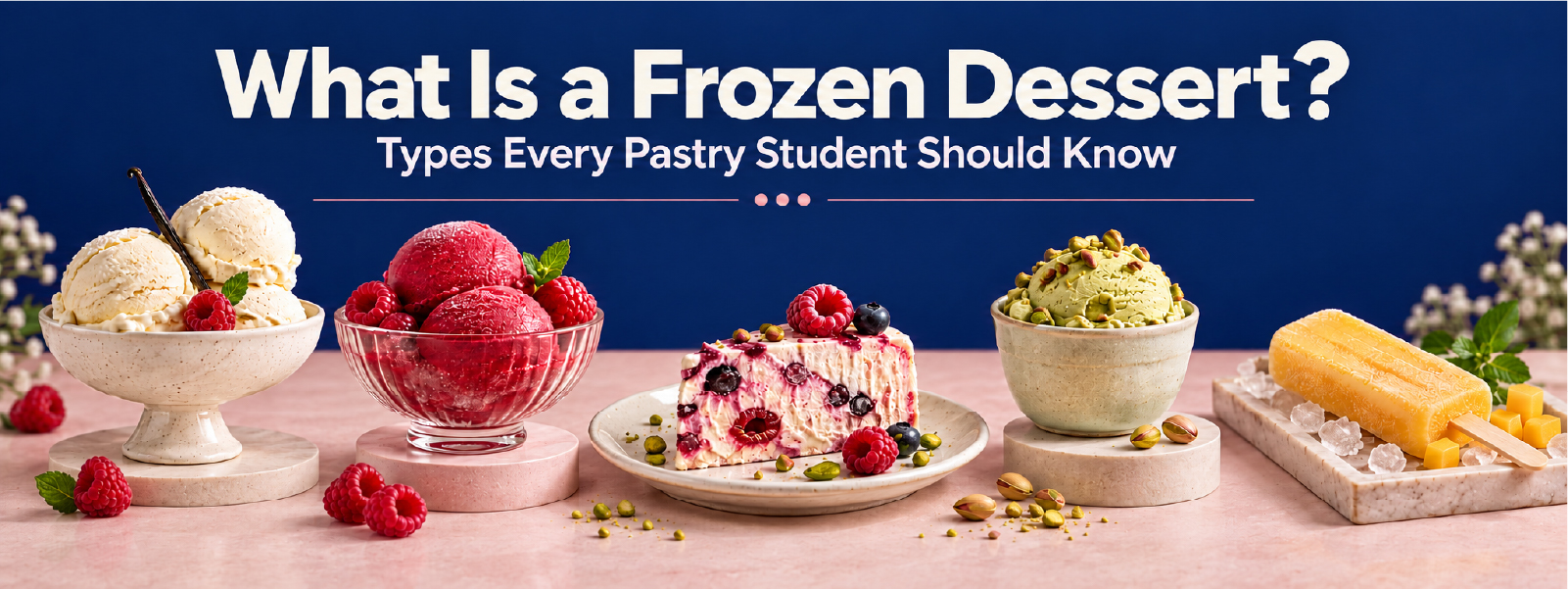
A cold dessert can look simple on the plate, but producing the right texture, flavour and stability requires considerable pastry knowledge. If you are considering a Professional Baking Course, understanding frozen desserts is useful because the category covers much more than conventional ice cream.
From gelato and sorbet to kulfi, semifreddo and frozen mousse, each product uses different ingredients, freezing methods and serving techniques. For pastry students, learning how these systems work helps build a stronger understanding of temperature control, texture and dessert presentation.
But first, there is an important distinction to understand: frozen dessert and ice cream are not automatically the same product under Indian food standards.
The terms are sometimes used interchangeably in everyday conversation, but FSSAI has separate standards for ice cream and frozen dessert.
Under FSSAI's food standards, a frozen dessert or frozen confection is produced by freezing a pasteurised mix prepared with edible vegetable oils or fats and/or vegetable protein products. The formulation may also contain milk fat, milk solids, sweeteners and permitted non-dairy ingredients.
This is different from ice cream, which is defined separately under the food standards for frozen milk products.
FSSAI has specifically clarified that both ice cream and frozen dessert are permitted food products when they meet the applicable standards.
The name reflects the product's formulation.
The distinction can affect:
For a pastry student, this is useful knowledge because understanding the base formula helps explain why two frozen products can have noticeably different melting behaviour and mouthfeel.
Churning is an important technique in frozen dessert production because it helps incorporate air while the mixture freezes.
Ice cream is made from a pasteurised mix based on milk or milk-derived ingredients, together with permitted sweeteners and other ingredients.
The final texture depends on factors such as the formulation, freezing process, air incorporation and storage conditions.
A pastry student should understand that producing smooth ice cream requires control over the entire process rather than simply freezing a liquid mixture.
Gelato is generally associated with a dense, smooth texture and relatively lower incorporation of air compared with many commercial ice creams.
Its texture is strongly influenced by the balance of dairy ingredients, sugars, solids and freezing conditions.
Because gelato is typically served at a different temperature from hard-frozen products, serving conditions also influence its texture and flavour perception.
Frozen custard uses a custard-style base containing egg yolks in addition to dairy ingredients and sweeteners.
The yolks contribute richness and emulsification, creating a characteristic dense texture.
Temperature control is particularly important when preparing the custard base because eggs require careful handling during heating.
Sorbet is generally made from fruit, water and sugar rather than a dairy base.
The challenge is achieving a texture that is smooth rather than excessively icy.
Fruit acidity, sugar concentration and the amount of water all influence the finished product.
Sherbet sits between sorbet and dairy-based frozen desserts.
It generally contains fruit or other flavouring ingredients with a dairy component, although exact formulations vary.
The addition of dairy can contribute body and a creamier mouthfeel compared with a traditional sorbet.
Granita has a deliberately coarse, crystalline texture.
Unlike smooth churned products, it is generally frozen and scraped or otherwise processed to create visible ice crystals.
Because of its lighter texture, granita is often used as a refreshing dessert or palate cleanser.
Not every frozen dessert requires continuous churning.
Semifreddo is an Italian-style frozen dessert known for its soft, mousse-like texture.
Its structure can come from a combination of whipped ingredients, a sweetened base and controlled freezing.
The dessert is usually served partially softened rather than at the extremely hard texture associated with some frozen products.
Frozen parfait and frozen mousse preparations rely heavily on incorporating air into the base.
The objective is to create a light texture that remains sliceable or spoonable after freezing.
The consistency of the base before freezing is therefore extremely important.
A bombe glacée is typically assembled in a mould, often using layers or different frozen components.
Frozen soufflé-style desserts use an aerated mixture that is frozen rather than baked in the conventional sense.
These preparations teach pastry students how moulds, temperature and structure can work together to create more elaborate desserts.
India has its own long-standing frozen dessert traditions.
Kulfi is one of the best-known Indian frozen desserts.
Unlike churned ice cream, traditional kulfi is generally made by concentrating a milk-based mixture before freezing it.
The reduction process changes the solids and flavour concentration, contributing to kulfi's dense and creamy character.
Common flavour variations include:
Matka kulfi refers to kulfi traditionally served in small earthen pots or matkas.
Falooda can combine ingredients such as kulfi, vermicelli, basil seeds, syrup and other toppings to create a more elaborate dessert.
These products demonstrate that frozen desserts do not have to follow European or Western production methods.
Traditional Indian frozen desserts often rely on milk concentration, flavour infusion and moulding rather than the same churning processes used for many Western frozen desserts.
Understanding these differences helps pastry students appreciate both traditional and contemporary dessert production.
Frozen desserts are a practical lesson in food science.
The objective is not simply to make something cold. It is to control how water freezes and how the other ingredients influence the final texture.
Overrun refers broadly to the amount of air incorporated into a frozen product during production.
Air affects volume, density and mouthfeel.
Too much or too little air can change the character of the finished product, which is why controlled production matters in professional kitchens.
Large ice crystals can create a coarse or icy texture.
Smaller crystals generally contribute to a smoother mouthfeel.
Freezing speed, formulation and storage conditions can all influence crystal formation.
Sugar affects sweetness as well as the freezing behaviour of the mixture.
Fat can contribute richness and body, while milk solids and other ingredients add structure and influence the amount of free water in the base.
A pastry chef therefore needs to think about the balance of the entire formula, rather than treating each ingredient independently.
Churning can help distribute ice crystals and incorporate air.
Rapid freezing can limit the time available for large ice crystals to form.
This is one reason commercial frozen dessert production relies on equipment and processes designed specifically for controlled freezing.
Professional kitchens may use specialised equipment depending on the scale and type of frozen dessert being produced.
A batch freezer freezes and agitates the dessert base simultaneously.
This is particularly useful for products such as ice cream and gelato.
A Pacojet is a specialised machine used to process deeply frozen mixtures into fine textures.
It can be useful for producing smooth frozen desserts, sorbets and other preparations in professional kitchens.
A blast chiller rapidly reduces the temperature of suitable foods.
In pastry production, controlled chilling and freezing can be important for certain desserts, moulded preparations and production workflows.
Commercial display freezers need to maintain suitable storage conditions while also allowing products to remain accessible for service.
The equipment used at home is generally very different from equipment designed for continuous commercial production.
Temperature affects both presentation and eating quality.
A properly prepared frozen dessert can be shaped into a quenelle or presented using moulds.
The consistency needs to be suitable for the technique. If the product is too hard, shaping becomes difficult. If it is too soft, the form may collapse.
Frozen desserts can be paired with contrasting temperatures, textures and flavours.
Examples include:
The contrast should be deliberate. A hot component should not be added simply for visual effect if it causes the frozen element to melt before the dessert reaches the guest.
Even a technically sound recipe can produce poor results if the process is not controlled.
Large ice crystals may create an unpleasantly coarse texture.
Potential contributing factors include excessive free water, slow freezing or unsuitable storage conditions.
Some frozen products can develop a sandy or grainy mouthfeel when certain sugars crystallise.
Formula balance, storage and temperature management can all influence this problem.
Rapid melting can result from the formulation, serving temperature, environmental conditions or the structure of the frozen product.
A dessert designed for a restaurant service needs to be tested under realistic service conditions.
Frozen desserts can lose volume or develop structural changes during storage.
Poor storage conditions, temperature fluctuations and formulation issues can contribute to quality deterioration.
Frozen desserts need consistent storage conditions.
Repeated temperature fluctuations can encourage changes in ice crystal structure and reduce quality. Good stock rotation, appropriate storage and controlled handling are therefore important parts of professional frozen dessert production.
Frozen desserts offer several possible business formats for trained pastry professionals.
Small-batch gelato businesses can focus on fresh flavours, seasonal ingredients and distinctive recipes.
Traditional Indian flavours can provide opportunities for specialised frozen dessert businesses, particularly when combined with contemporary presentation or packaging.
A dessert business can operate with a focused menu rather than a full restaurant kitchen.
Frozen cakes, ice creams, kulfi, semifreddo and other products can form part of a specialised dessert offering.
Anyone planning to sell frozen desserts commercially needs to understand applicable FSSAI requirements.
FSSAI maintains separate product standards for frozen desserts and ice cream, while its current labelling framework is governed by the Food Safety and Standards (Labelling and Display) Regulations, 2020 and subsequent amendments.
The exact requirements depend on the product, packaging and business model, so entrepreneurs should check the current regulations before launching a commercial product.
This is an important lesson for pastry students: product development and food compliance need to work together.
Frozen desserts bring together several skills that pastry students develop throughout professional training: ingredient balance, temperature control, texture development, presentation and production planning.
A Professional Baking Course can provide a structured environment for learning these principles alongside bread, pastry, cakes, chocolate and other areas of bakery production.
TGCA's Diploma in Bakery and Pastry Arts currently combines theory with practical training across areas including artisan bread, classic pastry, viennoiserie, entremets, chocolate, cake decoration and contemporary presentation. The programme also provides practical exposure using professional baking equipment.
For students considering Pastry and Baking Classes, this broader exposure is useful because frozen desserts rarely exist in isolation. A pastry chef may need to pair a frozen element with a cake, sauce, chocolate component, fruit preparation or plated dessert.
Frozen desserts are a broad category that includes far more than ice cream.
Ice cream, gelato, sorbet, sherbet, granita, semifreddo, frozen mousse and kulfi each have different characteristics and production methods. Understanding those differences gives pastry students a stronger foundation in freezing science and dessert development.
The most important lessons are simple: control the formula, manage temperature carefully, understand ice crystal formation and consider how the dessert will behave during service.
For aspiring pastry chefs, frozen desserts also offer plenty of room for creativity. Traditional Indian preparations such as kulfi can sit alongside modern gelato, semifreddo and plated desserts, giving professional kitchens a wide range of possibilities.
Frozen dessert is a broad category of foods served frozen. Under FSSAI standards, "Frozen Dessert or Frozen Confection" has a specific regulatory definition relating to its formulation, including the use of edible vegetable oils or fats and permitted ingredients.
No. FSSAI maintains separate standards for ice cream and frozen dessert. Their formulations can differ, particularly in the source of fat used in the product.
Sorbet is generally fruit-based and does not use a traditional dairy base, while gelato is generally dairy-based. Their formulations, texture and production methods therefore differ.
Traditional kulfi is generally made by concentrating a milk-based mixture before freezing rather than using the same churning process associated with many ice creams. This contributes to its dense texture and concentrated flavour.
Large ice crystals can create a coarse, icy texture. Controlled formulation, freezing and storage help limit excessive crystal growth and contribute to a smoother finished product.
Pastry Instructor
 Whatsapp
Click one of our representatives below to chat on WhatsApp or send us an email to
info@tedcoeducation.com

Counselor
Bakery and Pastry Courses
Counselor
Culinary Arts Courses
Click one of our representatives below to chat on WhatsApp or send us an email to
info@tedcoeducation.com
Counselor
Bakery and Pastry Courses
Counselor
Culinary Arts Courses

