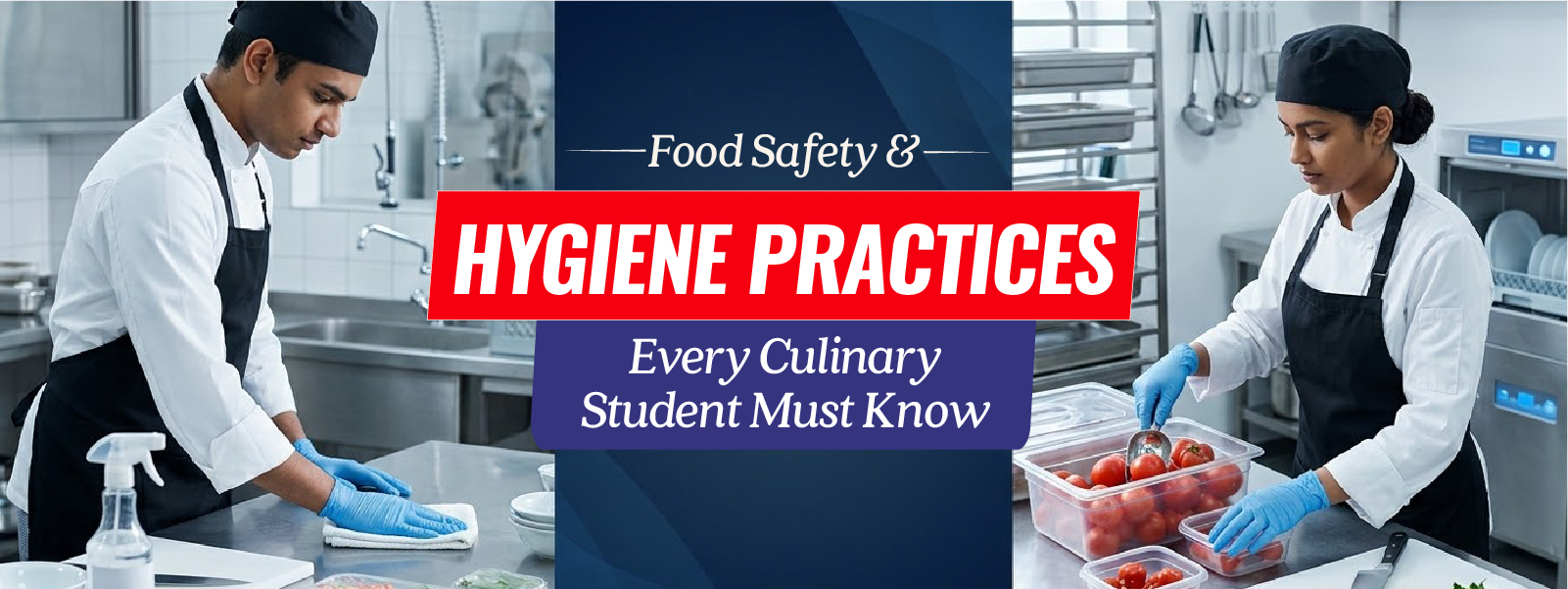
A professional kitchen can be a place of remarkable creativity. Within a few hours, raw ingredients can become sauces, breads, desserts and complete meals ready for service. But behind every well-executed dish is a responsibility that matters more than presentation or flavour: keeping the food safe.
For every student entering professional culinary training, food safety and hygiene should become a daily habit rather than a chapter studied only for an examination. From washing hands correctly to storing ingredients at appropriate temperatures, small actions can have a significant impact on food quality and customer safety.
Students considering a Culinary Arts Course in Delhi need to understand that culinary education is not limited to cooking techniques. Hygiene, safe food handling, kitchen discipline and professional responsibility are equally important. A strong culinary arts course should give students opportunities to practise these standards repeatedly in a controlled kitchen environment.
For those exploring cooking courses in Delhi, it is therefore worth looking beyond the menu of dishes taught and asking how thoroughly the programme develops professional kitchen habits.
What Is Food Safety and Hygiene?
Food safety and hygiene are closely connected, but they are not the same.
Food safety focuses on preventing food from becoming harmful to the people who consume it. This includes controlling contamination, handling ingredients safely, storing food correctly and following appropriate cooking practices.
Food hygiene covers the cleanliness and personal practices used while preparing and serving food.
Think of a kitchen as a chain. Safe ingredients can still become unsafe if they are handled with contaminated equipment. Clean equipment is not enough if hands are not washed properly. Correct cooking temperatures cannot compensate for poor storage.
Every link matters.
Personal Hygiene for Culinary Students
A culinary student's uniform and personal habits are part of professional kitchen discipline.
Students should develop habits such as:
- Washing hands regularly
- Wearing clean kitchen uniforms
- Keeping hair restrained
- Maintaining clean, short nails
- Wearing suitable kitchen footwear
- Covering cuts or wounds appropriately
- Avoiding unnecessary contact with the face or hair
- Staying away from food preparation when unwell according to workplace policy
Handwashing and Hand Hygiene
Handwashing is one of the simplest and most important food safety practices.
Hands should be washed before beginning food preparation and whenever they may have become contaminated.
For example, a student might handle raw poultry, touch a refrigerator handle and then reach for a ready-to-eat ingredient. Without proper handwashing, contaminants can potentially move from one surface or ingredient to another.
Students should therefore develop the habit of washing their hands:
- Before preparing food
- After handling raw ingredients
- After using the washroom
- After touching waste
- After coughing or sneezing
- After touching their face or hair
- After handling potentially contaminated surfaces
- Whenever moving between tasks where contamination could occur
Preventing Cross-Contamination
Cross-contamination occurs when harmful microorganisms or allergens are unintentionally transferred from one food, surface or object to another.
Imagine cutting raw chicken on a chopping board and then using the same board for salad ingredients without appropriate cleaning and sanitising. The second food can potentially become contaminated.
Professional kitchens reduce this risk through careful organisation.
Students learn to consider:
- Which ingredients are being handled
- Which equipment is being used
- Whether utensils need cleaning between tasks
- How raw and ready-to-eat foods are separated
- Whether work surfaces have been properly cleaned and sanitised
Safe Handling of Raw Ingredients
Raw ingredients require careful handling because some can naturally carry harmful microorganisms.
Raw meat, poultry, seafood and eggs should be handled according to appropriate food safety procedures. Fresh produce also needs suitable preparation and handling.
Students should understand the importance of preventing raw ingredients from coming into unnecessary contact with ready-to-eat foods.
This includes thinking about where ingredients are placed, which utensils are being used and how hands and work surfaces are cleaned between tasks.
Good food safety starts before cooking begins.
Food Storage and Temperature Control
Temperature is one of the most important factors in food safety.
Different foods have different storage requirements, and professional kitchens need systems for refrigeration, freezing and appropriate holding.
Students should understand why perishable ingredients cannot simply be left on a workbench indefinitely.
They also need to learn about:
- Correct refrigeration practices
- Freezer storage
- Appropriate food placement
- Temperature monitoring
- Avoiding unnecessary temperature fluctuations
- Safe storage of prepared foods
Cooking and Reheating Food Safely
Cooking changes food in many ways, including its texture, flavour and safety characteristics.
Students need to understand that cooking and reheating should follow appropriate temperature and time controls for the food being prepared.
Professional kitchens often rely on standard operating procedures and monitoring systems to maintain consistency.
Rather than treating temperature as an afterthought, culinary students should develop the habit of checking and controlling cooking conditions as part of the preparation process.
This becomes particularly important when food is prepared in large quantities for service.
Cleaning and Sanitising Kitchen Equipment
A clean-looking kitchen is not necessarily a properly sanitised kitchen.
Cleaning removes visible food residue, grease and dirt.
Sanitising is a separate step intended to reduce microorganisms to safer levels using an appropriate method or sanitiser.
Both are important.
Knives, chopping boards, worktops, mixers, utensils and other equipment should be maintained according to the kitchen's cleaning procedures.
Students should also understand that cleaning is not something that happens only at the end of a shift. Professional kitchens require cleaning and sanitation throughout the working process.
Safe Food Storage and Labelling
A professional refrigerator can quickly become confusing when several containers look identical.
Labelling and organisation solve much of this problem.
Students can learn to identify and follow systems for:
- Product names
- Preparation dates
- Use-by or discard information where applicable
- Storage areas
- Container identification
- Stock rotation
Personal Protective Practices
Protective practices can vary depending on the task and workplace.
Clean uniforms, suitable footwear and hair restraints are standard elements of many professional kitchen environments. Gloves may also be appropriate for particular tasks, but wearing gloves does not eliminate the need for proper hand hygiene.
In fact, gloves can become a source of contamination if they are treated as a substitute for handwashing or if the same pair is used across multiple tasks.
Students should therefore learn that protective equipment is one part of a wider hygiene system.
Food Allergens and Allergen Awareness
Food safety also includes understanding allergens.
Ingredients such as milk, eggs, wheat, nuts and other common allergens can present serious risks to some customers.
Culinary students need to understand the importance of accurate ingredient information and careful handling.
For example, using a utensil that has been in contact with an allergen and then using it for another preparation can create a cross-contact risk.
Clear communication between kitchen and service teams is also important when customers have declared allergies.
Never assume that a small amount of an allergen is harmless.
Common Food Safety Mistakes Students Should Avoid
Many food safety problems are not caused by complicated mistakes. They happen because someone becomes distracted or skips a basic step.
Common examples include:
- Forgetting to wash hands between tasks
- Leaving perishable food out unnecessarily
- Using unclean utensils
- Mixing raw and ready-to-eat foods
- Storing food incorrectly
- Failing to label prepared ingredients
- Neglecting cleaning routines
- Ignoring allergen information
Food Safety During Professional Kitchen Service
A kitchen becomes very different during busy service.
Orders arrive quickly. Multiple pans may be working simultaneously. Staff move between preparation areas, cooking stations and service points.
This is exactly when hygiene discipline matters most.
Speed should never mean abandoning safe practices.
Professional cooks need to develop systems that allow them to work quickly without becoming careless.
Organised workstations, clean tools, proper mise en place and good communication can all make it easier to maintain food safety when pressure increases.
Why Food Safety Matters for a Culinary Career
Food safety is not merely a compliance issue.
It affects customer wellbeing, food quality, kitchen efficiency and the reputation of a food business.
A chef may be technically excellent, but professional performance also means understanding responsibility.
Hotels, restaurants, bakeries, catering operations and other food businesses depend on employees who can follow established safety procedures consistently.
Strong hygiene habits can therefore become part of a student's professional identity.
How Culinary Training Builds Good Hygiene Habits
Food safety is easiest to understand when students can practise it rather than simply read about it.
Structured culinary education can introduce students to hygiene procedures through demonstrations, supervised kitchen sessions and repeated practical work.
At TGCA, practical culinary training can help students understand how food preparation, kitchen organisation and professional standards work together.
A student may learn the correct way to clean a workstation in theory. Repeating that process before, during and after practical sessions helps turn the procedure into a routine.
That repetition is valuable because professional kitchens require consistency every day.
Developing a Professional Food Safety Mindset
The most important lesson is that food safety should not feel like an extra task added to cooking.
It should become part of the way a culinary student thinks.
Before touching an ingredient, ask whether your hands are clean.
Before using a chopping board, consider what was prepared on it previously.
Before storing food, consider whether it is labelled and placed appropriately.
Before serving a dish, consider whether the preparation has been handled safely from beginning to end.
This mindset allows students to identify potential problems before they become actual problems.
Conclusion
Great cooking begins with good ingredients and skilled techniques, but professional cooking also depends on responsibility. Food safety and hygiene should therefore be among the first habits a culinary student develops and among the last habits they ever stop practising.
Students exploring cooking courses in Delhi can benefit from practical training that covers personal hygiene and handwashing, cross-contamination prevention, temperature control, safe storage, cleaning, allergen awareness and professional service practices. Each of these areas contributes to a safer and more organised kitchen.
For students considering culinary education, practical training should provide opportunities to develop these habits repeatedly. A professional kitchen is fast, demanding and highly collaborative, and food safety needs to remain consistent even when the pressure increases.
Ultimately, being a professional chef is not only about creating food that looks and tastes good. It is also about making sure that food reaches the customer safely, responsibly, and to the standards expected of a professional kitchen.

 Whatsapp