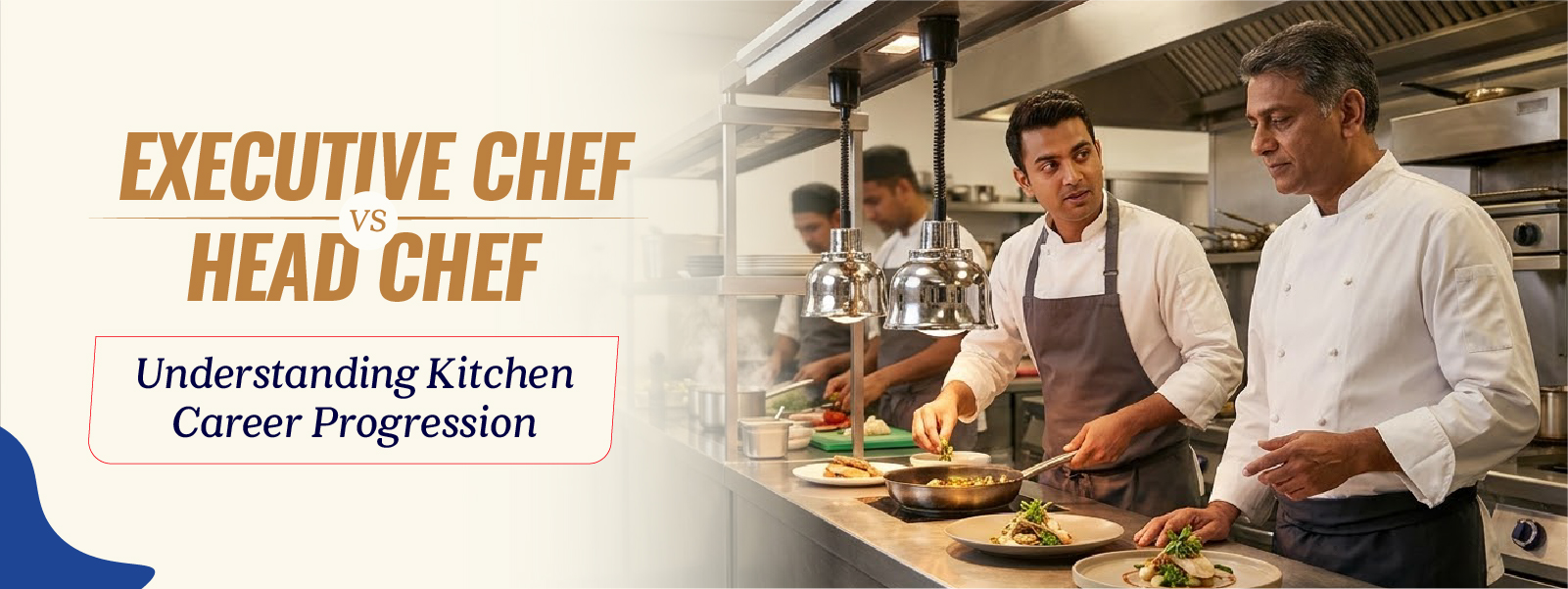
A professional kitchen has its own hierarchy, responsibilities and rhythm. At the beginning of a culinary career, the focus is often on learning how to prepare food correctly. With experience, however, the role can evolve from executing recipes to supervising teams, developing menus, controlling costs and eventually shaping the culinary direction of an entire operation.
Two titles that often create confusion are Head Chef and Executive Chef. They may sound similar, and their responsibilities can overlap, but they are not always the same position.
For students exploring Chef Courses After 12th, understanding this progression can help set realistic career expectations. Becoming an executive chef is usually not an immediate outcome of culinary education. It is a senior position that develops through technical expertise, professional experience, leadership and management ability.
The chefs frequently discussed among the top 10 chefs in India or as a leading chef of India have generally built their reputations over years of culinary and professional development rather than simply through a qualification.
The simplest distinction is scope of responsibility.
A Head Chef generally has strong responsibility for the daily operation of a particular kitchen or food outlet.
An Executive Chef usually works at a broader level, particularly in larger hotels, resorts, restaurant groups or operations with multiple food outlets.
| Head Chef | Executive Chef |
|---|---|
| Manages a kitchen or outlet | May oversee multiple kitchens or outlets |
| Focuses heavily on daily operations | Focuses on broader culinary strategy |
| Supervises kitchen staff | Leads senior culinary teams |
| Oversees food quality and service | Oversees culinary standards across operations |
| May develop menus | Often sets wider culinary direction |
| Handles operational issues | May have greater involvement in budgets and business decisions |
A Head Chef is often closely connected to the daily running of a kitchen.
When service begins, the Head Chef may be responsible for making sure every station is prepared, the team understands the day's requirements and dishes leave the kitchen according to established standards.
Responsibilities can include:
An Executive Chef typically operates at a broader level.
In a large hotel, for example, there may be several food outlets operating simultaneously. There might be an all-day dining restaurant, specialty restaurant, banquet kitchen, pastry section and other culinary operations.
An Executive Chef may oversee the culinary standards across these areas.
Their responsibilities can include:
Both positions care deeply about food quality, but their focus may differ.
A Head Chef is often concerned with questions such as:
Is the kitchen ready for service?
Are the dishes being prepared correctly?
Does the team have everything it needs?
An Executive Chef may also be thinking about:
Are all outlets following the culinary standards?
Is the menu commercially sustainable?
Are food costs under control?
Does the culinary operation reflect the hotel's or restaurant group's identity?
This difference in perspective becomes increasingly important as the size of the operation grows.
Culinary careers become less about individual cooking as professionals move into senior positions.
A Commis Chef may primarily be responsible for completing assigned tasks.
A Chef de Partie manages a particular station.
A Sous Chef helps coordinate the wider kitchen.
A Head Chef may lead the complete kitchen operation.
An Executive Chef may lead senior chefs across multiple departments or outlets.
Leadership therefore becomes increasingly important.
Senior chefs need to communicate clearly, delegate effectively, train team members and make decisions under pressure.
Senior chefs can have considerable influence over what a restaurant serves.
Menu development involves more than choosing dishes that sound appealing.
Chefs may need to consider:
At senior levels, culinary professionals need to understand numbers as well as food.
A kitchen can produce excellent dishes but still struggle financially if ingredients are wasted, portions are inconsistent or purchasing is poorly managed.
Senior chefs may therefore become involved in:
There is no universal job description for either title.
In a small independent restaurant, the Head Chef might oversee nearly everything related to food operations.
In a large hotel, the Executive Chef may oversee several kitchens while individual Head Chefs manage specific outlets.
Restaurant groups can have another structure altogether.
This is why aspiring chefs should look at the actual responsibilities attached to a position rather than relying entirely on its title.
The hierarchy can change according to the organisation's size, number of outlets and management structure.
A common culinary career pathway can look like this:
Commis Chef → Chef de Partie → Sous Chef → Head Chef → Executive Chef
This is often an early professional position where the chef develops fundamental kitchen skills and learns professional standards.
A Chef de Partie generally takes responsibility for a particular kitchen section or station.
The Sous Chef works closely with senior kitchen leadership and helps coordinate the wider kitchen team.
The Head Chef may take primary responsibility for a kitchen, outlet or culinary operation.
The Executive Chef generally takes on broader culinary leadership, particularly within larger operations.
Progression is not automatic. Some chefs specialise, change establishments or develop careers in other culinary directions.
A Head Chef needs much more than good cooking skills.
Important abilities can include:
Executive-level responsibilities require an even broader skill set.
In addition to culinary expertise, an Executive Chef may need:
Professional culinary education can provide the foundation on which a long-term career is built.
Students can develop knowledge of:
A qualification can provide a foundation.
The professional kitchen provides the test.
Real service introduces circumstances that are difficult to recreate completely in a classroom. Orders change. Equipment behaves differently. Ingredients vary. Customers have different expectations. Teams work under time pressure.
Experience teaches chefs how to respond.
Over time, professionals develop:
There is no fixed timeline.
One chef may progress quickly because of strong performance and opportunities in a growing organisation. Another may take longer while developing specialised skills or working through different types of kitchens.
Progression can depend on:
Absolutely.
A Head Chef who wants to move into an Executive Chef position may need to expand their responsibilities beyond daily kitchen management.
That could involve developing stronger knowledge of:
Experienced culinary professionals can explore opportunities in:
The most important point for aspiring chefs is that senior culinary positions are built progressively.
A student should not expect to become an Executive Chef immediately after completing culinary education.
Instead, think about the journey in stages.
First, learn how to cook correctly.
Then learn how to work efficiently.
Then learn how to manage a station.
Then learn how to lead people.
Eventually, learn how to manage an entire culinary operation.
Each stage adds another layer of responsibility.
The difference between a Head Chef and an Executive Chef is primarily one of scope, responsibility and leadership.
A Head Chef is often deeply involved in the daily operation of a particular kitchen, while an Executive Chef may oversee broader culinary operations, multiple outlets, budgets, standards and strategic decisions.
For aspiring chefs, the career path generally begins much earlier, often with foundational culinary education followed by practical industry experience.
Students considering Chef Courses After 12th should focus first on developing strong technical skills, professional discipline and kitchen knowledge. From there, experience can gradually build the leadership, management and business capabilities required for senior positions.
Becoming an executive chef is not about reaching a title as quickly as possible. It is about becoming capable of carrying the responsibilities that come with it.
And in professional kitchens, that capability is built one service, one station and one leadership challenge at a time.
Usually, an Executive Chef has broader authority than a Head Chef, particularly in large hotels or multi-outlet operations. However, organisational structures and titles vary between employers.
Bakery and Pastry Instructor
 Whatsapp
Click one of our representatives below to chat on WhatsApp or send us an email to
info@tedcoeducation.com

Counselor
Bakery and Pastry Courses
Counselor
Culinary Arts Courses
Click one of our representatives below to chat on WhatsApp or send us an email to
info@tedcoeducation.com
Counselor
Bakery and Pastry Courses
Counselor
Culinary Arts Courses

