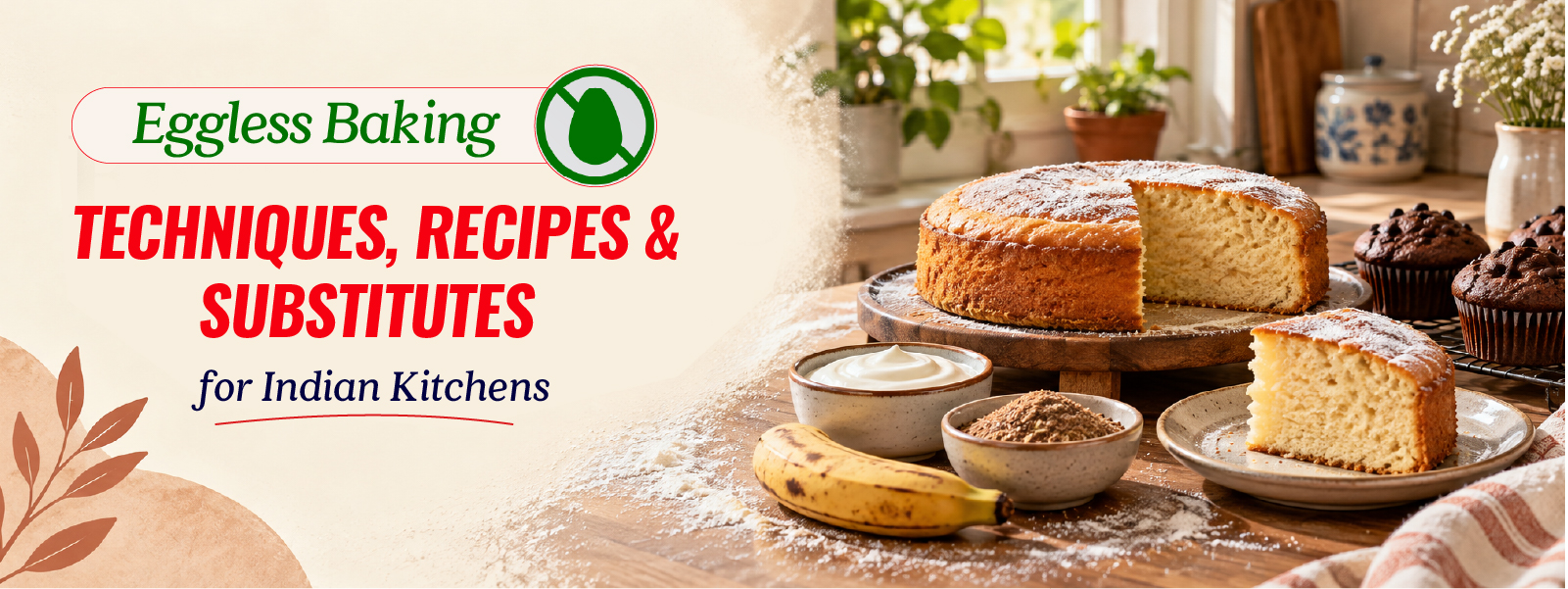
Eggless baking has become an important skill for anyone working in the Indian bakery and pastry industry. From birthday cakes and tea-time bakes to restaurant desserts and packaged products, bakeries regularly need recipes that deliver good texture and flavour without eggs. For students taking a Professional Baking Course, learning how to make these products consistently is therefore a practical skill, not simply a recipe variation.
The challenge is that eggs perform several jobs in a recipe. They can provide structure, moisture, binding, emulsification, aeration and colour. Successful eggless baking means replacing the function of the egg, not simply replacing one ingredient with another.
India has a strong market for vegetarian food, and eggless bakery products are widely requested by customers for different dietary, cultural and personal reasons.
Bakeries and cafés may receive requests for eggless:
Some customers avoid eggs because they follow vegetarian diets, while others may have allergies or personal preferences. Jain customers may also have specific dietary requirements that go beyond simply removing eggs.
For professional bakers, this means knowing how to adapt recipes while maintaining the expected texture, appearance and flavour.
Before choosing an egg substitute, understand the role eggs play in the original recipe.
Egg proteins coagulate during baking and help give cakes, custards and other products structure.
Eggs can help incorporate and retain air, particularly in whipped preparations and certain sponge cakes.
Eggs help hold ingredients together. This is especially important in cookies, cakes and some desserts.
Eggs contain water, which contributes to the moisture of baked products.
The yolk contains lecithin, an emulsifier that helps combine ingredients such as fat and water.
Egg yolks contribute colour to cakes, pastries and other preparations. Egg washes can also provide shine and browning.
This is why there is no universal "one substitute equals one egg" solution. A substitute that works well for binding may not provide the same aeration or emulsification.
The best substitute depends on the recipe and the function you need to replace.
Curd is commonly used in Indian eggless cake recipes because it contributes moisture and tenderness.
Buttermilk can provide acidity and moisture while also interacting with chemical leaveners such as baking soda.
Condensed milk contributes sweetness, solids and richness as well as moisture. Because it contains substantial sugar, simply replacing eggs with condensed milk may require adjustments elsewhere in the recipe.
These ingredients are particularly useful in cakes, muffins and some dessert preparations.
Ground flaxseed mixed with water can form a gel-like mixture that helps with binding.
A common starting point is:
1 tablespoon ground flaxseed + 3 tablespoons water = approximately 1 egg equivalent for binding.
Allow the mixture to hydrate before adding it to the batter.
Chia seeds can be used in a similar way, although their texture and appearance can be more noticeable.
These options work particularly well where binding is more important than creating a light, highly aerated structure.
Aquafaba is the liquid associated with cooked chickpeas and other legumes. When whipped, it can hold air and become useful in certain egg-free preparations.
It can be used in applications such as:
Aquafaba requires careful whipping and recipe development. It should not be treated as a direct substitute for eggs in every recipe.
An acidic ingredient such as vinegar can react with baking soda and produce carbon dioxide, helping provide lift in suitable cake recipes.
The important point is balance. Adding excessive baking soda or acid can affect flavour, colour and texture.
Mashed ripe banana can provide moisture, binding and some structure.
It works particularly well in products where a banana flavour is welcome, such as banana muffins or certain tea cakes.
It is not suitable when you want a completely neutral flavour profile.
Applesauce can contribute moisture and binding while keeping the flavour relatively mild.
It is useful in selected cakes, muffins and other soft baked products, although recipes may need adjustment because additional moisture can affect structure.
Silken tofu can contribute moisture, body and protein to certain desserts and cakes.
When blended smoothly, it can work particularly well in preparations where a creamy texture is desirable.
There is no universal conversion chart that works perfectly for every recipe. Egg size, recipe composition and the function of the egg all affect the result.
However, these can serve as starting points for recipe testing:
| Substitute | Approximate starting point for 1 egg | Best suited to |
|---|---|---|
| Ground flaxseed + water | 1 tbsp flaxseed + 3 tbsp water | Binding |
| Chia gel | 1 tbsp ground chia + 3 tbsp water | Binding |
| Mashed banana | About 60 g | Cakes and muffins |
| Applesauce | About 60 g | Cakes and muffins |
| Aquafaba | About 3 tbsp | Aeration and selected desserts |
| Curd | Varies by recipe | Cakes and muffins |
| Buttermilk | Varies by recipe | Cakes and quick breads |
These quantities should be treated as starting points rather than guaranteed one-to-one replacements.
When replacing eggs, you may need to adjust:
This is particularly important when using ingredients such as banana, applesauce or condensed milk, which bring additional moisture or sugar into the recipe.
Cakes are among the most common applications for eggless baking.
A basic eggless cake may use a combination of flour, sugar, fat, dairy or another liquid, a leavening system and an acidic ingredient where appropriate.
The mixing method matters.
Overmixing can develop too much gluten and produce a dense texture. Under-mixing can leave ingredients unevenly distributed.
For a consistent sponge:
Dense eggless cakes can result from several factors, including:
Recipe testing is therefore essential when developing an eggless formula.
Eggs influence the spread, structure and texture of cookies and other small bakes.
For cookies, the balance between flour, fat, sugar and moisture determines much of the final texture.
A substitute that introduces too much moisture can make cookies spread differently or become softer than intended.
Eggless brownies need enough structure to hold their shape while retaining the characteristic dense and moist texture expected from a brownie.
Ingredients such as curd or suitable plant-based alternatives can be incorporated depending on the formula.
Muffins are generally more forgiving than delicate sponge cakes, making them a useful product for experimenting with eggless formulations.
However, too much liquid can still produce a gummy centre.
Not every bread requires eggs in the first place.
Many bread formulas rely primarily on flour, water or milk, yeast, salt and other ingredients. Enriched doughs may contain additional fat, sugar, dairy and sometimes eggs.
For eggless enriched breads, ingredients such as milk, butter or suitable alternatives can contribute softness and richness.
The dough still needs proper gluten development and fermentation.
An egg wash is often used to produce a glossy, browned surface.
Egg-free alternatives can include:
The appropriate option depends on the product and desired appearance.
Eggless pastry work can become more technically challenging because eggs often provide structure and emulsification.
Traditional custards rely heavily on egg proteins for thickening.
Egg-free versions may instead use starches, dairy products, chocolate, gelatin where suitable, or other thickening systems depending on the recipe.
The objective is to recreate the desired texture without introducing unwanted flavours or excessive starchiness.
Aquafaba has opened up interesting possibilities for egg-free meringue-style preparations.
However, these products can be sensitive to moisture, mixing, piping and baking conditions.
Eggless macarons in particular require recipe testing because replacing egg whites changes the behaviour of the mixture significantly.
Even a good recipe can fail if the ingredients or method are not controlled.
Possible causes include:
A gummy centre can also indicate that the batter has not baked sufficiently.
A cake may sink when its structure is not strong enough to support itself.
Potential causes include excessive liquid, too much leavening, opening the oven too early or removing the cake before it has set.
If a cake or cookie is too dry, review the balance of flour, liquid and fat.
Overbaking is another common cause.
The solution is not always to add more egg substitute. Sometimes the baking time, temperature or overall formula needs adjustment.
Eggless baking becomes more complex when products are being sold commercially.
Changing an ingredient can affect shelf life, texture and production cost.
For example, a substitute may be inexpensive but introduce additional moisture that changes the product's storage behaviour.
Before selling a new eggless product, test it over an appropriate period under the intended storage conditions.
Commercial bakers need to provide accurate product information and comply with applicable food labelling requirements.
Do not describe a product as eggless simply because the recipe does not intentionally contain eggs if there is a risk of cross-contact that needs to be addressed under the applicable requirements.
If a kitchen produces both egg-containing and eggless products, separation becomes important.
This may involve:
For customers with egg allergies, cross-contact can be a serious concern. Food businesses should follow appropriate allergen management and food safety procedures rather than making assumptions.
Eggless baking is a useful skill for anyone pursuing professional bakery work. It requires an understanding of ingredients, recipe balance and the science behind texture and structure.
Students attending baking classes in Delhi can benefit from practical training that allows them to compare different formulas and understand how changes in ingredients affect the final product.
A Cake Baking Course can also provide a useful foundation for students interested in understanding cake mixing, baking, troubleshooting and decoration. For those planning a professional career, professional baking classes can take this further by introducing production methods, consistency and working with a wider range of bakery products.
At TGCA, bakery training provides students with practical exposure to professional baking techniques and production. For students interested in eggless products, the ability to understand ingredient functions and adapt recipes is particularly useful because commercial bakeries often need to cater to different customer requirements.
Eggless baking is not simply about removing eggs from a recipe.
Eggs contribute structure, moisture, binding, aeration, emulsification and colour, so the right substitute depends on the role the egg plays in the original formula.
Curd, buttermilk, flaxseed, chia, aquafaba, banana, applesauce and other ingredients can all be useful, but they behave differently. Successful eggless baking comes from understanding those differences, testing recipes carefully and adjusting the rest of the formula when necessary.
For aspiring bakers, this knowledge can turn eggless baking from a collection of substitutions into a genuine professional skill.
There is no single best substitute. Curd, flaxseed, aquafaba, banana, applesauce and other options perform different functions, so the choice depends on the recipe and the role eggs play.
A common starting point is one tablespoon of ground flaxseed mixed with three tablespoons of water for approximately one egg equivalent. The mixture should hydrate before being added.
Yes. Many cakes can be formulated without eggs using suitable combinations of dairy or plant-based ingredients, leavening agents and other binders. The recipe usually requires more than a simple ingredient swap.
No. Aquafaba is particularly useful for aeration and some meringue-style applications, but it does not reproduce every function of an egg and may require significant recipe adjustments.
Yes. Eggless products are widely relevant to bakeries and cafés serving customers with different dietary preferences and requirements. Professional bakers benefit from understanding how to formulate and produce them consistently.
Culinary Instructor
 Whatsapp
Click one of our representatives below to chat on WhatsApp or send us an email to
info@tedcoeducation.com

Counselor
Bakery and Pastry Courses
Counselor
Culinary Arts Courses
Click one of our representatives below to chat on WhatsApp or send us an email to
info@tedcoeducation.com
Counselor
Bakery and Pastry Courses
Counselor
Culinary Arts Courses

