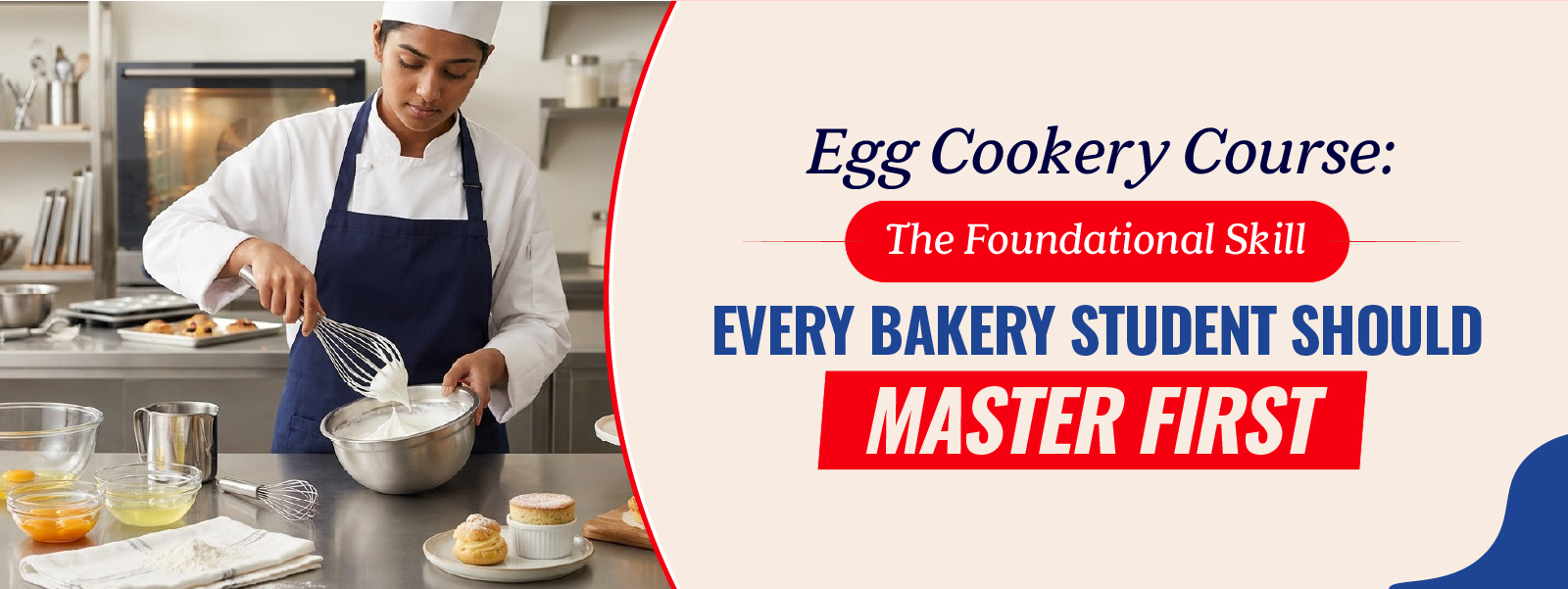
Walk into a professional bakery or pastry kitchen, and you will find eggs almost everywhere. They may be whisked into a sponge batter, separated for a meringue, folded into a custard or used to give a pastry its final golden finish. An egg may look like a simple ingredient, but its behaviour can change dramatically depending on how it is handled.
That is why an egg cookery course can be a valuable foundation for students learning professional food preparation. Understanding eggs helps students build skills that extend far beyond breakfast preparations. It can influence the structure, texture, colour, richness and stability of numerous bakery and pastry products.
For students exploring baking classes in Delhi or cooking classes in Delhi, learning ingredient functionality can be just as important as learning recipes. At The Global Culinary Academy (TGCA), students can develop practical culinary knowledge that supports their progression into professional kitchen environments.
So, why does such a simple ingredient deserve so much attention?
An egg cookery course introduces students to the properties, preparation methods and practical applications of eggs in professional kitchens.
Rather than simply teaching students how to prepare a few egg dishes, structured training can help them understand how eggs respond to heat, agitation, mixing and other ingredients.
Students can explore techniques such as boiling, poaching, frying, scrambling and omelette preparation while developing an understanding of temperature control and timing.
For bakery students, this knowledge becomes particularly useful because eggs perform several different functions in baking and pastry.
Eggs are among the most versatile ingredients used in baking.
Depending on the preparation, they can contribute:
Think about a sponge cake. The eggs are not simply there for flavour. Whipped eggs can help create volume and structure.
In a custard, eggs help transform a liquid mixture into a smooth, thick preparation when heated correctly.
In pastries and baked products, eggs can help bind ingredients together or provide a glossy finish when brushed over the surface.
Understanding these different functions allows students to become more analytical bakers.
An egg consists primarily of two components that behave differently: the white and the yolk.
The egg white contains proteins that can form a foam when whisked. This property is particularly important in preparations where air needs to be incorporated.
The yolk, meanwhile, contains fat and emulsifying components that contribute richness, colour and texture. It also plays an important role in preparations such as custards and pastry creams.
Separating eggs correctly and understanding the purpose of each component can therefore make a significant difference to the finished preparation.
For a pastry student, this is not merely theoretical knowledge. It becomes practical every time a recipe calls for a separated egg.
Before students start applying eggs to sophisticated pastry preparations, they need to understand how eggs respond to heat.
Foundational techniques can include:
Boiling: Boiling teaches students how cooking time and temperature affect the texture of the egg. The difference between a soft and fully cooked egg comes down largely to controlled cooking.
Poaching: Poaching requires careful temperature management and gentle handling. Students learn how to cook an egg without aggressively disturbing its structure.
Frying: Frying demonstrates how direct heat changes the white and yolk while also introducing considerations around temperature and cooking time.
Scrambling: Scrambled eggs are a useful exercise in heat control. Too much heat can quickly produce a dry texture, while controlled cooking can create a softer result.
Omelette Making: Omelettes bring together preparation, temperature control, timing and folding. They also encourage students to develop coordination and presentation skills.
One of the most fascinating properties of eggs is their ability to help incorporate and retain air.
When egg whites are whisked, the proteins help create a foam that can hold air bubbles. This principle is central to preparations such as meringues and certain sponge cakes.
The process requires control.
Under-whipping can result in insufficient volume, while over-whipping can affect the texture and stability of the mixture.
Students learn that aeration is not simply about whisking as quickly as possible. It is about understanding the desired stage and knowing how to handle the mixture afterwards.
That knowledge can make a major difference in delicate pastry preparations.
Once students understand the basic properties of eggs, they can see how widely those principles are applied.
Eggs feature prominently in preparations such as:
Eggs respond quickly to heat, making temperature control essential.
One of the common problems students encounter is curdling. If an egg-based mixture is heated too aggressively, the proteins can coagulate too quickly and produce an undesirable texture.
Other problems can include:
Technical skill must always be supported by proper food safety practices.
Eggs need to be stored, handled and prepared carefully to reduce food safety risks. Professional kitchens require attention to cleanliness, storage conditions, cross-contamination prevention and appropriate cooking practices.
Students should learn to maintain clean work surfaces and utensils and handle eggs according to professional food safety procedures.
For anyone preparing food commercially, these practices are not optional. They are part of professional kitchen discipline.
Some recipes use alternatives to eggs for dietary, allergen-related or formulation reasons.
However, replacing an egg is not always as simple as replacing one liquid ingredient with another.
The replacement needs to perform the required function.
If eggs are providing structure, the alternative needs to help provide structure. If they are contributing moisture, binding or aeration, the replacement needs to address those properties.
Understanding egg functionality therefore helps students make more informed decisions when working with alternative ingredients.
Ingredient knowledge can change the way students approach baking.
Instead of thinking:
"The recipe says two eggs, so I need two eggs."
A technically trained baker starts thinking:
"What are these eggs doing in this recipe?"
Are they adding structure? Are they helping emulsify fat and liquid? Are they providing moisture? Are they creating volume?
Once students understand the answer, they can better diagnose problems and understand why a recipe behaves differently when ingredients or techniques change.
That is an important step towards professional baking.
Egg cookery is particularly suited to hands-on learning because students need to observe and feel changes as they work.
Practical sessions can help students develop skills such as:
An egg cookery course can be useful for a variety of learners.
It may benefit:
Egg cookery is not an isolated culinary topic.
The same principles students learn while cooking eggs can appear repeatedly throughout professional baking and pastry.
Temperature control becomes important when preparing custards.
Whisking technique becomes important when creating aerated mixtures.
Egg separation becomes essential for certain cakes and meringues.
Understanding emulsification becomes useful when working with creams and enriched mixtures.
The further a student progresses into pastry, the more frequently these principles appear.
This is why foundational ingredient training can have a lasting impact on professional development.
A strong culinary education should connect individual ingredients to broader professional techniques.
At TGCA, students can develop practical culinary foundations through structured training that introduces them to professional kitchen methods, ingredient handling, food preparation, and culinary techniques.
For students interested in bakery and pastry, understanding ingredients such as eggs can provide a useful foundation before moving into more complex preparations.
The objective is not simply to memorise recipes. It is to develop the ability to understand ingredients and use appropriate techniques to achieve consistent results.
Eggs may be one of the most familiar ingredients in the kitchen, but their role in professional cooking and baking is remarkably complex. They can create structure, add richness, provide moisture, bind ingredients, contribute colour and help introduce air into careful preparations. Learning how to boil, poach, fry or scramble an egg also teaches students valuable lessons about heat, timing and texture.
For bakery and pastry students, that foundation becomes even more important when working with sponge cakes, custards, pastry creams, meringues and other egg-based preparations. Students exploring baking classes in Delhi can also benefit from understanding how eggs influence the texture, stability and finish of different baked and pastry products.
An egg cookery course can therefore be much more than a lesson in preparing eggs. It can help students understand one of the most technically versatile ingredients in professional kitchens and build knowledge that continues to support them as their culinary and baking skills develop.
Eggs can provide structure, moisture, richness, colour, binding and aeration. Understanding these functions helps baking students control recipes and achieve more consistent results.
Students can learn egg preparation methods, temperature control, egg separation, whisking, cooking techniques, food safety, and applications of eggs in culinary and pastry preparations.
Whisked eggs can incorporate air into certain cake mixtures. During baking, heat helps stabilise the structure, contributing to the volume and light texture of preparations such as sponge cakes.
Yes. Understanding eggs helps students work more confidently with custards, pastry creams, meringues, sponge cakes and other preparations where temperature, aeration and structure are important.
Egg cookery training can benefit culinary students, bakery students, aspiring chefs, beginners and anyone seeking stronger foundational knowledge of ingredient behaviour and professional cooking techniques.
Bakery and Pastry Instructor
 Whatsapp
Click one of our representatives below to chat on WhatsApp or send us an email to
info@tedcoeducation.com

Counselor
Bakery and Pastry Courses
Counselor
Culinary Arts Courses
Click one of our representatives below to chat on WhatsApp or send us an email to
info@tedcoeducation.com
Counselor
Bakery and Pastry Courses
Counselor
Culinary Arts Courses

