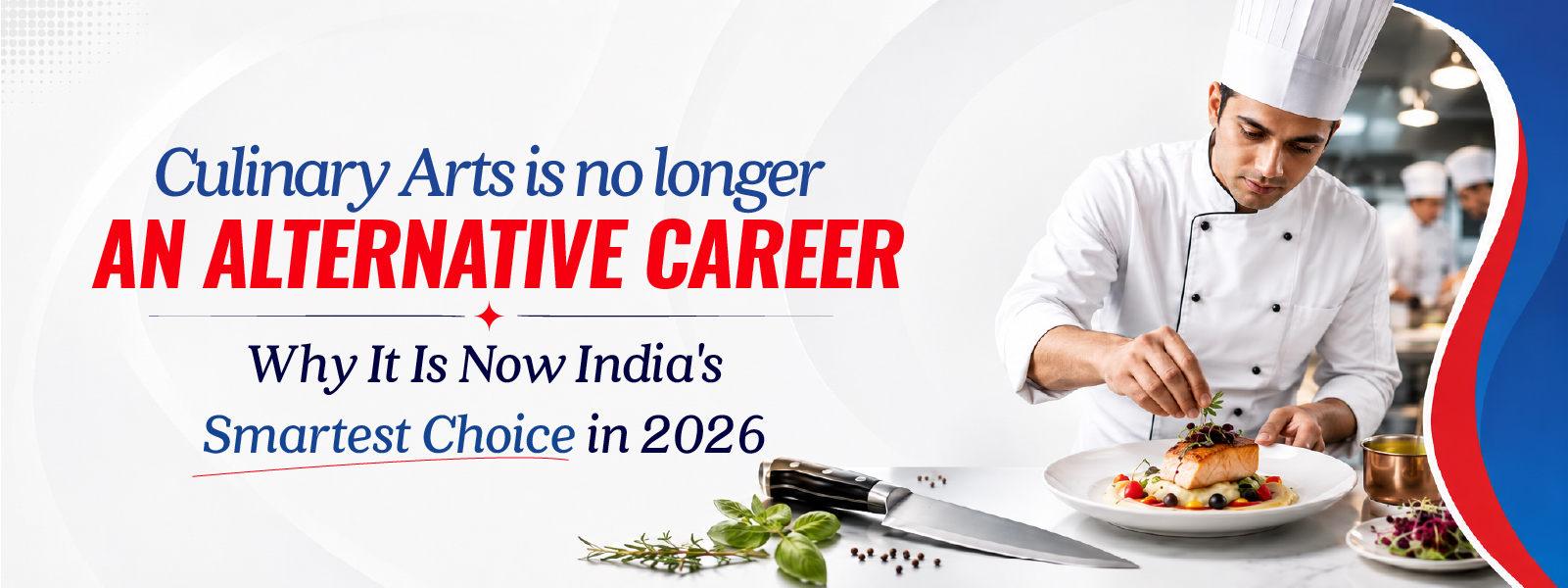
Not too long ago, telling your parents you wanted to pursue a culinary arts course after 12th came with a predictable response. A long pause. A concerned look. A gentle suggestion that you consider something more stable, more conventional, more respectable. Engineering. Medicine. Commerce. Law. Anything but cooking.
That response was never really about cooking. It was about the perception of cooking as a career, one that felt uncertain, poorly paid, and somehow lesser than the paths that came with a recognisable degree and a clear corporate trajectory. Culinary arts was the backup plan. The fallback. The thing you did when nothing else worked out.
In 2026, that perception is not just outdated. It is factually incorrect. And this blog is going to show you exactly why, with data, with career outcomes, and with the honest picture of what a culinary career in India actually looks like today.
The argument is simple: a culinary arts course in 2026 is not a compromise. It is a calculated, forward-looking career decision backed by a booming industry, strong salary progression, and global opportunity. If you love food and are considering this path, or if you are a parent trying to understand whether it is a serious choice for your child, this guide will give you the clearest possible picture of what culinary arts actually offers in India right now.
Already convinced and looking for the right institute? Skip to Section VIII to see how TGCA is preparing students for this new culinary reality.
The scale of change in India's food industry over the last decade is genuinely remarkable. The Indian food service industry is now valued at over Rs 5.99 lakh crore. It is growing at approximately 9 percent annually, making it one of the fastest-growing sectors in the entire economy. Every percentage point of that growth represents new restaurants, new hotel properties, new catering operations, and new food businesses, all of which need trained, skilled, professionally certified culinary talent to function.
What makes this particularly relevant for anyone considering a career in the culinary arts in India is the supply gap. India is producing far fewer formally trained culinary professionals than the industry currently demands. That gap is the single most important structural factor in the culinary job market right now, and it means that a qualified, certified culinary graduate from a reputable accredited institute enters a market where demand for their skills is measurably higher than supply.
Ten years ago, the career paths available to a culinary graduate were essentially hotel kitchen, restaurant kitchen, or catering. Today, the landscape looks dramatically different. Cloud kitchens have created an entirely new category of food businesses that need culinary talent to scale. Food media, YouTube channels, Instagram food content, and OTT cooking shows have created legitimate, well-paying careers for people who can cook and communicate. International hospitality, from cruise lines to luxury hotels in the Middle East and Europe, is actively recruiting Indian culinary graduates. And the rise of food entrepreneurship has turned baking, catering, and specialty food businesses into real scalable ventures that professionally trained culinary graduates are uniquely positioned to launch.
There is an irony in the alternative career label that anyone who has spent time in a professional kitchen will recognise immediately. Culinary training is genuinely hard. The physical demands of a professional kitchen, long hours on your feet, intense heat, service pressure, and the requirement to produce consistent, high-quality output every single service would challenge most people who have dismissed it as a soft option.
The intellectual demands are equally real. A professional culinary education covers food science, nutrition, kitchen management, food costing, menu engineering, supplier relationships, team leadership, and a comprehensive mastery of techniques across multiple cuisines. This is not a casual skill set. It is a rigorous professional qualification that takes genuine commitment, focus, and practice to earn. Calling it an alternative career has always said more about the prejudice of the label than the reality of the work.
When you compare culinary arts to other career paths on the three metrics that actually matter, income, growth, and global opportunity, the comparison is far more favourable than most people expect. On income, a Sous Chef at a 5-star hotel earns significantly more than many entry-level corporate professionals. On growth, the culinary career ladder from Commis Chef to Executive Chef is a clear, merit-based progression with concrete milestones. And on global opportunity, a City and Guilds-certified culinary arts course graduate from an accredited institute has access to kitchens in over 100 countries, an international mobility that very few other professional qualifications can match.
A culinary career offers income, growth, and global mobility. The only thing it ever lacked was the right reputation. In 2026, that is changing fast.
One of the most persistent myths about culinary careers is that they do not pay well. The reality, for graduates from accredited programmes at serious institutes, is considerably more encouraging.
Entry level (Commis Chef, 0 to 2 years): Rs 15,000 to Rs 28,000 per month in hotel kitchens and restaurant groups. Graduates from City and Guilds-accredited programmes consistently receive stronger starting offers than those from non-accredited backgrounds.
Mid-level (Chef de Partie, 3 to 5 years): Rs 30,000 to Rs 55,000 per month. At this stage, chefs with strong technical foundations and leadership instincts move up fast, and the salary reflects that.
Senior level (Sous Chef, 5 to 8 years): Rs 60,000 to Rs 1,20,000 per month. Sous Chefs at leading hotel chains in India earn in this range, with additional benefits that make the total package substantially higher.
Executive Chef or Head Chef (8 plus years): Rs 1,50,000 to Rs 4,00,000 per month and above. Executive Chefs at top hotel groups and restaurant chains are among the highest-paid hospitality professionals in India.
The salary numbers above are for domestic hotel and restaurant roles. They do not capture two of the most significant earning multipliers available to culinary graduates. First, international placements: a Commis Chef on a cruise ship earns Rs 80,000 to Rs 1,20,000 per month with free accommodation and food included. A Chef de Partie in a Middle Eastern luxury hotel earns in ranges that significantly exceed equivalent domestic roles. Second, entrepreneurship: a professionally trained baker who launches a cloud kitchen brand or a custom cake studio can build revenues that quickly surpass any hotel kitchen salary. Among all culinary arts colleges in India, those that build both technical skill and business awareness in their students are the ones producing graduates who access these higher-earning paths most effectively.
One of the genuinely underappreciated strengths of a culinary arts career in India is the sheer variety of paths it opens. A culinary diploma is not a ticket to one specific job. It is a foundation for a range of careers that most other degrees cannot access:
Career resilience is increasingly important in a world where industries can be disrupted rapidly. One of the genuine strengths of a culinary career is that food is non-negotiable. People will always eat, and they will always value people who can prepare food to a high standard. The specific formats and business models evolve- hotels, restaurants, cloud kitchens, food delivery- but the underlying demand for culinary skill is consistent. That consistency makes culinary arts one of the more resilient career choices available to any student in 2026.
The shift in how Indian parents perceive culinary careers is real and accelerating, driven by three specific forces. The first is salary visibility: as more culinary graduates share their career outcomes publicly, the income trajectory of a culinary career has become more visible and more credible to parents who previously only had assumptions to go on. The second is placement data: as accredited institutes like TGCA consistently place graduates in top hotel chains and internationally, the evidence base for culinary careers as serious professional choices grows stronger with every batch. The third is cultural shift: food has become a mainstream, aspirational part of Indian culture in a way it simply was not a decade ago, and that shift has changed the way parents see a career connected to food.
The students who enrol in a culinary arts course in 2026 are not making a compromise. They are making a deliberate, informed choice backed by industry data, career outcome evidence, and a clear understanding of where the food industry is going. These are exactly the kinds of decisions that earn respect, from parents, from peers, and eventually from employers. The era of the culinary career as a quiet fallback is over. What has replaced it is a career path that rewards passion, discipline, and professional training with genuine financial and personal outcomes.
The single most significant structural change in India's culinary education landscape over the last decade has been the arrival and adoption of internationally recognised accreditation, particularly City and Guilds (UK). City and Guilds is one of the most respected vocational qualification bodies in the world, founded in 1878 and recognised in over 100 countries. For chef courses from City and Guilds-accredited institutes in India, this accreditation means that a graduate's qualification is evaluated the same way in a London hotel, a Dubai resort, or a cruise ship HR office as it is in an Indian 5-star property. That portability is not a minor advantage. It is a career game-changer.
There is a common assumption that culinary qualifications are local, that they do not travel the way an MBA or an engineering degree does. City and Guilds accreditation fundamentally changes that assumption. A graduate from a City and Guilds-accredited culinary programme carries a qualification that international employers recognise, trust, and actively seek. Among all culinary arts colleges in India, those that hold City and Guilds accreditation are the ones producing graduates with genuine international career mobility, which is why the choice of institute, not just the decision to pursue culinary arts, matters so profoundly.
Culinary arts is no longer a local career. City and Guilds accreditation makes it a global one.
Tedco Education's culinary academy, TGCA, is built specifically for the culinary reality of 2026, not the one of a decade ago. Every element of the programme is designed to produce graduates who are ready for the industry as it actually exists today: technically strong, professionally disciplined, internationally credentialed, and supported through the transition from training to employment.
The feedback chef courses' graduates from Tedco Education receive from industry partners is consistent: they arrive prepared. Not just technically, but professionally, with the kitchen discipline, the communication skills, and the composure under pressure that a hotel kitchen demands from day one. That readiness is the direct result of a training environment that takes the modern culinary career seriously and builds graduates who can perform at the level the industry actually needs in 2026.
The evidence is clear. Culinary arts as a mainstream career in India in 2026 is not a slogan. It is a fact supported by industry growth data, salary progression, global career mobility, and the genuine breadth of career paths that a professional culinary education opens up. The days of calling this an alternative career are over, not because the label became unfashionable, but because it became factually indefensible.
A culinary arts course from an accredited institute in 2026 is a serious professional qualification that leads to serious career outcomes. The students who make this choice are not falling back. They are stepping forward, into one of India's fastest-growing industries, with one of the most portable and internationally recognised professional skill sets available.
If you are a student who has been holding back from pursuing culinary arts because of what someone else might think, this is the moment to stop letting other people's outdated assumptions determine your future. And if you are a sceptical parent, we would genuinely invite you to sit down with us, visit the campus, see the kitchen, and have an honest conversation about why culinary arts is a smart career choice in India in 2026.
TGCA's 2026 batches are open now. The students who act first are the ones who start building their careers first. Come and see for yourself why this is India's smartest career choice right now.
TGCA's City and Guilds-accredited programmes are open for 2026 batches. Seats are limited. Book a free campus visit or counselling session and take the first step toward a career that genuinely excites you.
Visit tedcoeducation.com to apply or book a Free Campus Visit Today!
Culinary Instructor
 Whatsapp
Click one of our representatives below to chat on WhatsApp or send us an email to
info@tedcoeducation.com

Counselor
Bakery and Pastry Courses
Counselor
Culinary Arts Courses
Click one of our representatives below to chat on WhatsApp or send us an email to
info@tedcoeducation.com
Counselor
Bakery and Pastry Courses
Counselor
Culinary Arts Courses

