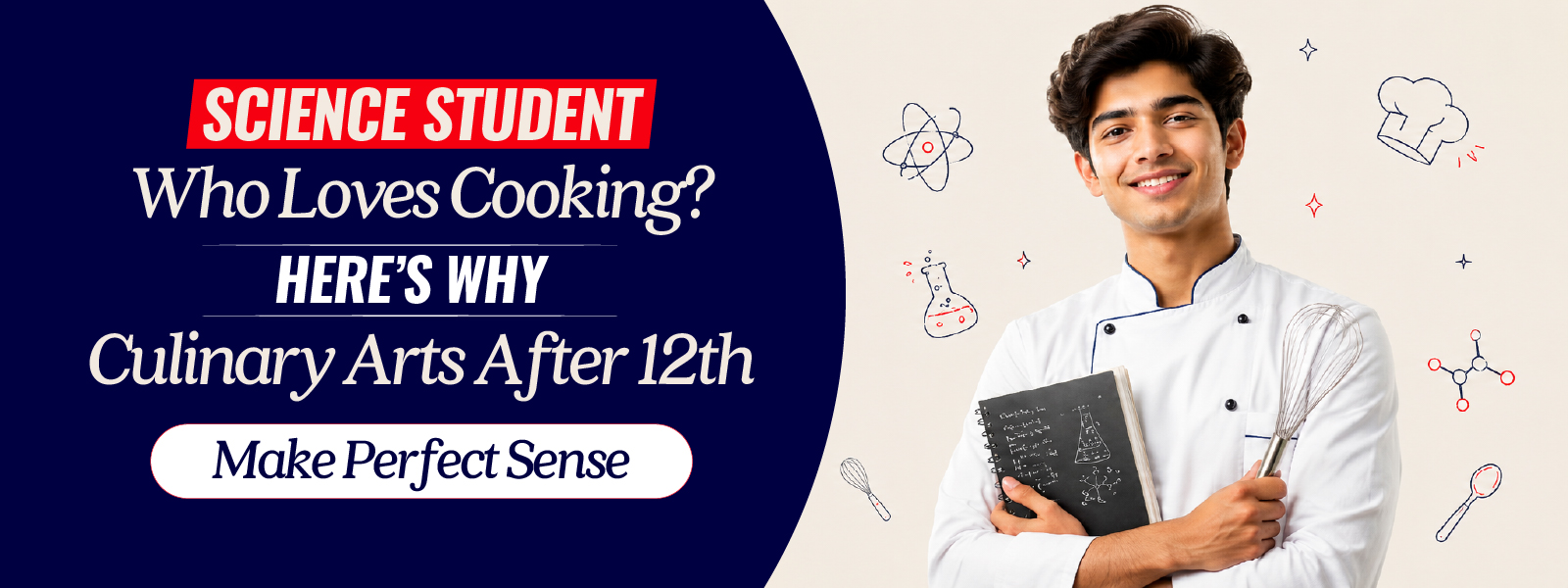
If you studied Physics, Chemistry, Biology, or Maths in 11th and 12th, there is a good chance that the people around you, parents, relatives, even teachers, have a fairly fixed idea of where that path is supposed to lead. Medicine. Engineering. Maybe a pure sciences degree. And if you have quietly been more interested in the chemistry of caramelisation than the chemistry syllabus, or more excited about a sourdough starter's fermentation than your biology practical, you have probably felt that tension.
Here is the thing though. That tension is based on an assumption that does not actually hold up: that culinary arts after 12th is somehow a step away from science, rather than a different application of it. This guide is going to challenge that assumption directly, and show you why a science background might be one of the most genuinely useful foundations a culinary student can have.
By the end of this guide, you will understand why any stream, including science, is fully eligible for culinary arts after 12th, why the analytical and experimental thinking developed through science subjects translates directly into culinary skill, what career paths uniquely reward the combination of science and culinary training, and how to apply to TGCA with confidence. Let us get into it.
Let us be completely direct about this. Culinary programmes in India, including every course at TGCA, are open to students from every academic stream. Science, Arts, and Commerce students are equally eligible for culinary arts after 12th. There is no stream restriction, no minimum percentage requirement, and no entrance exam. A 12th pass certificate is the only formal requirement, regardless of whether your stream was PCB, PCM, or any combination of science subjects.
Whatever specific subjects you studied, they have no bearing on your eligibility or your potential in a culinary programme. What matters is your genuine interest in food and your willingness to commit to the training. That is the entire qualification that matters.
In fact, far from being a mismatch, science students often arrive at culinary arts course programmes with a genuinely useful head start. Cooking, at its core, is applied chemistry and physics, heat transfer, chemical reactions between ingredients, the biology of fermentation, and the physical transformations that turn raw ingredients into finished dishes. Students who already have a foundation in how these processes work at a scientific level often find that culinary technique makes intuitive sense in a way that surprises them.
Several of the most important techniques in professional cooking are, at their core, science concepts with a delicious application. Here is what that looks like in practice:
Baking in particular rewards scientific thinking enormously. Unlike savoury cooking, where adjustments can often be made by taste as you go, baking is closer to a controlled experiment, precise measurements, specific reactions between ingredients like leavening agents and flour proteins, and exact timing and temperature requirements. A diploma in culinary arts student with a science background often approaches baking modules with an intuitive understanding of why a recipe works the way it does, not just how to follow it.
This is the question that sits behind most of the pressure science students feel, and it deserves a direct answer. Nothing about a culinary career wastes a science education. The analytical thinking, the understanding of chemical and biological processes, and the disciplined, methodical approach that science education builds are not discarded when you pursue culinary arts after 12th, they are applied in a different domain. A science background is not wasted on cooking any more than it would be wasted in any field that involves precision, experimentation, and understanding how and why things work.
Professional culinary training is genuinely demanding, intellectually and physically. Mastering classical technique, understanding the science behind hundreds of ingredients and processes, and developing the speed and consistency required in a professional kitchen takes serious commitment and discipline. A culinary arts course is not an easier alternative to a science career, it is a different career that happens to share more intellectual DNA with science than most people realise.
This is where the combination of science and culinary training becomes genuinely distinctive. FMCG companies, food brands, and food technology startups in India increasingly look for people who understand both how food is made at a commercial scale and the underlying science of why ingredients and processes behave the way they do. A culinary arts after 12th science stream India graduate is well-positioned for roles like food product developer, where new products are created and refined, food technologist, working on shelf life, ingredient substitution, and processing methods, and R&D chef, developing recipes and formulations for food brands at scale.
Beyond corporate roles, science-trained culinary graduates are also well-suited to more specialised and entrepreneurial paths. Molecular gastronomy, a culinary movement that applies scientific principles to create new textures, flavours, and presentations, rewards exactly the kind of curiosity and technical understanding that science students bring. Fermentation specialists, working with everything from artisan bread to kombucha and craft pickles, combine culinary skill with a genuine understanding of microbiology. And science students become chefs after 12th entrepreneurs are increasingly building food businesses around scientifically informed approaches, from precision fermentation products to health-focused food brands grounded in nutritional science.
Every programme at TGCA is available to science students on exactly the same terms as any other stream. For students considering culinary arts after 12th, here is what is available in 2026:
EMI and instalment payment options are available for all programmes. Contact the admissions team at tedcoeducation.com or call 011-69240093 for the most current fee breakdown.
Applying is straightforward and identical regardless of stream. You will need your 10th mark sheet, your 12th mark sheet or admit card if results are pending, a valid government-issued ID proof such as Aadhaar or passport, and two to four passport-size photographs. There is no entrance exam and no stream-specific requirement. You can apply right now using your admit card, even before your 12th results are declared, and submit your final mark sheets once results are announced.
In a professional kitchen, a chef who understands why a technique works, not just how to perform it, often troubleshoots problems faster and adapts more confidently when something does not go as expected. If a sauce breaks, a science-background student is more likely to understand the underlying emulsification failure and how to correct it. If a baked good does not rise properly, understanding the chemistry of leavening agents helps diagnose the issue quickly. This kind of understanding does not replace hands-on practice, a culinary arts course still requires the same hours of repetition and skill-building for everyone, but it often accelerates the depth of understanding that comes with that practice.
Consider a chef developing a new recipe for a restaurant menu or a food brand. Understanding food chemistry means being able to predict how an ingredient substitution will affect texture, how a change in cooking temperature will affect a dish's structure, or why a particular combination of ingredients creates a specific flavour or texture outcome. This predictive understanding, the ability to reason about food rather than just follow recipes, is exactly the kind of thinking that best culinary schools in Delhi increasingly value, because it produces chefs who can innovate, not just execute.
TGCA's approach to culinary education is built around the idea that genuinely understanding food, not just replicating recipes, produces better chefs. For science students considering culinary arts after 12th, TGCA offers open admission with no stream restriction, City and Guilds (UK) accreditation recognised in over 100 countries, a professional commercial kitchen at Connaught Place, New Delhi, and a curriculum that builds technical depth alongside classical technique. Faculty with real hotel and international kitchen experience bring practical context to the scientific principles underlying culinary work.
The best first step for any science student considering culinary arts after 12th, particularly those drawn to the more technical or experimental side of food, baking and pastry, food product development, or fermentation, is a direct conversation with TGCA's counselling team. They will discuss your specific interests and help map them to the right programme, whether that means emphasising the precision-driven Diploma in Bakery and Pastry Arts or the broader technical foundation of the Diploma in Culinary Arts.
If you are a science student who loves cooking and has felt pressure to see that interest as separate from, or even in conflict with, your academic background, this guide should change that. culinary arts after 12th is not a departure from science, it is an application of it, in a field that rewards curiosity, precision, and the desire to understand why things work the way they do. Far from being wasted, your scientific thinking becomes an active asset in professional kitchen training and in the technical and entrepreneurial paths that science-trained culinary graduates are uniquely positioned for.
This is what it genuinely means to be a science student who loves cooking in 2026: not someone choosing between two separate paths, but someone bringing the best of both into one.
Stop treating your love of cooking as something separate from, or in tension with, your science background. They belong together, and the food industry increasingly needs people who can bring both. Book a free counselling session at TGCA today. Visit the campus, see the kitchen, and have an honest conversation about how your analytical strengths fit into a culinary education built around real understanding, not just recipes. 2026 batches are open now and seats are filling up.
Yes, absolutely. Any stream is eligible for culinary programmes at TGCA. Science, Arts, and Commerce students are all equally welcome, with no stream restriction, no entrance exam, and no minimum percentage required to enrol in any TGCA programme.
Yes. PCB and PCM students often find that their understanding of chemistry and biology applies directly to food science, baking, and fermentation. This analytical foundation can be a genuine advantage in both kitchen technique and food-related entrepreneurial paths.
All TGCA programmes are open to science students, including the Diploma in Culinary Arts, Diploma in Bakery and Pastry Arts, and Certificate in Culinary Arts. A counsellor can help match the right programme to your specific interests and goals.
Yes, significantly. Baking relies heavily on precise measurements and chemical reactions between ingredients, similar to a controlled experiment. Science students often find this precision-driven environment intuitive, given their familiarity with methodical, accuracy-focused processes from their academic background.
Yes. Combining a culinary diploma with a science background positions graduates well for food product development, food technology, and R&D chef roles with FMCG and food brand companies, where understanding both culinary technique and food science is genuinely valuable.
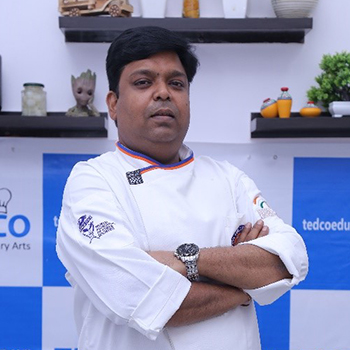
Centre Head & Head of Department
 Whatsapp
Click one of our representatives below to chat on WhatsApp or send us an email to
info@tedcoeducation.com

Counselor
Bakery and Pastry Courses
Counselor
Culinary Arts Courses
Click one of our representatives below to chat on WhatsApp or send us an email to
info@tedcoeducation.com
Counselor
Bakery and Pastry Courses
Counselor
Culinary Arts Courses

