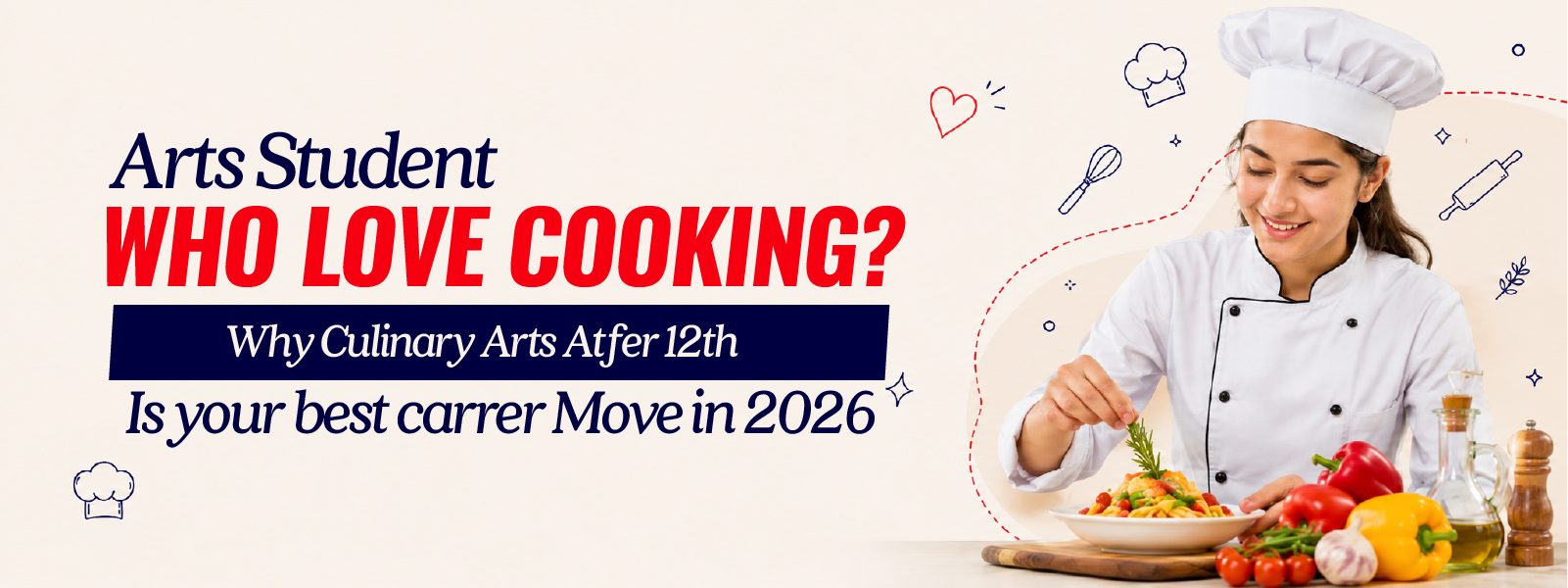

If you spent your 11th and 12th studying History, Political Science, Psychology, or Fine Arts, while quietly spending your weekends experimenting with recipes, plating your meals like you were styling them for a magazine, and watching every cooking show you could find, you have probably had this thought at least once: maybe culinary arts is not really for someone like me. Maybe it is more of a science or commerce thing.
That thought is completely understandable, and completely wrong. Every year, talented, creative arts students hold themselves back from culinary arts after 12th because of an assumption nobody ever actually verified. This guide exists to verify it, and to show you why your arts background might be one of the most underrated advantages a culinary student can have.
By the end of this guide, you will know exactly why any stream, including arts, is fully eligible for culinary programmes, why the creative and aesthetic thinking developed through arts subjects translates directly into culinary skill, what specific career paths arts-background culinary graduates are uniquely positioned for, and how to apply to TGCA with no prior cooking experience required. Let us get into it.
Let us settle this immediately and clearly. Culinary arts programmes in India, including every course at TGCA, are open to students from every academic stream. Arts, Science, and Commerce students are equally eligible for culinary arts after 12th. There is no stream restriction, no minimum percentage requirement, and no entrance exam. The only real qualification is a 12th pass certificate, regardless of which subjects you studied.
The subjects you studied in 11th and 12th, whether History, Sociology, Fine Arts, or Languages, have absolutely no bearing on your ability to master knife skills, develop your palate, learn kitchen management, or build a successful culinary career. What matters is your passion for food and your willingness to learn. Nothing else.
TGCA does not just tolerate arts students in its culinary arts course programmes, it actively welcomes them, because the food and hospitality industry increasingly values exactly the kind of thinking that arts education develops. Visual storytelling, aesthetic judgement, an understanding of culture and context, these are not decorative extras in the food industry. They are central to how food is presented, marketed, and experienced by customers in 2026.
Here is something that culinary career guides rarely talk about: a huge part of what separates a good dish from a memorable one is not just taste, it is presentation, composition, and the story a dish tells on the plate. Arts students, whether their background is in fine arts, literature, design, or the social sciences, have spent years developing exactly the kind of thinking that elevates food from functional to memorable.
These are not abstract advantages. They show up directly in a professional kitchen. A diploma in culinary arts teaches the technical skill of plating, but a student who already has a refined visual sense from their arts education will often pick up advanced plating concepts faster and develop a more distinctive personal style sooner. The same applies to menu design, where understanding how to present a menu as a cohesive, appealing narrative is itself a creative skill.
This is the most common concern, and the honest answer is yes, hotels will absolutely take you seriously. Hotel HR teams and executive chefs evaluate candidates based on which culinary institute they attended, what certification they hold, their practical kitchen skills, and their internship experience. Nobody asks which subjects you studied in 11th and 12th. A chef courses graduate from TGCA with an arts background and a City and Guilds Level 2 diploma stands on exactly equal footing with a science or commerce graduate holding the same qualification.
The skills that get you noticed in a hotel kitchen interview, knife technique, sauce knowledge, plating, kitchen discipline, and composure under pressure, are built through a year of professional training, regardless of your academic background before you walked through the door.
Not at all, and here is why this worry does not hold up under examination. Every culinary arts after 12th student starts from the same foundational point, regardless of stream. Your first week at TGCA covers the same knife skills session, the same kitchen orientation, and the same foundational technique modules as every other student. No prior cooking knowledge or technical background is assumed.
In fact, many of the technical aspects of cooking, precision, measurement, timing, and methodical process, are skills that disciplined arts students, particularly those who have done detailed creative work like painting, design, or performance, often adapt to quickly because they are already used to the kind of focused, repetitive practice that builds mastery.
This is where the arts plus culinary combination genuinely shines. Several of the most exciting and fastest-growing roles in the modern food industry sit precisely at the intersection of culinary skill and creative or aesthetic training.
Beyond hands-on kitchen roles, arts-background culinary arts after 12th graduates are particularly well-suited to roles that combine culinary knowledge with communication. Culinary instructors need to explain techniques clearly and engagingly. Food writers need both culinary credibility and writing skill. Recipe developers need to think about how a dish will be communicated as much as how it is made. And culinary brand storytellers, working with restaurants or food companies, need to translate culinary concepts into compelling brand narratives. Each of these roles draws directly on strengths that an arts education builds.
Every programme at TGCA is available to arts students on exactly the same terms as any other stream. For students considering culinary arts after 12th, here is what is available in 2026:
EMI and instalment payment options are available for all programmes. Contact the admissions team at tedcoeducation.com or call 011-69240093 for the most current fee breakdown.
Applying is straightforward and identical regardless of stream. You will need your 10th mark sheet, your 12th mark sheet or admit card if results are pending, a valid government-issued ID proof such as Aadhaar or passport, and two to four passport-size photographs. There is no entrance exam and no stream-specific requirement. You can apply right now using your admit card, even before your 12th results are declared, and submit your final mark sheets once results are announced.
Professional kitchens are increasingly recognising that technical skill alone does not differentiate a chef in a competitive market. The chefs and culinary professionals who stand out are often the ones who bring something extra, a distinctive plating style, a memorable menu concept, a compelling way of presenting food on social media. Arts-trained culinary arts course graduates frequently bring exactly this extra dimension, not as an afterthought, but as a core part of how they approach their work from day one.
Consider a fine-dining restaurant launching a new seasonal menu. The technical execution matters enormously, but so does how the menu is described, how each dish is presented, and how the overall dining experience is conceptualised. A culinary graduate with an arts background can contribute meaningfully to all of these dimensions, not just the cooking. Similarly, a restaurant building its social media presence benefits enormously from team members who understand both the food and how to present it compellingly on camera. These are not niche exceptions. They are increasingly central to how successful food businesses operate in 2026.
TGCA is built on the principle that culinary excellence comes from training quality and individual commitment, not from which subjects a student studied in school. For arts students considering culinary arts after 12th, TGCA offers open admission with no stream restriction, City and Guilds (UK) accreditation recognised in over 100 countries, a professional commercial kitchen at Connaught Place, New Delhi, small batch sizes that ensure individual attention, and faculty with real hotel and international kitchen experience.
The curriculum also includes plating, presentation, and menu development modules that are particularly relevant for creatively inclined students, ensuring that the aesthetic strengths arts students bring with them are actively developed rather than left untapped.
The best first step for any arts student considering culinary arts after 12th, particularly those drawn to the creative side of food, food styling, content creation, fine-dining presentation, or culinary writing, is a real conversation with TGCA's counselling team. They will discuss your specific interests and help map them to the right programme and the right focus areas within that programme, whether that leans toward classical culinary technique, pastry and presentation, or a broader foundation that supports multiple creative paths.
If you are an arts student who loves cooking and has been hesitating about culinary arts after 12th, the hesitation can end here. Your stream is not a barrier. The creativity, aesthetic sensibility, and storytelling instincts you have developed through arts education are not separate from culinary excellence, they are an active part of it, particularly in the creative and presentation-focused roles that are growing fastest in the food industry today.
This is what culinary arts after 12th arts stream India really looks like in 2026: not a compromise, but a combination of skills that the industry genuinely values.
Stop assuming your stream defines what is possible for you. Your creativity is not separate from a culinary career, it is part of what could make your culinary career genuinely distinctive. Book a free counselling session at TGCA today. Visit the campus, see the kitchen, and have an honest conversation about how your specific strengths fit into a culinary education built around real career outcomes. 2026 batches are open now and seats are filling up.
Yes, absolutely. Any stream is eligible for culinary programmes at TGCA. Arts, Science, and Commerce students are all equally welcome, with no stream restriction, no entrance exam, and no minimum percentage required to enrol.
Both the Diploma in Culinary Arts and Diploma in Bakery and Pastry Arts work well for arts students, especially those interested in plating, presentation, and creative food roles. A counsellor can help match the right programme to your specific interests.
No. There is no entrance exam for culinary programmes at TGCA regardless of stream. Admission is based on 12th pass eligibility from any stream, including arts, with a simple application and counselling process.
Yes. Creative and aesthetic skills developed through arts education, visual composition, storytelling, and design sensibility, translate directly into food styling, plating, and culinary content creation, areas where arts-background graduates often excel.
No prior cooking experience is required at any level. TGCA's curriculum begins from the basics and builds every student systematically. Passion and commitment are the only prerequisites, regardless of your stream or prior experience.
Bakery & Pastry Instructor
 Whatsapp
Click one of our representatives below to chat on WhatsApp or send us an email to
info@tedcoeducation.com

Counselor
Bakery and Pastry Courses
Counselor
Culinary Arts Courses
Click one of our representatives below to chat on WhatsApp or send us an email to
info@tedcoeducation.com
Counselor
Bakery and Pastry Courses
Counselor
Culinary Arts Courses

