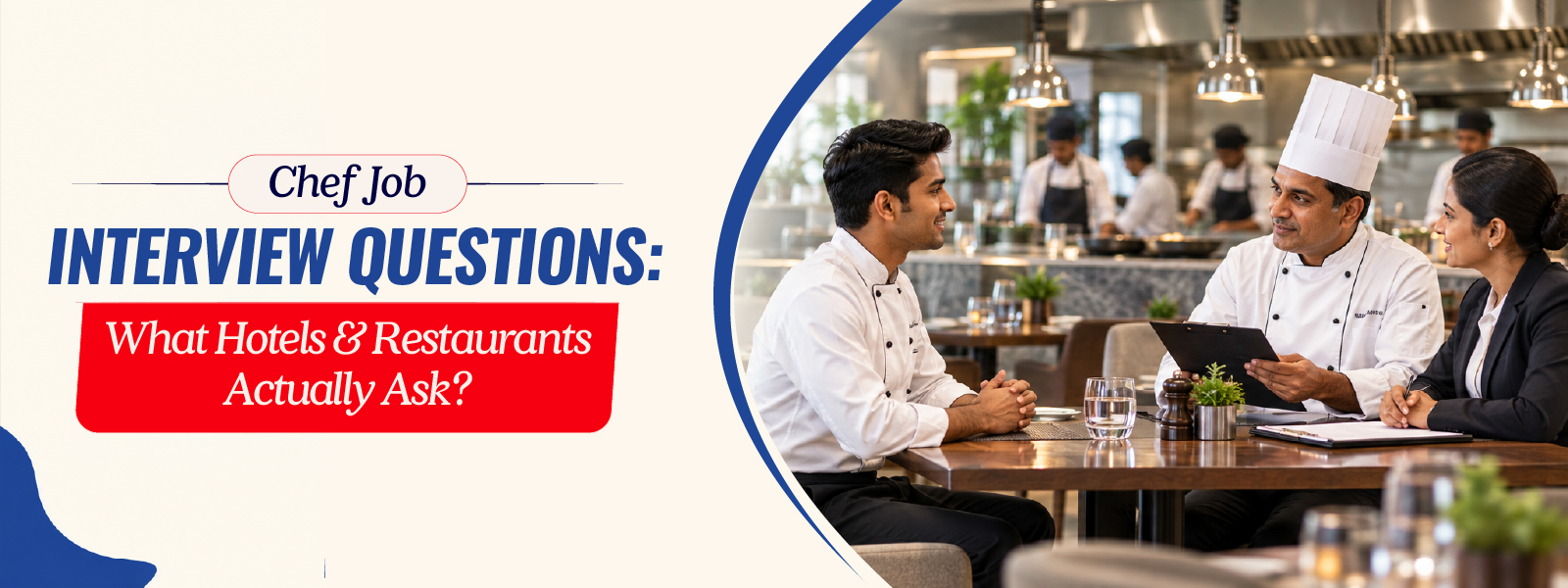
Getting shortlisted for a chef position is only the first step. The interview is where employers assess whether you can actually work in a professional kitchen. If you have completed culinary classes, chef courses or a culinary arts course, you may already have the technical foundation. The interview is where you need to show how you apply those skills under pressure.
Hotels, QSR chains and standalone restaurants may ask different questions depending on their kitchen style, menu and service volume. Some focus heavily on technical knowledge, while others pay close attention to attitude, hygiene, consistency, teamwork and your ability to stay organised during a busy service.
Here is what you should expect and how to prepare.
Walking into an interview without knowing anything about the kitchen can make even a skilled candidate appear unprepared. Spend some time researching the property or restaurant before the interview.
Look at the restaurant's menu, cuisine style, service format and signature dishes.
For a hotel, understand whether the opening is for a fine-dining restaurant, all-day dining outlet, banquet kitchen, pastry section or another operation. A QSR may place greater emphasis on speed, consistency and standardised preparation, while a standalone restaurant may look closely at cuisine-specific skills.
Read the job description carefully. It often tells you which skills the employer is likely to test.
Keep your documents organised in a folder. Depending on the employer, these may include:
If you are a fresher, your training records and practical exposure can help demonstrate what you have learnt.
A chef interview does not require you to arrive dressed as though you are already working a service. However, you should look clean, professional and well groomed.
Pay attention to clean clothing, trimmed nails, neat hair and good personal hygiene. In a kitchen environment, these details matter because hygiene is part of professional behaviour.
Most interviews begin with straightforward questions. Do not mistake them for unimportant questions.
Keep your answer relevant to the kitchen.
Talk about your culinary education, practical training, areas of interest, internships or previous kitchen experience. Avoid giving a long personal history.
For example, a fresher could explain that they have completed culinary training, gained practical experience across different sections and are particularly interested in developing their skills in a professional kitchen.
Employers want to understand your motivation.
Instead of simply saying, "I love cooking", explain what attracted you to professional kitchens. You could discuss your interest in food preparation, working with ingredients, learning different cuisines or the discipline involved in kitchen operations.
This is where your research becomes useful.
Mention something specific about the property, such as its cuisine, menu concept, reputation, kitchen operation or the type of experience it provides. A generic answer that could apply to every restaurant is less useful than one that shows you have researched the employer.
Your answer should show direction without making unrealistic promises.
You might want to develop expertise in a particular cuisine, progress through the kitchen brigade, take responsibility for a section or eventually move into a leadership role.
The important point is to demonstrate that you understand career progression takes time and practical experience.
Candidates applying after culinary classes or chef courses should expect questions about basic cooking knowledge.
Depending on the position, you could be asked about:
The interviewer may not simply ask you to define a term. They may give you a situation and ask how you would use a particular technique.
For example, instead of asking only what a stock is, they may ask which stock you would choose for a particular preparation and why.
Be comfortable explaining methods such as:
You should understand how heat affects different ingredients and how cooking time influences texture and doneness.
The questions you receive will depend heavily on the position.
A garde manger candidate may be questioned about salads, cold preparations, dressings and presentation. A hot kitchen candidate may face questions about sauces, proteins and cooking temperatures. A bakery candidate may be asked about dough, fermentation, mixing methods and baking conditions.
This is why understanding the specific job description is so important.
Technical cooking skills are only one part of working in a professional kitchen. Food safety is equally important.
Depending on the employer and position, you may be asked about HACCP principles, cross-contamination and safe food handling.
You should understand the importance of separating raw and ready-to-eat foods, maintaining clean workstations and following established food safety procedures.
Questions may also cover:
Do not memorise terms without understanding how they work in a real kitchen.
If asked about FIFO, for example, explain how it helps kitchens use older stock appropriately, reduce unnecessary waste and maintain better inventory control.
A kitchen interview is not only about what you know. Employers also want to understand how you behave when service becomes difficult.
A strong answer should focus on communication and prioritisation.
You could explain that you would first identify which orders are most urgent, communicate with the relevant team members and reorganise your mise en place where possible. If support is needed, you should communicate early rather than allowing the problem to grow silently.
Avoid becoming defensive.
First understand why the dish was returned. Check the preparation and communicate with the relevant senior chef or service team. The objective is to resolve the issue professionally while maintaining food quality and service standards.
Professional kitchens have clear hierarchies.
If the issue concerns an immediate service decision, follow the appropriate chain of command. If there is an opportunity to discuss the matter later, raise your point respectfully rather than arguing during a busy service.
Employers are often looking for people who can communicate without creating unnecessary conflict.
The interview expectations can differ considerably depending on your experience.
For a fresher, employers may pay particular attention to:
Nobody expects a fresher to know everything. However, pretending to know something you have never done can create problems during a practical trial.
Experienced candidates can expect broader questions about kitchen operations.
These may include:
The more senior the role, the more the conversation may move beyond cooking into people, cost and operational responsibilities.
Many kitchen recruitment processes include a practical assessment.
The format varies by employer. You might be asked to prepare a specific dish, reproduce an existing menu item, work with a mystery basket or demonstrate your skills at a particular station.
The finished plate is important, but it is not the only thing being assessed.
The kitchen team may also observe:
A practical trial is not simply a cooking competition. It is a chance for the employer to see how you actually operate in a kitchen.
An interview should not be a one-way conversation. Asking sensible questions can help you understand whether the role matches your career goals.
You could ask:
Questions about shifts, staff meals and other practical matters can also be appropriate once the conversation reaches the relevant stage.
Even technically capable candidates can make avoidable mistakes.
If you write "advanced pastry skills" on your CV but struggle during a basic practical test, the problem is not just the technique. It affects the employer's trust in the rest of your application.
Be honest about your current level.
A messy workstation, poor hygiene or disorganised mise en place can quickly become noticeable during a trial.
Professional cooking is not only about producing a good dish. It is also about producing it safely, consistently and efficiently.
When the interviewer asks, "Do you have any questions for us?" replying immediately with "No" can make the conversation end abruptly.
Prepare two or three genuine questions beforehand. They can relate to the kitchen structure, training, responsibilities or progression.
A strong foundation can make the transition from culinary education to professional kitchens easier. Structured culinary classes give students opportunities to practise techniques repeatedly rather than learning them only in theory.
At TGCA, practical culinary training can help students build familiarity with professional kitchen routines, cooking techniques, hygiene practices and the discipline expected in a working kitchen. Placement-focused support can also help students prepare for interviews and understand what employers expect from entry-level candidates.
For students considering a culinary arts course, the value of training goes beyond learning recipes. The goal is to build dependable habits: accurate preparation, clean workstations, time management, teamwork and consistency.
Chef interviews test much more than your ability to cook.
Whether you are applying after completing culinary classes or entering the industry with several years of experience, prepare for questions covering cooking fundamentals, food safety, teamwork, pressure handling and kitchen discipline.
Research the property, understand the position, be honest about your skills and practise explaining your decisions clearly. And when a practical trial is part of the process, remember that the chef is watching how you work, not just what you put on the plate.
The right preparation can help you walk into the interview with a clearer understanding of what the kitchen expects and what you can bring to the team.
Pastry Instructor
 Whatsapp
Click one of our representatives below to chat on WhatsApp or send us an email to
info@tedcoeducation.com

Counselor
Bakery and Pastry Courses
Counselor
Culinary Arts Courses
Click one of our representatives below to chat on WhatsApp or send us an email to
info@tedcoeducation.com
Counselor
Bakery and Pastry Courses
Counselor
Culinary Arts Courses

