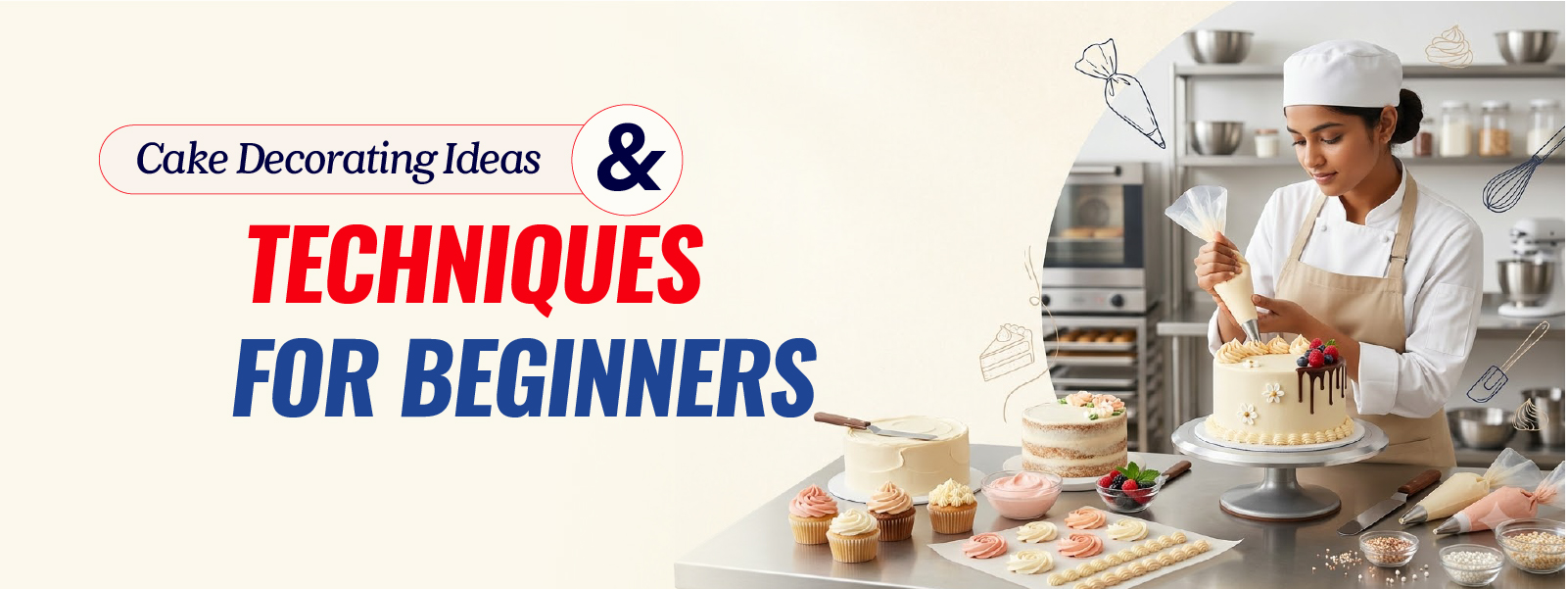
A freshly baked cake can be delicious on its own, but decorating is what gives it personality. A smooth buttercream finish, a neat row of piped shells, or a few carefully placed chocolate decorations can turn a simple cake into something that looks made for a celebration.
For beginners, however, cake decorating can initially feel intimidating. Frosting may refuse to become smooth, piping may look uneven, and fondant may crack when it is rolled too thin.
The good news is that professional-looking decoration does not begin with complicated designs. It begins with understanding the basics and practising them repeatedly. A structured cake decoration course can help beginners learn those fundamentals in a more organised way, while a cake making course can build the baking foundation needed before decoration even begins. For those looking for cake baking classes in Delhi, it is worth choosing training that includes both practical preparation and decorating techniques.
A beautifully decorated cake is not necessarily the most elaborate one.
Good decoration is usually about balance. The cake should have a clean finish, appropriate colours, controlled textures and decorations that complement rather than overwhelm the design.
Imagine a simple round cake covered in smooth buttercream. A few carefully piped rosettes sit around the top, with small chocolate pieces providing contrast. Nothing is excessive, but every element has a purpose.
Beginners should focus on:
Having the right tools makes decorating easier and gives beginners better control.
Some of the most useful tools include:
Decoration begins before the frosting goes onto the cake.
The cake needs to be completely cooled before decorating. Warm cake can soften buttercream and make the entire process more difficult.
The next steps may include trimming, levelling, and layering.
A cake with uneven layers can become difficult to decorate because the final surface may slope or shift. Levelling creates a more stable foundation.
If the cake contains multiple layers, the filling should also be spread evenly. Think of each layer as part of a carefully constructed structure. If the foundation is uneven, beautiful decoration cannot completely hide the problem.
Good decorating therefore begins with good preparation.
Buttercream is one of the most versatile decorating materials for beginners.
It can be used to fill cakes, cover them, create borders and produce decorative patterns.
The consistency matters.
A softer buttercream may be easier to spread, while a firmer consistency can provide better control for piping. Students learn through practice how temperature, ingredients and mixing affect the final texture.
Start with an even layer of buttercream around the cake. A scraper can then be used to gradually smooth the sides while the turntable rotates.
The aim is not to remove all the buttercream in one movement.
Instead, controlled passes help create a more even surface.
Beginners often discover that patience makes a bigger difference than pressure.
Piping is one of the easiest ways to add character to a cake.
Beginners can start with a small collection of simple techniques.
Beginners do not need elaborate equipment to create attractive designs.
A simple cake can be transformed using:
Fondant provides a smooth surface and allows decorators to create shapes and decorative details.
Beginners can start by learning how to roll fondant evenly and cover a cake without creating unwanted folds.
They can then progress towards simple shapes, cut-outs, lettering and decorative elements.
Fondant requires careful handling. If it becomes too dry, it may crack. If it becomes too soft, it can become difficult to handle.
Temperature, thickness and working speed can all affect the final result.
Structured practical training can help beginners understand these differences through hands-on practice.
Chocolate can add both flavour and visual contrast.
It can be used as curls, shards, curls, discs, drizzles or simple decorative pieces.
Other ingredients can also contribute texture and colour. Nuts, sprinkles, fruit and edible decorations can turn a plain surface into something more visually interesting.
The secret is restraint.
A cake can contain several different textures without looking crowded if the decorations are arranged thoughtfully.
For example, smooth buttercream combined with a few crisp chocolate pieces creates contrast without requiring a complicated design.
Colour can change the entire character of a cake.
Soft tones can create a delicate appearance, while stronger contrasts can produce a more dramatic result.
Beginners should avoid using too many unrelated colours at once. Choosing two or three complementary shades can make the design easier to control.
It also helps to consider where each colour will appear.
A darker colour might work as a border or accent, while a lighter shade can cover the main surface.
The goal is to make the design look intentional.
Everyone makes mistakes while learning.
Some of the most common include:
Cake decorating is a practical skill. Watching someone decorate a cake can help, but your hands develop control through repetition.
Beginners can improve by practising one technique at a time.
For example, spend one session working only on smooth buttercream. Another can focus on piping shells. A later session can concentrate on rosettes.
This approach makes improvement easier to recognise.
It also prevents beginners from becoming overwhelmed by trying to learn everything simultaneously.
Keeping photographs of earlier work can be useful as well. Comparing an early cake with a later one can reveal improvements in piping consistency, finishing and overall design.
Self-learning can be a useful starting point, but structured education can shorten the trial-and-error process.
A cake decoration course can introduce learners to professional tools, finishing methods, piping techniques, fondant work and design principles in a structured environment.
At TGCA, practical learning can help students understand how preparation, technique and presentation come together.
Instead of simply copying a design, students can learn the principles behind it.
That distinction matters because professional cake decoration requires adaptability. A customer may request a different colour, shape, flavour or theme. A trained decorator needs to know how to modify a technique rather than simply reproduce one example.
Cake decorating can support several career pathways within the bakery and hospitality industry.
Depending on experience and additional training, opportunities may exist in:
Not every decorating programme offers the same learning experience.
Before enrolling, beginners should consider:
Cake decoration becomes easier when students understand what is underneath the decoration.
A well-baked cake provides the foundation. Correctly prepared fillings provide stability. Properly mixed buttercream creates a workable coating. Accurate piping turns that coating into decoration.
At TGCA, students can develop practical baking and pastry knowledge alongside specialised techniques, helping them understand the relationship between preparation and presentation.
This broader approach can be particularly useful for learners who want to move from beginner-level decorating towards professional bakery or pastry work.
Cake decorating does not have to begin with elaborate flowers, intricate figures or highly detailed designs. It can begin with a smooth buttercream finish, a steady piping bag and the patience to repeat the same technique until the movement becomes natural.
A cake making course can help beginners build this foundation by introducing essential skills such as preparing cake layers, making and applying frostings, filling cakes evenly and learning basic decorating techniques. Understanding these fundamentals makes it easier to progress towards more detailed designs with confidence.
Beginners who understand their tools, prepare their cakes correctly and master basic techniques can gradually progress towards more detailed designs.
Whether the goal is to decorate cakes confidently at home or explore professional opportunities, structured learning can provide valuable direction. With consistent practice and the right training, cake decoration becomes less about simply making a cake look beautiful and more about understanding how to create a balanced, precise and professionally finished product.
A cake decoration course can teach buttercream finishing, piping, fondant work, decorative techniques, colour coordination, cake assembly, and professional presentation through structured practical training.
Basic baking knowledge can be helpful, but beginners can learn decoration techniques through structured training. Understanding cake preparation, cooling, and layering makes decorating considerably easier.
Beginners should start with foundational skills such as applying smooth buttercream and basic piping. These techniques build the control needed for more detailed cake decoration.
Yes. Cake decorating skills can support opportunities in bakeries, cake studios, hotels, pastry kitchens, cafés, catering businesses and independent cake ventures.
Yes. Structured training can help home bakers learn professional decorating techniques, understand tools, and practise finishing methods more efficiently than relying entirely on trial and error.
Centre Head & Head of Department
 Whatsapp
Click one of our representatives below to chat on WhatsApp or send us an email to
info@tedcoeducation.com

Counselor
Bakery and Pastry Courses
Counselor
Culinary Arts Courses
Click one of our representatives below to chat on WhatsApp or send us an email to
info@tedcoeducation.com
Counselor
Bakery and Pastry Courses
Counselor
Culinary Arts Courses

