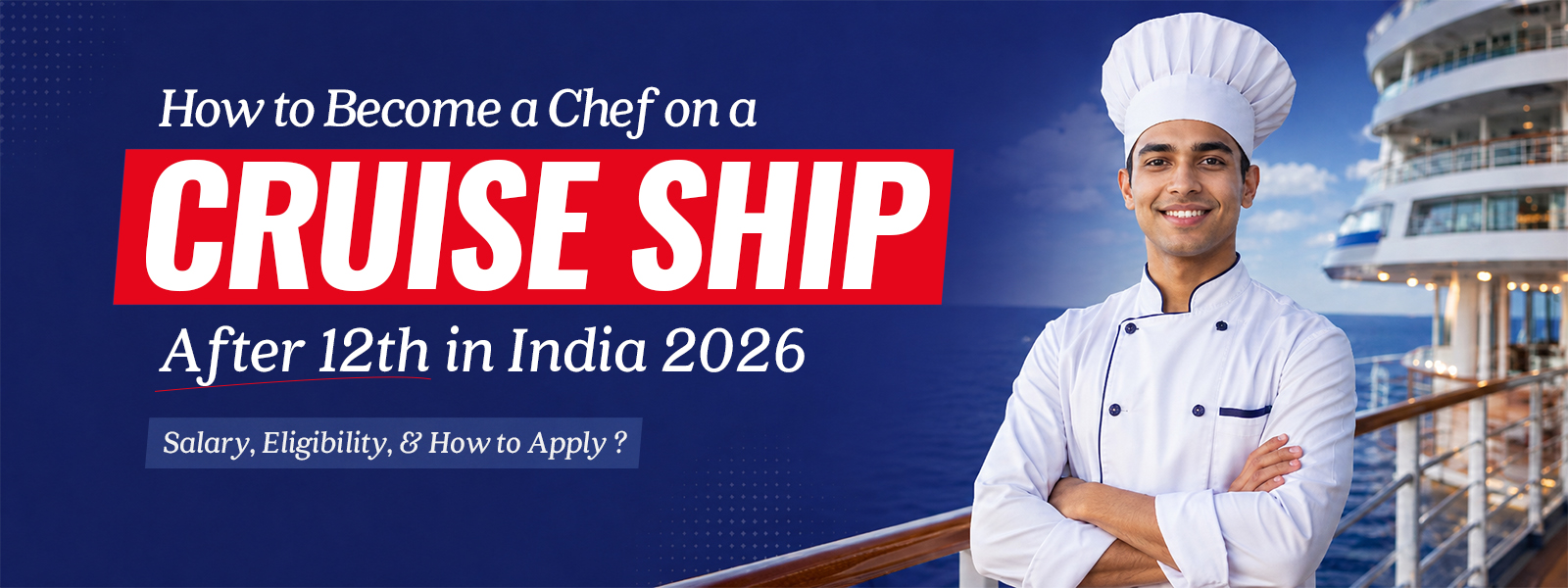
Imagine waking up in the Mediterranean one week, the Caribbean the next, and the Norwegian fjords the week after, all while doing the work you love in one of the most professionally demanding kitchens in the world. For Indian culinary graduates who complete the right chef courses after 12th, this is not a fantasy. It is a genuinely accessible career path in 2026, and the number of Indian chefs working on international cruise lines has grown significantly over the last decade.
Cruise ship kitchens are among the most well-organised, well-equipped, and well-paying professional environments in the global hospitality industry. They offer competitive salaries, free accommodation, free food, travel allowances, and the kind of global culinary exposure that most chefs spend decades trying to accumulate in conventional hotel and restaurant careers.
This guide gives you a complete, honest picture of what it takes to become a cruise ship chef after 12th in India in 2026, from the eligibility requirements and the right course to choose, to the salary you can expect and how to actually apply. :contentReference[oaicite:0]{index=0}
By the end of this blog, you will know exactly what a cruise ship chef does, what qualifications and certifications you need, the step-by-step pathway from 12th pass to your first cruise contract, realistic salary figures, which cruise lines are actively hiring Indian chefs, and how TGCA's training and international internship programme give you the right foundation to pursue this career.
A large international cruise ship can carry anywhere from 2,000 to 6,000 passengers and operate 10 to 20 restaurants, cafes, buffets, and specialty dining venues simultaneously. That requires a kitchen brigade of anywhere from 200 to 500 culinary staff, creating a genuine range of roles for Indian chefs at every experience level.
Entry-level roles for fresh culinary graduates typically include Commis Chef positions in the main galley or speciality restaurants, Bakery and Pastry Commis roles in the onboard pastry sections, Garde Manger staff responsible for cold dishes, salads, and buffet preparation, and Kitchen Steward roles for students who want to begin in a support function and move up quickly. More experienced chefs can progress to Chef de Partie, Sous Chef, and eventually Executive Chef roles that carry significant responsibility for the entire onboard culinary operation.
Cruise ship kitchens operate at a scale that most hotel kitchens in India cannot match. Feeding 4,000 passengers across multiple venues simultaneously requires extraordinary logistics, consistency, and team coordination. The kitchen runs 24 hours a day, 7 days a week, for months at a time without a break. This environment is genuinely demanding and genuinely rewarding. The chefs who thrive in it are those who have been trained in professional kitchen environments with real brigade discipline, exactly the kind of training that a City and Guilds-accredited programme at an institute like TGCA provides.
Cruise lines have specific requirements for the chefs they hire, and understanding them is the first step to knowing whether this path is right for you. Here is what most international cruise lines require from Indian culinary candidates in 2026:
Among all the culinary arts colleges in India preparing students for international careers, the ones that hold City and Guilds (UK) accreditation give their graduates the most consistent advantage in cruise ship applications. The City and Guilds name is recognised by cruise line HR teams in Europe, the Middle East, and North America. When a recruiter sees a City and Guilds Level 2 diploma from an accredited Indian institute on a CV, they know immediately what standard of training the candidate has received. That recognition dramatically reduces the friction in the hiring process.
The foundation of your cruise ship career starts with the right chef courses after the 12th. A Diploma in Culinary Arts or a Diploma in Bakery and Pastry Arts from a City and Guilds (UK) accredited institute like TGCA gives you both the culinary training and the internationally recognised certification that cruise lines require. The diploma takes 1 year and leads to a City and Guilds Level 2 qualification.
After completing your diploma, your first step is to enter a professional kitchen in India. A hotel, resort, restaurant, or catering company job gives you the real-world brigade experience that cruise lines expect before hiring entry-level candidates. This experience also gives you the confidence and composure to thrive in the high-pressure onboard kitchen environment from your very first contract.
STCW, Standards of Training, Certification and Watchkeeping for Seafarers, is mandatory for anyone working on a commercial vessel, regardless of their role. It covers personal survival techniques, fire prevention and firefighting, elementary first aid, and personal safety and social responsibilities. STCW courses are available at maritime training centres across India and typically take 5 to 7 days to complete. Without it, you cannot legally work on a cruise ship.
Cruise lines require a valid medical fitness certificate from an approved seafarer medical examiner. This ensures you are fit to work in the demanding onboard environment. The examination covers general health, eyesight, hearing, and other fitness indicators. Most major ports in India have approved examination centres.
Indian chefs apply to international cruise lines either directly through the cruise line's career portal or through authorised manning agents based in Mumbai, Goa, and Chennai who have placement relationships with major cruise companies. Having a diploma in culinary arts from a City and Guilds-accredited institute, along with your STCW certification and domestic kitchen experience, puts you in a strong position for shortlisting.
When you factor in that almost all living expenses are covered, a Commis Chef earning Rs 1 lakh per month on a cruise ship is effectively saving almost all of it, a financial position that would take years to reach in a domestic hotel career.
A typical entry-level cruise ship contract for an Indian culinary professional runs for 4 to 6 months, followed by 2 to 3 months of leave back in India before the next contract begins. Onboard, kitchen shifts run across three rotations covering breakfast, lunch, and dinner service, with rest periods between. The work is hard, the hours are long, and the kitchen environment is demanding. But the compensation, the travel, and the professional development are exceptional.
Crew accommodation is in shared cabins below deck, meals are provided in the crew mess, and there is limited but real leisure time in port. Many crew members use port stops to explore destinations, which is one of the genuine lifestyle benefits of a cruise career that no shore-based job can offer.
Among the best culinary schools in India preparing students for international careers, TGCA stands out for three specific reasons:
The pathway from TGCA to an international culinary career is well-established. Students complete their culinary arts course at TGCA, receive City and Guilds Level 2 certification, complete their internship, gain domestic kitchen experience, obtain their STCW certification, and apply to cruise lines through TGCA's placement network and authorised manning agents.
Becoming a cruise ship chef after 12th in India is a clear, achievable pathway for students who love cooking and want a career that combines professional excellence with global adventure. The steps are straightforward: complete the right chef courses after 12th at an accredited institute, gain domestic kitchen experience, obtain STCW certification, build a strong CV, and apply through the right channels.
Every international culinary career begins with the same first step: the right training at the right institute. TGCA's 2026 batches are open right now. Book a free campus visit, speak to the team about the international pathway, and see for yourself why TGCA graduates are working in professional kitchens across India and around the world.
The ocean is waiting. Your career starts today.
Entry-level Commis Chefs typically earn Rs 80,000 to Rs 1,20,000 per month with free accommodation and food. Chef de Partie roles range from Rs 1,20,000 to Rs 2,00,000. All living expenses are covered, making the effective savings rate very high.
Yes. STCW, Standards of Training Certification and Watchkeeping, is mandatory for all cruise ship crew. You also need a valid passport, a seafarer medical certificate, and an internationally recognised culinary qualification like City and Guilds from TGCA.
A City and Guilds (UK) Level 2 Diploma in Culinary Arts from an accredited institute like TGCA is the most recognised qualification. Cruise line HR teams across Europe and internationally are familiar with City and Guilds standards and actively value this credential.
Typically 2 to 3 years. One year for the culinary diploma, 6 to 12 months of domestic kitchen experience, plus time for STCW training and application processes. Students with strong qualifications and internship experience can achieve this faster.
Yes. TGCA's City and Guilds accreditation, international internship programme, and placement cell all support students pursuing international careers. Speak to the TGCA team about the international pathway during your free counselling session.

Centre Head & Head of Department
 Whatsapp
Click one of our representatives below to chat on WhatsApp or send us an email to
info@tedcoeducation.com

Counselor
Bakery and Pastry Courses
Counselor
Culinary Arts Courses
Click one of our representatives below to chat on WhatsApp or send us an email to
info@tedcoeducation.com
Counselor
Bakery and Pastry Courses
Counselor
Culinary Arts Courses

