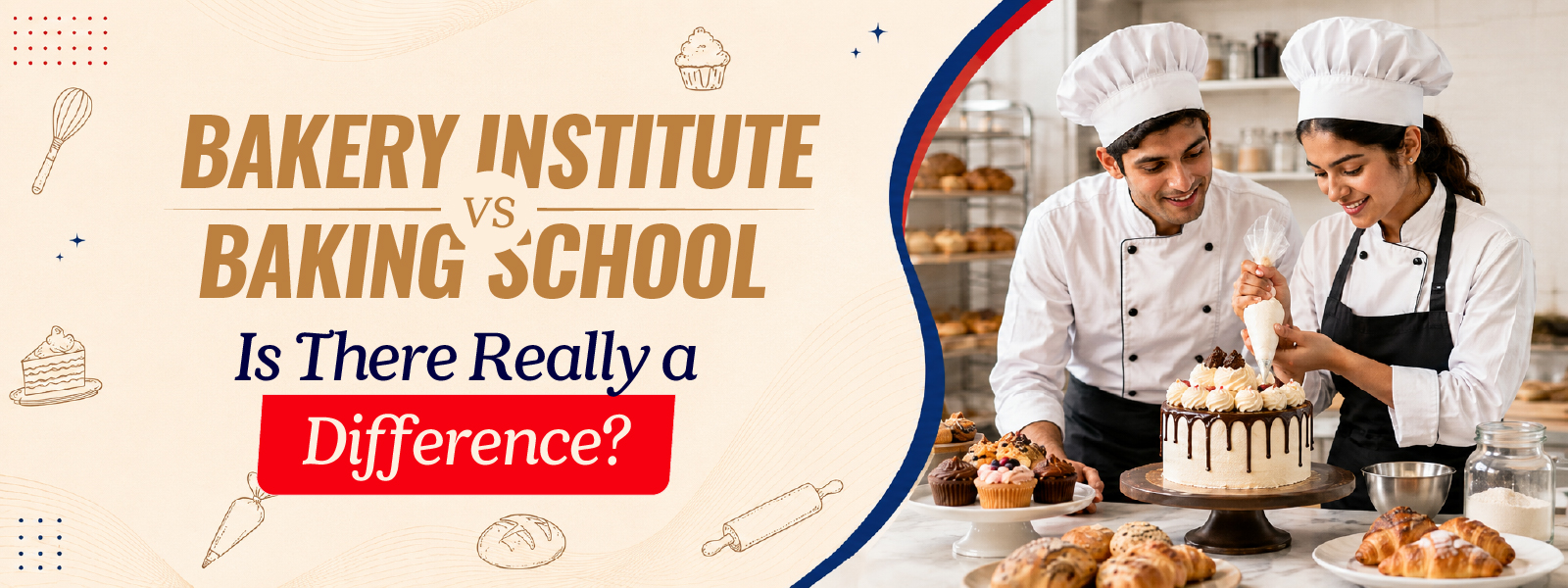
Imagine walking into a bakery kitchen early in the morning. The ovens are warming up, trays are lined across stainless-steel counters, dough is resting under carefully controlled conditions, and the aroma of freshly baked bread fills the room. In one corner, a student is learning how to laminate croissant dough. Nearby, another is practising cake decoration while an instructor explains why temperature matters.
For someone searching for a Baking Institute Near Me, this is the kind of practical learning environment that can make a real difference.
But when you begin researching your options, you may notice several terms: bakery institute, baking school, bakery academy and baking classes. Are they actually different, or are these simply different names for similar training?
The answer is that there can be differences, but the name alone does not tell you whether an institution is right for you. The curriculum, practical training, instructors, facilities and career focus matter far more.
If you are considering a bakery institute in Delhi, understanding these differences can help you choose a programme that matches your ambitions, whether you want to become a professional baker, work in a hotel pastry kitchen or eventually start your own bakery.
A bakery institute generally provides structured education focused on professional baking and pastry production.
Unlike casual workshops, an institute may offer longer programmes covering a wider range of skills. Students can learn how ingredients behave, how different doughs are prepared, how cakes are structured and how professional bakery equipment is used.
Depending on the programme, training may include:
The important point is that an institute generally aims to provide a structured learning journey rather than teaching one isolated skill.
A baking school can refer to an institution that teaches baking skills through courses, classes and workshops.
The duration can vary considerably.
One baking school may offer weekend classes for beginners, while another may provide professional diploma-level programmes.
This is why the term "baking school" should not automatically be associated with a particular level of education.
A short workshop and a professional baking programme can both technically be offered by a baking school, yet the learning experience and career outcomes may be completely different.
When searching for a baking school near me, therefore, look beyond the name.
Ask what you will actually learn.
The simplest way to understand the distinction is to think about depth and purpose.
A bakery institute often focuses on structured, professional-oriented education.
A baking school can cover anything from beginner classes to advanced professional programmes.
There is considerable overlap between the two.
In fact, two institutions with different names may offer almost identical training, while two institutions with the same name may have completely different approaches.
So instead of asking:
"Is an institute better than a school?"
Ask:
"Does this programme give me the skills I need for my goal?"
That question will lead you towards a much better decision.
Baking is not a skill you master by reading recipes alone.
You need to work with the ingredients.
You need to feel dough.
You need to understand how butter behaves.
You need to recognise when a sponge has been mixed correctly.
You need to learn what happens when an oven is too hot or when fermentation takes longer than expected.
This is why practical training should be one of your first considerations when comparing institutions.
A good programme should give you repeated opportunities to practise techniques rather than simply watching an instructor demonstrate them.
Imagine making croissants for the first time.
You follow the instructions carefully, but your butter breaks through the dough during lamination.
The next time, you manage the temperature better.
After several attempts, you begin to understand the relationship between dough temperature, butter consistency, rolling pressure and resting time.
That knowledge stays with you.
This is what practical education provides.
A well-structured professional programme should go beyond basic cakes and cookies.
Students should gradually build a foundation before moving towards more advanced products.
Bread introduces students to some of the fundamental principles of baking.
They learn about yeast, gluten development, fermentation, shaping and baking.
Products can range from basic loaves to enriched breads and specialty varieties.
Cake-making involves much more than mixing ingredients together.
Students need to understand aeration, emulsification, ingredient ratios, mixing techniques and baking temperatures.
They may also learn layering, filling, frosting and finishing.
Pastry work introduces another level of precision.
Shortcrust, puff pastry, choux pastry and laminated products each require different techniques.
Small mistakes in temperature or handling can affect the final product significantly.
Chocolate work teaches students about temperature control, texture, decoration and presentation.
These skills can be valuable for pastry kitchens as well as specialised chocolate businesses.
A product may taste excellent, but presentation matters too.
Students can learn piping, finishing, garnishing and basic decorative techniques to create products that look as good as they taste.
Not everyone looking for baking education wants to become a professional baker.
This is where shorter baking classes can be useful.
Someone may simply want to learn how to make better cakes at home.
Another person may want to start a home-based baking business.
Someone else may be considering baking as a full-time career.
These three people do not necessarily need the same course.
Short classes can teach specific recipes and techniques without requiring a long-term commitment.
A more structured programme can help build consistency, particularly if you plan to sell cakes, breads or desserts.
A comprehensive programme with extensive practical training is generally more suitable.
The lesson is simple:
Choose the programme according to what you want to do after learning.
You can learn basic baking at home using a domestic oven.
Professional baking is different.
Commercial kitchens introduce students to larger equipment, professional workstations and production methods.
When comparing institutions, look at the training environment.
Can students work individually or in small groups?
Do they have access to ovens and professional baking equipment?
Are they allowed to practise?
Is there enough workspace?
These questions matter because your learning experience depends partly on how much time you actually spend working with the equipment.
A recipe can tell you that dough should be kneaded until it reaches a certain stage.
An experienced instructor can show you what that stage actually looks and feels like.
That distinction is important.
Good instructors do not simply demonstrate recipes. They explain why something works.
They can identify mistakes, suggest corrections and share practical observations developed through professional experience.
When researching a bakery institute in Delhi, look at the instructors as carefully as you look at the course curriculum.
Practical training is essential, but theory should not be ignored.
Understanding why something happens can make you a better baker.
For example, knowing that yeast produces carbon dioxide during fermentation helps you understand why dough rises.
Understanding gluten development explains why mixing and kneading affect bread structure.
Knowing how sugar, fat and eggs behave helps you troubleshoot cakes.
Learning about temperature explains why chocolate, butter and dough respond differently under different conditions.
When theory and practical work come together, recipes become less like instructions and more like a system you understand.
There is a major difference between these two statements:
"The recipe says to mix for five minutes."
and
"I understand what the mixture should look like at this stage."
The second represents a deeper skill.
Recipes are useful starting points, but professional bakers need to respond to real conditions.
Flour can vary.
Room temperature can change.
Humidity can affect dough.
Ovens can behave differently.
Ingredients may not always perform identically.
Training teaches you how to recognise these differences and adjust accordingly.
Before enrolling, create a simple checklist.
A two-day workshop cannot provide the same depth as a professional programme lasting several months.
Check whether the programme covers the products and techniques you actually want to learn.
Ask how much time students spend baking themselves rather than watching demonstrations.
Visit the kitchen if possible.
Look at the equipment and workspace.
Understand who will teach you and what practical experience they bring.
Internships, demonstrations and professional interactions can help students understand the realities of bakery work.
If you want a professional career, ask about placement assistance and industry connections.
These factors provide a much clearer picture than the institution's name alone.
It can be, particularly when the programme is designed around professional bakery production.
A structured institute can provide a progression from fundamentals to more advanced techniques.
You might begin by learning basic dough preparation.
Then you move into breads.
Later, you work with pastries.
Eventually, you may handle chocolate, confectionery, advanced cakes and production planning.
This progression helps build confidence.
It also allows students to understand how different areas of baking connect.
Yes, but technical baking skills are only one part of the equation.
Suppose you decide to launch a home bakery.
You may know how to make beautiful cakes, but you will also need to think about:
A professional-oriented programme can help introduce students to some of these considerations.
The strongest approach is to combine excellent baking with sound business thinking.
Delhi has a diverse food and hospitality environment.
The city has hotels, restaurants, cafés, bakeries, patisseries and independent food businesses operating across different segments.
This creates an environment where aspiring bakers can see how baking skills are used commercially.
Students can also observe how customer preferences influence products.
A bakery serving one neighbourhood may focus on celebration cakes, while a premium patisserie may specialise in French-style pastries.
Understanding this variety can help students think more broadly about their own career options.
If you are still unsure, consider your objective.
Want to learn a few recipes?
A short baking class may be enough.
Want to improve your home baking?
Look for structured classes that teach techniques rather than recipes alone.
Want to start a home bakery?
Choose training that combines baking skills with consistency, costing and production knowledge.
Want a professional baking career?
Look for a comprehensive programme with extensive practical training and industry-oriented education.
The institution's label matters less than what you actually receive.
There is something special about learning baking in a professional kitchen.
You hear the mixer running.
You watch dough change under your hands.
You smell bread developing in the oven.
You see a cake rise and learn to recognise the signs that it is ready.
Then comes the moment when the oven door opens.
Perhaps your first batch is not perfect.
Maybe the crust is too dark.
Maybe the sponge is slightly dry.
That is not failure.
It is feedback.
You adjust the temperature, change your mixing method and try again.
Eventually, you stop simply hoping that the product will turn out correctly.
You begin to understand why it will.
That is the real value of professional baking education.
The difference between a bakery institute and a baking school is not always as clear-cut as their names suggest.
One may offer highly professional training, while another may provide excellent career-focused education under the name "baking school". What matters is what happens inside the classroom and kitchen.
Look for practical experience, strong fundamentals, knowledgeable instructors, suitable equipment, a well-planned curriculum and opportunities to develop professional discipline.
If you are researching a bakery institute in Delhi, do not simply ask which institution sounds the best.
Ask which one will give you the skills, practice and confidence to become the baker you want to be.
Because great baking is not built in a single class.
It is built through understanding, repetition, correction and practice, one dough, one cake and one successful bake at a time.
The terms can overlap. A bakery institute often suggests structured professional training, while a baking school may offer anything from short workshops to advanced programmes. Always compare curriculum and practical training.
Check course duration, practical hours, curriculum, kitchen facilities, instructors, equipment, industry exposure and career support. These factors are more useful than choosing an institution based only on location.
Yes. Delhi offers baking classes designed for different experience levels. Beginners can start with foundational techniques, while experienced bakers can select advanced programmes focused on specialised products and professional skills.
The duration depends on your goals and programme. Basic techniques can be learned relatively quickly, while professional competence requires structured training, repeated practice and experience across multiple baking disciplines.
If you want baking as a career, consider an institute offering comprehensive practical training, professional equipment, experienced instructors and industry-oriented education. These factors can provide a stronger foundation for employment.
Pastry Instructor
 Whatsapp
Click one of our representatives below to chat on WhatsApp or send us an email to
info@tedcoeducation.com

Counselor
Bakery and Pastry Courses
Counselor
Culinary Arts Courses
Click one of our representatives below to chat on WhatsApp or send us an email to
info@tedcoeducation.com
Counselor
Bakery and Pastry Courses
Counselor
Culinary Arts Courses

