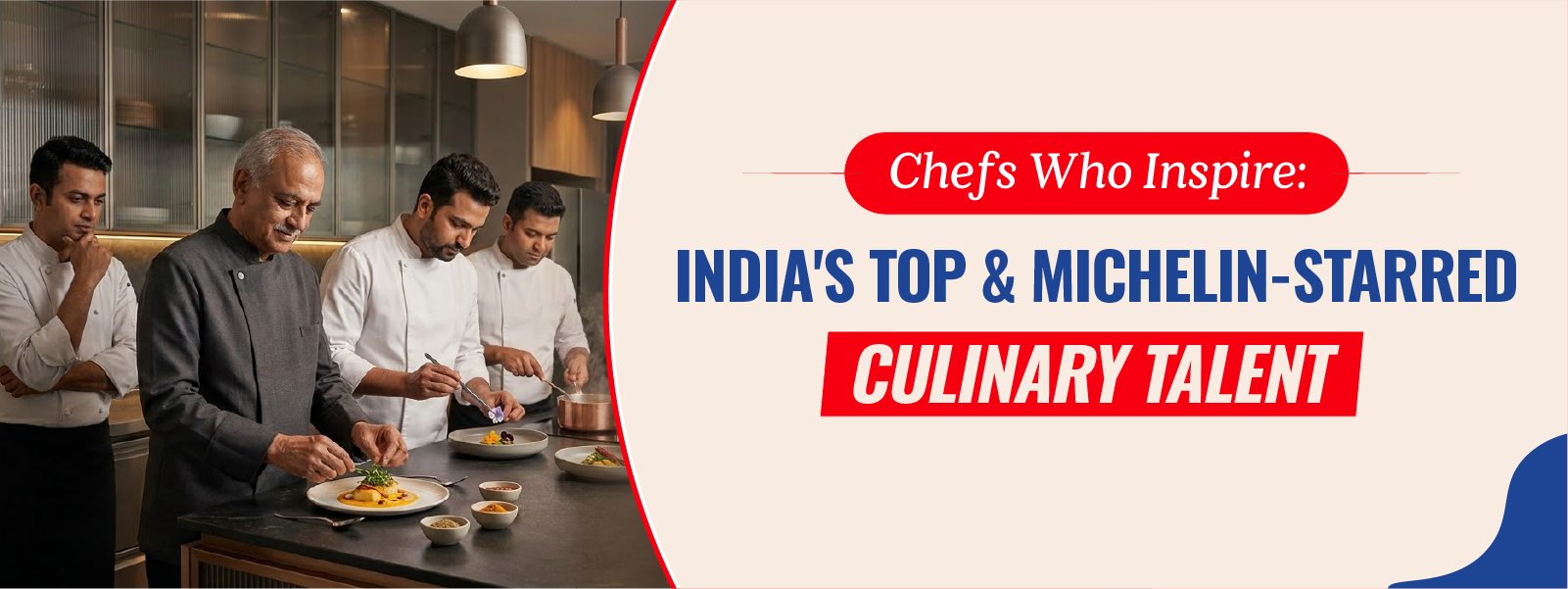
Indian cuisine has never been a single culinary story. It is a collection of regional traditions, family recipes, local ingredients, ancient techniques and constantly evolving interpretations. In recent years, Indian chefs have taken these stories far beyond traditional kitchens, presenting Indian food to audiences across the country and around the world.
Some have become familiar television personalities. Others have built acclaimed restaurants, earned international recognition or developed distinctive approaches to Indian cuisine.
For students researching the Best Culinary Schools in India, these professionals can provide something more valuable than a list of famous names: examples of how culinary careers actually develop.
The stories behind famous Indian chefs, Michelin star chefs in India and abroad, and the country's leading celebrity chefs show that there is rarely one route to becoming a successful professional chef. Technical training, experience, discipline, creativity and a strong culinary identity all play their part.
A chef's career may involve:
The journey is rarely overnight.
Sanjeev Kapoor is one of India's most recognisable culinary personalities.
For many Indian households, television played an important role in making professional cooking more accessible, and Sanjeev Kapoor became one of the most familiar faces associated with that movement.
His career demonstrates that a chef's influence does not have to remain inside a restaurant kitchen.
It can extend into:
One important lesson is communication.
Being able to cook well is one skill.
Being able to explain cooking clearly to millions of people is another.
For aspiring chefs, this demonstrates the value of developing both culinary and communication skills.
Vikas Khanna is another prominent name in discussions about Indian chefs with international careers.
His work has included restaurant kitchens, cookbooks, television and culinary storytelling.
His connection with New York's Junoon helped bring Indian cuisine into the international fine-dining conversation.
For an aspiring chef, his career demonstrates something important.
Indian cuisine can have a place on the global fine-dining stage without losing its cultural identity.
A chef does not necessarily need to abandon their culinary roots to work internationally.
Regional ingredients, traditional recipes and cultural history can become strengths when they are understood deeply and presented thoughtfully.
Manish Mehrotra has become closely associated with modern Indian fine dining through Indian Accent.
His approach has often involved taking familiar Indian flavours and presenting them in unexpected combinations and formats.
This is particularly interesting for culinary students.
Imagine recognising a flavour from childhood, but encountering it in a completely different form on a fine-dining plate.
That experience demonstrates how chefs can work with tradition without simply reproducing it.
Creativity works best when it is supported by strong foundations.
Before changing a traditional dish, you need to understand why it works in the first place.
That means knowing:
Only then can experimentation become purposeful.
Ranveer Brar has built a strong public identity around Indian cuisine, combining culinary knowledge with storytelling and digital content.
His career highlights another route available to modern chefs.
The kitchen is no longer the only place where culinary professionals can build an audience.
Today, chefs can work across:
Communication can become part of your professional identity.
A chef who can explain why a dish matters can connect with audiences in ways that go beyond the plate.
Garima Arora is an important name for anyone interested in Indian chefs working on the international fine-dining stage.
She became the first Indian woman chef to receive a Michelin Star when her Bangkok restaurant Gaa earned the distinction.
That achievement was significant not only for her personal career but also for the visibility of Indian culinary talent internationally.
Garima Arora's journey demonstrates the importance of:
Vineet Bhatia has built an international career with restaurants across different markets.
He is also associated with Michelin-recognised culinary work.
His career provides an interesting example of how Indian cuisine can be interpreted through an international fine-dining lens.
For aspiring chefs, it highlights the value of understanding both culinary tradition and the expectations of international hospitality.
The term Michelin star chefs India can be slightly misleading.
The Michelin Guide awards Stars to restaurants based on its inspection criteria. The award is not technically given to an individual chef.
However, chefs are naturally associated with Michelin-starred restaurants because they often lead the culinary vision and kitchen operation.
The Michelin Guide does not cover every Indian city or every Indian restaurant.
This means the absence of a Michelin Star does not mean a chef or restaurant is not excellent.
There are countless outstanding Indian restaurants and chefs operating outside Michelin Guide destinations.
The phrase celebrity chef India can describe chefs who have become well known beyond professional kitchens. Some have television careers, some operate major restaurant businesses, while others have built large digital audiences.
Celebrity status can provide exciting opportunities, but it also comes with additional responsibilities. A chef in the public eye becomes a representative of their culinary philosophy, making communication, professionalism and credibility important parts of their career.
For students considering chefs courses after 12th, the lesson is simple. Do not chase celebrity status first. Build strong culinary abilities, gain practical kitchen experience and develop a solid understanding of food preparation and professional kitchen operations. A good culinary education can provide the foundation needed to build a successful career, whether your goal is to work in restaurants, hotels, catering, food media or eventually become a recognised chef.
These categories can overlap, but they are not identical.
A celebrity chef may be known primarily for television or digital media.
A fine-dining chef may be known primarily for restaurant work.
A chef can be both.
But one does not automatically imply the other.
Someone can have millions of followers without operating a Michelin-recognised restaurant.
Another chef may lead an exceptional restaurant while remaining relatively unknown to the general public.
Both can be successful.
Talent can take you somewhere.
Training gives you structure.
If you are researching the Best Culinary Schools in India, look for institutions that teach more than recipes.
A strong culinary programme should help you develop:
Absolutely.
Indian cuisine has a huge range of regional ingredients, cooking methods and culinary traditions.
Chefs can work internationally in:
India's culinary talent is increasingly visible both nationally and internationally.
Chefs such as Sanjeev Kapoor, Vikas Khanna, Manish Mehrotra, Ranveer Brar, Garima Arora and Vineet Bhatia represent very different career paths, from television and culinary storytelling to contemporary Indian cuisine and international fine dining.
Their journeys demonstrate that there is no single formula for becoming a successful chef.
For students researching the Best Culinary Schools in India, the most important lesson is to focus on the foundation: strong culinary techniques, practical training, discipline, food knowledge and professional experience.
Michelin recognition, celebrity status and public visibility may come later, but they should not be the starting point.
The starting point is learning how to cook well, understanding why techniques work and developing the discipline to repeat those standards consistently.
With education, practice and experience, today's culinary student can begin building the skills and perspective needed to create a professional identity of their own.
Centre Head & Head of Department
 Whatsapp
Click one of our representatives below to chat on WhatsApp or send us an email to
info@tedcoeducation.com

Counselor
Bakery and Pastry Courses
Counselor
Culinary Arts Courses
Click one of our representatives below to chat on WhatsApp or send us an email to
info@tedcoeducation.com
Counselor
Bakery and Pastry Courses
Counselor
Culinary Arts Courses

