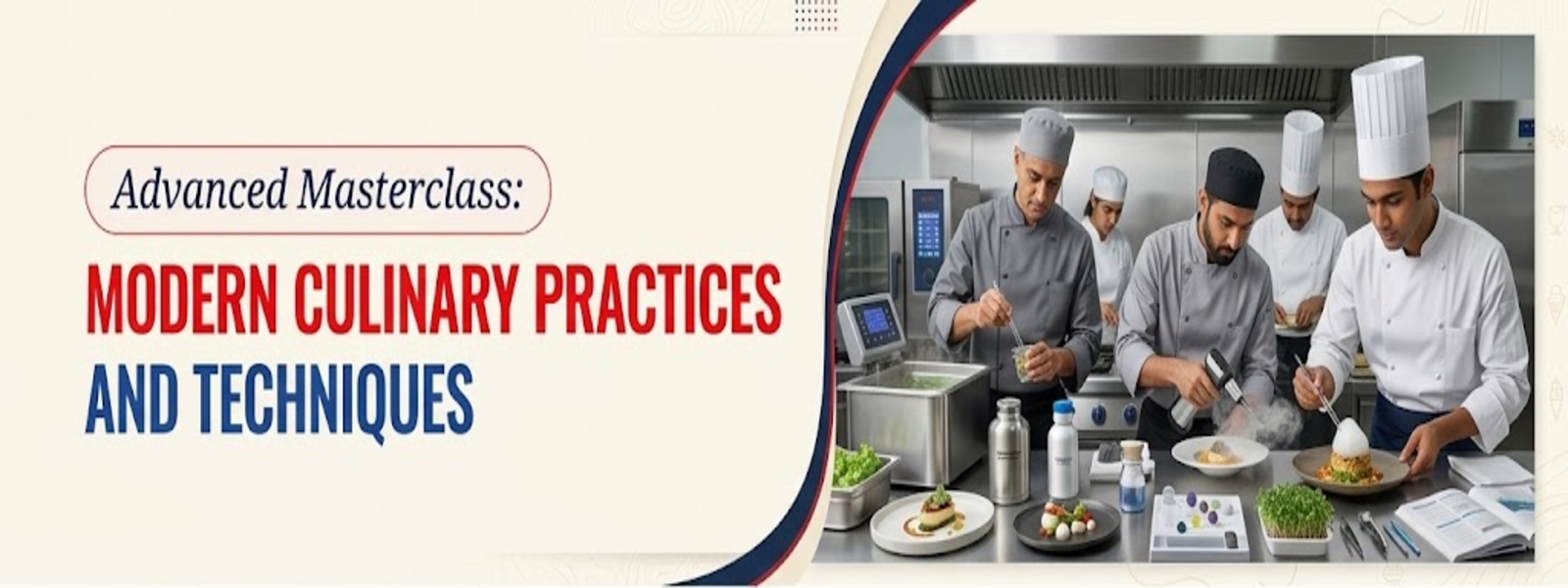
Modern professional kitchens are no longer defined only by traditional recipes and classical cooking methods. Walk into a contemporary hotel kitchen or fine-dining restaurant and you may see chefs working with precision equipment, carefully controlled temperatures, fermentation, modern plating techniques and digital production systems.
Yet the fundamentals remain the same. A chef still needs to understand ingredients, heat, seasoning, timing and technique.
Modern culinary practices build on those foundations. They give chefs additional ways to control texture, improve consistency, develop flavour and present food with greater precision. For students considering culinary courses after 12th, learning these techniques can provide valuable exposure to the methods and systems used in contemporary professional kitchens.
Modern culinary practices refer to contemporary approaches to food preparation, cooking, presentation and kitchen management.
They can include techniques such as sous vide, controlled fermentation, dehydration, modern preservation, precision cooking and contemporary plating. They can also involve equipment and digital systems that help professional kitchens work more efficiently.
Consider a chef preparing the same dish for 50 guests.
Cooking by instinct alone may produce slightly different results from one plate to another. A modern professional approach introduces measurable processes, from ingredient weights and cooking temperatures to portion sizes and preparation schedules.
The objective is not to remove creativity from cooking. Instead, precision gives chefs greater control over their creativity.
Today's chefs work across a wide range of environments, from hotels and restaurants to contemporary cafés, fine-dining establishments and international hospitality brands.
Modern techniques can help chefs develop:
Precision is one of the defining characteristics of modern professional cooking.
Imagine preparing a sauce and adding ingredients simply by estimating their quantities. The first batch may taste excellent, but reproducing exactly the same result tomorrow becomes difficult.
Professional kitchens reduce that uncertainty through:
Sous vide is a controlled cooking technique in which food is sealed and cooked at a carefully regulated temperature, usually in a water bath.
Instead of relying primarily on the surface appearance of food to judge doneness, chefs can control the cooking environment much more precisely.
This technique can be particularly useful for certain meats, seafood and vegetables.
For a culinary student, the bigger lesson is temperature control.
Sous vide demonstrates how changing cooking temperature can influence texture, moisture and doneness. It encourages chefs to think scientifically about what happens to food during cooking rather than relying entirely on guesswork.
Food is experienced with the eyes before the first bite.
Modern plating focuses on composition rather than simply placing food on a plate.
Professional chefs consider:
Fermentation has existed for centuries, but modern chefs continue to explore it because of its ability to create complex flavours and textures.
Pickling, curing and fermentation can transform ingredients in surprisingly different ways.
For example, fermentation can introduce acidity and depth, while pickling can provide brightness that cuts through rich food.
Preservation techniques can also help professional kitchens make better use of ingredients and reduce unnecessary waste.
For culinary students, these methods demonstrate that preservation is not simply about extending shelf life. It can also be a tool for flavour development.
Sauces remain central to professional cooking, but contemporary chefs have expanded the ways in which sauces and flavour components are presented.
Students may encounter:
Molecular and modernist cooking introduced many chefs and diners to unusual textures and presentations.
Techniques can include creating gels, spheres, foams and other controlled textural transformations.
The interesting part for culinary students is not simply seeing a liquid become a different form.
It is understanding why that transformation happens and how it can be used.
A modernist technique can provide contrast, concentrate flavour or change the way a familiar ingredient is experienced.
However, not every dish needs molecular techniques. A perfectly prepared traditional dish can be just as technically impressive.
Modern professional kitchens increasingly rely on specialised equipment to improve consistency and efficiency.
Students may encounter equipment such as:
Technology is also changing how kitchens are organised.
Digital systems can support:
Modern culinary excellence also involves thinking carefully about resources.
Professional kitchens are increasingly focused on reducing waste and using ingredients efficiently.
Chefs can explore practices such as:
Modern kitchens give chefs numerous ways to transform ingredients.
Removing moisture can intensify flavour and create a completely different texture.
Smoking can introduce aromatic depth to selected ingredients.
Infusion allows flavours from herbs, spices, fruits or other ingredients to transfer into liquids and fats.
Precise roasting can help chefs develop colour, aroma and deeper flavour while maintaining the desired internal texture.
These methods give chefs more control over the final character of an ingredient.
Modern techniques cannot replace basic food safety.
In fact, greater technical complexity often makes disciplined hygiene and temperature control even more important.
Professional kitchens need reliable systems for:
Modern cooking should not be viewed as the replacement for classical culinary knowledge.
Imagine two chefs preparing a sauce.
One understands the classical principles of stock preparation, reduction and seasoning. The other knows several modern techniques but lacks an understanding of basic flavour development.
The first chef may have a much stronger foundation for innovation.
Traditional techniques teach chefs how ingredients behave. Modern techniques give them additional tools for controlling that behaviour.
This is why professional culinary education should ideally expose students to both.
A modern kitchen requires more than technical cooking ability.
Aspiring chefs also need:
Structured culinary education gives students an opportunity to learn techniques progressively.
At TGCA, practical culinary training is designed around hands-on kitchen experience, allowing students to develop foundational cooking skills before progressing towards more professional applications.
The Diploma in Culinary Arts covers areas including Indian, Western and Oriental cuisines, food safety, kitchen practices and food presentation. The programme also includes industrial training, giving students exposure to professional working environments.
This combination matters because modern techniques are best understood through practice.
A student can read about temperature control, plating or specialised equipment, but practical kitchen sessions allow them to understand how those principles work in real preparation.
Modern culinary skills can be useful across many professional environments.
Graduates may eventually work in:
For students considering professional culinary training, the choice of programme matters.
A strong programme should not teach techniques in isolation. It should provide a progression from fundamental cooking skills to professional kitchen practices.
TGCA's Diploma in Culinary Arts provides practical exposure to multiple cuisines while developing professional kitchen discipline, food safety, food presentation and culinary techniques.
The programme also combines classroom learning and practical training with industrial exposure, helping students understand the difference between learning a technique and applying it in a professional kitchen.
For students interested in building a career as a chef, this practical foundation can be more valuable than simply collecting knowledge about individual cooking trends.
Modern culinary practices are ultimately about control, creativity and purpose.
Sous vide can provide precise cooking. Fermentation can introduce complexity. Dehydration can transform texture. Modern plating can improve presentation. Digital systems can make kitchen operations more organised.
But none of these techniques can replace an understanding of ingredients, seasoning, heat and professional discipline.
The strongest modern chefs know when to use a contemporary technique and when a traditional method is the better choice.
For aspiring chefs, the goal should therefore not be to learn every new culinary trend. It should be to build strong foundations, understand modern tools and techniques, practise them consistently and develop the judgement needed to use them effectively in a professional kitchen.
Bakery and Pastry Instructor
 Whatsapp
Click one of our representatives below to chat on WhatsApp or send us an email to
info@tedcoeducation.com

Counselor
Bakery and Pastry Courses
Counselor
Culinary Arts Courses
Click one of our representatives below to chat on WhatsApp or send us an email to
info@tedcoeducation.com
Counselor
Bakery and Pastry Courses
Counselor
Culinary Arts Courses

