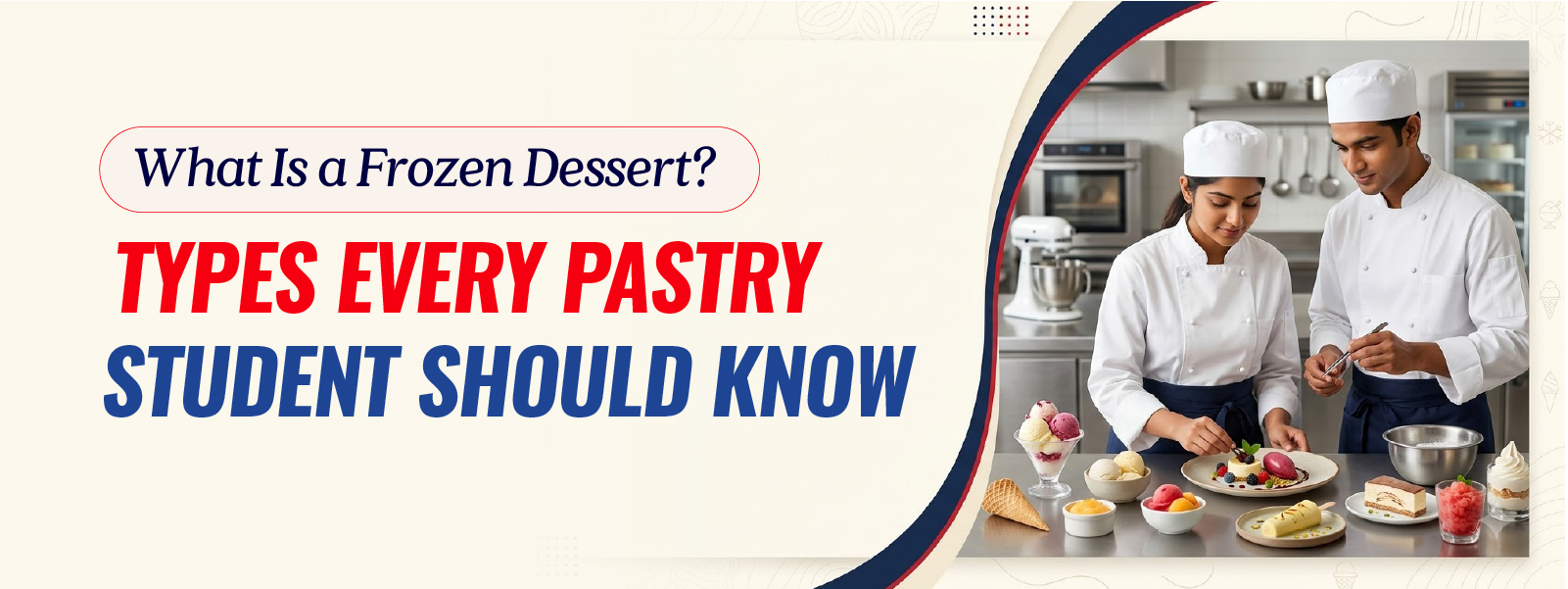
Think of a dessert arriving at the table on a warm afternoon. A smooth scoop of ice cream slowly softens at the edges, a granita catches the light with tiny ice crystals, or a semifreddo sits neatly on a plate with a soft, creamy texture. Although all of these desserts are served cold or frozen, they are not made in the same way.
For pastry students, learning about frozen desserts is not simply about knowing different recipes. It is about understanding temperature, texture, ingredients, aeration and freezing techniques.
Students attending Pastry and Baking Classes can encounter frozen desserts as an important part of modern pastry training, from classic ice cream and gelato to plated desserts and contemporary frozen creations.
Understanding the frozen dessert meaning and the science behind each preparation can help students make better decisions when working with ingredients, equipment and presentation.
A frozen dessert is a sweet preparation that is frozen or partially frozen to create its characteristic temperature and texture.
The category includes many different preparations, such as:
What makes these desserts different is the relationship between water, sugar, fat, air and temperature.
Freezing might sound simple, but creating a desirable frozen dessert requires control.
Water naturally forms ice crystals when it freezes. If those crystals become too large, the dessert can develop a coarse or icy texture.
Pastry professionals therefore pay attention to several factors.
Ice cream is perhaps the most familiar frozen dessert.
Traditional ice cream generally contains dairy ingredients, sugar and flavourings. Some styles also use eggs.
Its creamy texture develops through a combination of ingredients, controlled freezing and the incorporation of air.
Imagine a freshly churned ice cream moving through a machine. The mixture is being cooled while being agitated. This process helps control ice crystal formation and incorporates air into the developing dessert.
Flavour possibilities are almost endless, from vanilla and chocolate to fruit, nuts, coffee and more elaborate pastry-inspired combinations.
For students, ice cream provides an excellent introduction to the relationship between recipe formulation, churning and temperature control.
Gelato is often compared with ice cream, but the two are not identical.
Traditional gelato generally contains less fat and is churned with less air than many styles of ice cream. It is also commonly served at a slightly warmer temperature.
The result can be a denser, smoother and more intensely flavoured experience.
For pastry students, gelato provides another useful lesson: seemingly small differences in formulation and production can significantly change texture.
The technique also demonstrates why frozen desserts cannot be understood through ingredients alone. The production process matters just as much.
Sorbet takes a completely different direction.
It is generally made without dairy and is commonly based around fruit, water and sugar.
Picture a spoon moving through a bright lemon sorbet. There is no creamy dairy richness. Instead, the experience is refreshing, clean and intensely flavoured.
The balance between fruit, water and sugar is crucial.
Too much water can produce a hard, icy preparation. An unsuitable sugar balance can affect both sweetness and texture.
For pastry students, sorbet is a useful preparation for understanding fruit concentration, sugar balance and ice crystal formation.
Sherbet occupies a space between sorbet and dairy-based frozen desserts.
It generally contains fruit or another flavour base, sugar and some dairy.
That small addition of dairy changes the character of the dessert, giving it a creamier quality than sorbet while keeping it relatively light compared with many ice creams.
This makes sherbet another interesting example of how changing one component can influence texture and flavour.
Frozen yoghurt uses yoghurt as an important part of its base.
Yoghurt contributes acidity, a distinctive tang and dairy characteristics.
That acidity can create a refreshing contrast to sweetness, particularly when paired with fruits or other bright flavours.
For pastry students, frozen yoghurt can also demonstrate how familiar ingredients can be transformed through temperature and technique.
The finished dessert may feel quite different from the yoghurt from which it started.
The name semifreddo refers to a partially frozen dessert associated with Italian pastry tradition.
Unlike a dense frozen preparation, semifreddo can have a soft, airy texture because whipped ingredients introduce significant aeration.
Imagine cutting into a slice and seeing a smooth, light interior rather than a dense block of frozen cream.
The technique makes semifreddo particularly valuable in pastry education because it demonstrates the relationship between whipping, air incorporation, and controlled freezing.
Granita offers one of the clearest visual examples of controlled ice formation.
Instead of being churned into a smooth texture, the mixture is frozen and periodically scraped or agitated to create distinctive ice crystals.
The result is granular and crystalline.
Flavours can include citrus, coffee, fruit and other ingredients.
A well-made granita should feel refreshing rather than simply like crushed ice. Achieving that balance requires appropriate sugar concentration, freezing and scraping.
Frozen mousse and parfait preparations introduce another dimension of pastry work.
Whipped cream, eggs, flavourings and other components may be combined to create an aerated mixture that is subsequently frozen.
Because air is incorporated before freezing, these desserts can maintain a lighter texture than a simple frozen liquid.
They are also particularly useful for plated pastry work because they can be moulded into attractive shapes and combined with sauces, fruit, chocolate or other components.
Understanding ingredients is one of the most important parts of pastry education.
Pastry students may encounter several techniques when working with frozen desserts.
Frozen desserts can expose technical mistakes quickly.
Common problems include:
Frozen desserts teach pastry students something fundamental: temperature changes ingredients.
A liquid mixture can become firm.
Cream can become airy and frozen.
Fruit can become a crystalline dessert.
Custard can transform into ice cream.
This makes frozen desserts an excellent training ground for understanding texture and ingredient functionality.
They also encourage students to think beyond traditional cakes and pastries and consider how desserts are experienced on a plate.
Frozen desserts have an important place in professional hospitality.
They can appear in:
Reading about frozen desserts is useful.
Making them is better.
Hands-on practice allows students to see how small changes affect the final result.
A student can compare two preparations and notice how changing sugar concentration affects firmness, or how additional whipping affects the texture of a frozen mousse.
Structured Pastry and Baking Classes can provide opportunities to practise these techniques under guidance while learning how professional pastry kitchens approach consistency and presentation.
This practical experience becomes particularly valuable when students progress from simple preparations to more advanced plated desserts.
Students interested in professional pastry careers should look beyond a course title.
When evaluating a programme, consider:
Frozen desserts may look simple when presented on a plate.
A neat scoop of gelato, a delicate semifreddo or a bright granita can appear effortless.
Behind that appearance, however, are decisions about ingredients, temperatures, texture, timing and presentation.
That is precisely why these preparations matter in pastry education.
They teach students to observe.
They teach students to measure.
They teach students to understand how ingredients behave.
And most importantly, they teach students that professional pastry is a combination of science, technique and creativity.
Understanding the frozen dessert meaning is only the beginning.
Ice cream, gelato, sorbet, sherbet, frozen yoghurt, semifreddo, granita, frozen mousse and parfait may all belong to the same broad category, but each requires a different understanding of ingredients, temperature and preparation.
For aspiring pastry professionals, learning these differences can strengthen their technical foundation and improve their ability to troubleshoot and create desserts with consistent texture and presentation.
Whether a student is beginning baking classes in Delhi or exploring more advanced pastry and baking classes, frozen desserts offer an opportunity to understand pastry from a different perspective.
The freezer may seem to slow everything down, but in professional pastry, it opens the door to an entirely new world of textures, flavours and creative possibilities.
Pastry Instructor
 Whatsapp
Click one of our representatives below to chat on WhatsApp or send us an email to
info@tedcoeducation.com

Counselor
Bakery and Pastry Courses
Counselor
Culinary Arts Courses
Click one of our representatives below to chat on WhatsApp or send us an email to
info@tedcoeducation.com
Counselor
Bakery and Pastry Courses
Counselor
Culinary Arts Courses

