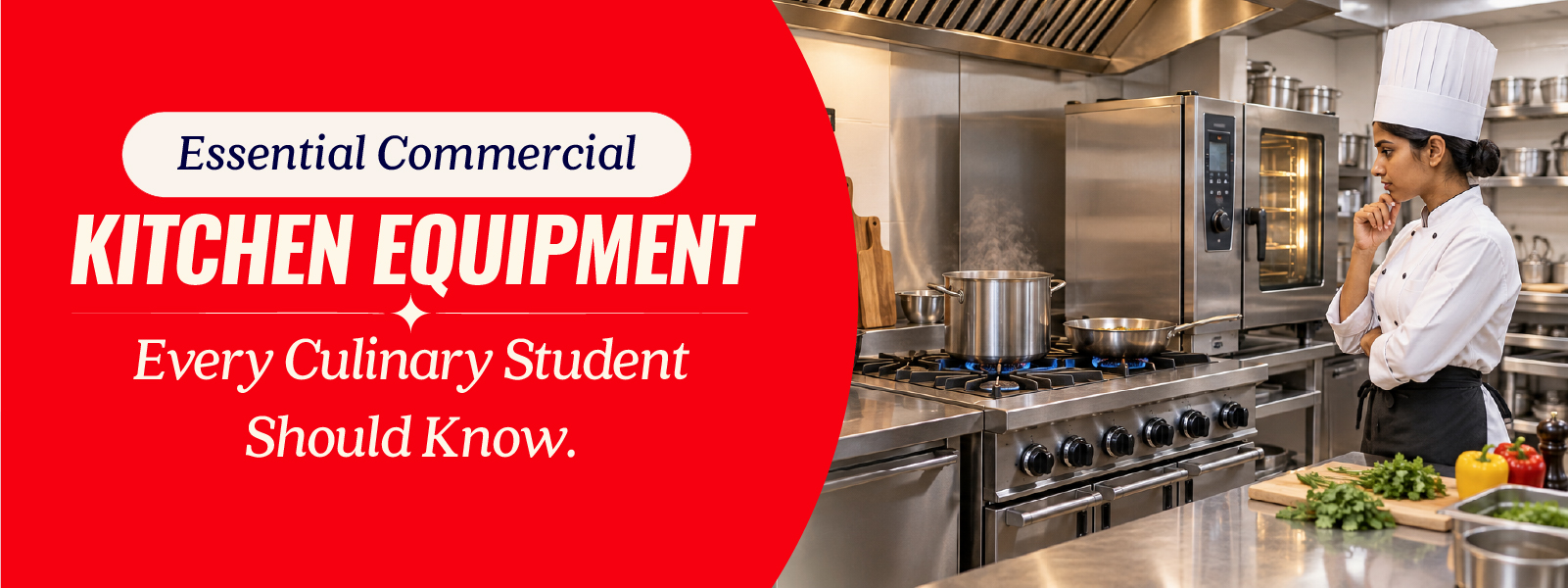
Walking into a commercial kitchen for the first time can feel very different from cooking at home. There are larger machines, specialised tools, multiple workstations and a much faster pace. For students attending culinary classes, understanding this equipment is an important part of becoming comfortable in a professional kitchen.
A commercial kitchen is designed around consistency, volume, safety and speed. A chef needs to know not only what a piece of equipment does, but also when to use it, how to operate it safely and how to keep it clean. This is one reason practical exposure matters when choosing a culinary arts course or professional chef training.
A home kitchen might be designed for preparing dinner for a family. A commercial kitchen may need to produce hundreds of portions during a single service.
That difference changes everything, from the size of the cooking equipment to the way ingredients are stored and prepared.
Students entering professional kitchens should become familiar with:
Equipment knowledge also helps students work more efficiently. Knowing which machine to use for a particular task can save time, reduce waste and help maintain consistency.
Cooking equipment forms the centre of most professional kitchens. Different machines are designed for different cooking methods and production requirements.
The four-burner range is one of the most versatile pieces of equipment in a commercial kitchen. Chefs can use individual burners for sauces, soups, sautéing, boiling and other preparations simultaneously.
A salamander provides intense overhead heat. It is commonly used for browning, gratinating, melting cheese and finishing dishes.
A griddle provides a large, flat heated surface suitable for foods such as pancakes, eggs, vegetables, sandwiches and certain meat preparations.
A char grill uses direct heat to create the characteristic grilled surface and flavour associated with grilled foods. Students should understand heat management because excessive heat can burn the exterior before the centre is properly cooked.
Ovens vary considerably in their operation and purpose.
A convection oven uses circulating hot air to promote relatively even cooking. It can be useful for roasting, baking and general production.
A deck oven has a heated deck or baking surface and is particularly associated with bread and bakery production. Heat management and baking conditions can significantly influence the final product.
A combi oven combines different cooking modes, commonly including hot air and steam. This gives professional kitchens greater flexibility when preparing different foods.
Students should learn to understand the difference between the equipment rather than treating every oven as interchangeable.
A commercial deep fryer maintains cooking oil at controlled temperatures for producing fried foods consistently.
A bain-marie provides gentle, indirect heat. It can be useful for keeping certain foods warm or preparing delicate preparations that require controlled heating.
An induction range transfers heat directly to compatible cookware through electromagnetic energy. It offers rapid heating and precise control, while also leaving the cooking surface relatively cooler than traditional cooking equipment.
Cooking is only one part of kitchen operations. Safe storage is equally important.
Large commercial kitchens may use a walk-in cold room to store substantial quantities of chilled ingredients.
A reach-in chiller is more compact and allows kitchen staff to access frequently used ingredients quickly.
Under-counter refrigeration is useful when ingredients need to remain close to a particular workstation. For example, a preparation or pastry station may have refrigeration positioned underneath the working surface.
Students should understand that refrigeration is not simply about keeping ingredients cold. Organisation, labelling, separation and temperature monitoring are also important.
A blast chiller rapidly reduces the temperature of suitable cooked foods. Rapid cooling can help kitchens manage prepared foods safely when the process is carried out according to appropriate food safety procedures.
A deep freezer is designed for frozen storage and operates at temperatures suitable for maintaining frozen foods.
Students should understand that cooling and freezing are controlled processes. Food should not simply be placed wherever space happens to be available.
Dry stores commonly use shelving and racking to organise ingredients such as flour, grains, pulses, spices and packaged products.
A FIFO system, meaning First In, First Out, helps kitchens use older stock before newer stock where appropriate.
Clear labelling should identify relevant information such as the product, date and storage requirements. Good storage organisation makes stock easier to manage and can reduce unnecessary waste.
Preparation can consume a significant amount of kitchen time, particularly when large quantities need to be produced.
A planetary mixer is widely used for mixing, whipping and preparing various batters, doughs and mixtures, depending on the attachment and machine specification.
A food processor can perform tasks such as chopping, slicing, shredding and blending.
A stick blender, also known as an immersion blender, is useful for blending soups, sauces, purées and other preparations directly in suitable containers.
Students should learn which attachment or machine setting is appropriate for each task rather than relying on trial and error.
Commercial slicers can produce consistent slices quickly, while a mincer processes suitable meat products into a required texture.
Vegetable preparation machines can help kitchens process larger quantities efficiently.
However, speed should never replace safe operation. Students need to understand guards, blades, operating procedures and cleaning requirements before using powered preparation equipment.
A vacuum sealer removes air from specially designed packaging and seals the contents.
A sous vide circulator maintains water at a controlled temperature for cooking vacuum-sealed food according to a defined process.
These techniques require careful attention to food safety, temperature control and storage procedures. They should never be treated simply as modern cooking shortcuts.
Students interested in baking need familiarity with equipment designed specifically for dough, pastry and confectionery production.
A spiral mixer is designed primarily for mixing and developing dough efficiently.
A dough sheeter rolls dough to a consistent thickness. This is particularly useful when preparing pastry and other products requiring uniform sheets.
A proofer provides controlled conditions that support the fermentation and proofing of yeast-based dough.
Understanding these machines helps bakery students see how professional production differs from making small quantities at home.
A chocolate tempering machine helps maintain chocolate within controlled temperature ranges required for proper tempering.
A dough divider divides dough into consistent portions, which can improve uniformity during larger-scale production.
Alongside machines, students also need to understand the importance of accurate weighing and portion control.
Large equipment may attract attention, but professional kitchens rely heavily on smaller tools.
Every culinary student should become comfortable with essential tools such as:
Knife skills are particularly important. Consistent cuts help ingredients cook more evenly and improve presentation.
A reliable thermometer helps chefs monitor temperatures rather than relying solely on appearance or guesswork. Scales are equally important for accurate recipes, portion control and bakery production.
GN pans, or gastronorm containers, are widely used for preparation, storage and service in professional kitchens.
Other useful tools include mandolines, sieves, piping bags, pastry tips, scrapers, rolling pins and moulds.
Students should also learn how to clean, store and handle sharp tools safely.
Professional kitchens need dedicated systems for maintaining hygiene and safety.
Commercial dishwashers can process large quantities of utensils, crockery and equipment efficiently.
Where manual washing is used, a properly organised three-sink system may support the different stages of washing, rinsing and sanitising according to the kitchen's procedures.
Grease traps also play an important role in managing fats and grease before wastewater enters the drainage system.
Commercial cooking produces heat, smoke, vapour and grease. Exhaust hoods help manage these conditions and support appropriate ventilation.
Professional kitchens may also have fire suppression systems and accessible fire safety equipment.
Students should know where emergency equipment is located and understand the basic safety procedures followed in their training kitchen.
A first aid station should also be accessible to kitchen staff.
Equipment does not exist independently. It forms part of a larger workflow.
A well-planned kitchen commonly separates activities into areas such as:
The exact arrangement varies according to the kitchen, cuisine and operation.
Good workflow reduces unnecessary movement. If ingredients are stored far away from the preparation area, staff may waste time repeatedly walking between stations. Poor placement can also increase congestion and create safety risks.
For culinary students, understanding kitchen layout is therefore as important as learning individual equipment.
Professional equipment represents a significant investment, so students should learn to treat it accordingly.
Daily cleaning routines may include:
Preventive maintenance can also help identify problems before they become major equipment failures.
If a machine does not appear to be working correctly, students should report it rather than attempting an unsafe repair.
Knowing the names of commercial kitchen machines is not enough. A student should understand what each piece of equipment does, when it should be used and how it fits into the wider kitchen workflow.
This is where practical training becomes particularly valuable. Culinary schools in India vary in their facilities and training approaches, so students should look beyond the course title when comparing programmes.
At TGCA, students receive practical exposure in training kitchens where they can become familiar with professional culinary equipment and kitchen routines. Hands-on practice allows students to build confidence with preparation, cooking, hygiene and workstation management rather than learning equipment purely from textbooks.
For anyone considering chef courses, this practical exposure can be an important part of preparing for the expectations of a professional kitchen.
Commercial kitchen equipment is much more than a collection of machines. Each piece has a specific role in helping chefs prepare food safely, consistently and efficiently.
From ranges, ovens and refrigeration units to mixers, knives, thermometers and pastry equipment, culinary students should gradually become comfortable with the tools they will encounter in professional kitchens.
The goal is not simply to know what an oven or mixer does. It is to understand how equipment, ingredients, people and workflow work together during real kitchen operations.
That equipment confidence, combined with strong culinary fundamentals, hygiene awareness and disciplined work habits, gives students a practical foundation as they move towards professional kitchen environments.

Centre Head & Head of Department
 Whatsapp
Click one of our representatives below to chat on WhatsApp or send us an email to
info@tedcoeducation.com

Counselor
Bakery and Pastry Courses
Counselor
Culinary Arts Courses
Click one of our representatives below to chat on WhatsApp or send us an email to
info@tedcoeducation.com
Counselor
Bakery and Pastry Courses
Counselor
Culinary Arts Courses

